Marshmallow Laser Feast at ACMI is a sumptuous visual feast – but something is missing
- Written by: Dominic Redfern, Associate Professor, RMIT University
In my office, someone has pinned a cartoon in which two dogs consider an abstract sculpture on a plinth. As he strokes his chin one of them asks, “Yes, but is it food?”.
ACMI’s Marshmallow Laser Feast: Works of Nature is most definitely food.
This exhibition featuring artworks by London-based experiential art collective Marshmallow Laser Feast is sumptuous, a feast for eyes and ears at the technological bleeding edge of audio-visual practice. With its swirling murmurations of atoms, cells, blood platelets and gravitational forces, it is straightforwardly beautiful.
We are immersed from the moment we begin our descent into the vault of ACMI’s project hall. On the first landing is a portrait ratio image projected flush with the architecture and populated with flowing, bifurcating veins that break like dandelion blossoms to disperse.
Text from the poetry of Daisy Lafarge fades up and down between images. Linking each space, wall panels of Lafarge’s writing offer us a counterpoint to the didactic panels. The projection is accompanied by sound somewhere between breath and wind in the trees, an analogy central to an exhibition so focused on the breathing, pulsing dimension of all that lives.
Lafarge’s text is memorably recited into our ear in the meditation room by video art go-to Cate Blanchett (see her ongoing collaboration[1] with Julian Rosefeldt). Blanchett has shown great generosity to artists and lends a gravitas and humanity to all she touches.
No exception, this ten-minute experience lounging in bean bags sets the tone, gearing us down to the required contemplative tempo.
Read more: Light: Works from the Tate's Collection honours the body and its sensations – this is art which is meant to be felt[2]
United by sound
Sound is a vital feature of the installation.
Crackles, creaks, drippings, fizzes, distant reverberant booms and rushing fluid sounds suffuse and unite the space, contributing to the sense of interiority established by the dark subterranean setting.
At times, though, I found myself slightly troubled by the score. Recurrent throughout the exhibition are the smeared synth pads and soothing, never resolving harmonic progressions of massage therapy rooms. This fairly screams calm and slightly cheapens the installation.

Next to the meditation room is a towering projection of a Colombian kapok tree. The camera slowly circumnavigates this buttressed giant as the naturalistic image transforms into a 3D scan reminiscent of photogrammetric point-cloud images[3] showing the flow of oxygen and nutrients within the tree.
A black mirror at the foot of the projection extends us further underground and compounds the “as above, so below” motif recurring throughout the exhibition.
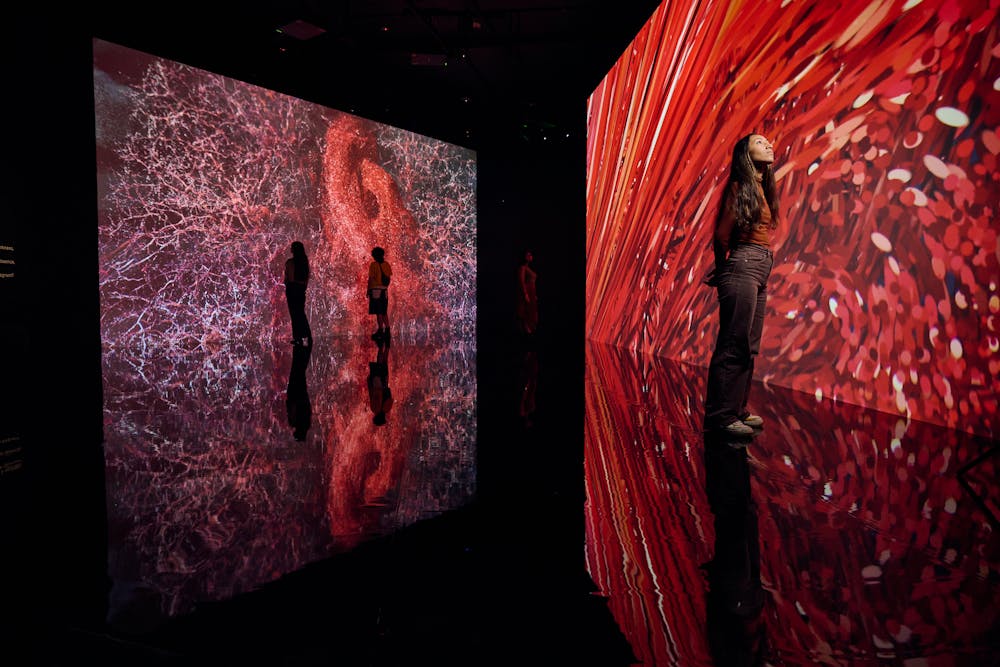 Oxygen flows into swimming, hurrying platelets.
Eugene Hyland/ACMI
Oxygen flows into swimming, hurrying platelets.
Eugene Hyland/ACMI
Mirrored floors also feature in the third space where diagonally opposed screens are accompanied by the rushing sound of water, muted in its upper frequencies, emphasising our interior perspective.
Oxygen flows into swimming, hurrying platelets which move like plankton, fish or flocking birds as we travel inside our own bodies. These dots, whether acting cells, atoms or droplets, provide a delightful flip between 2D and 3D. A skeleton is revealed as we shift from micro to macro, up and out, and form is conjured out of air.
In the fourth space we loll on more of the comfortable furnishings provided throughout, as these eddying dots take us down and further down to our cell’s engine room, conjured here as a literal furnace.
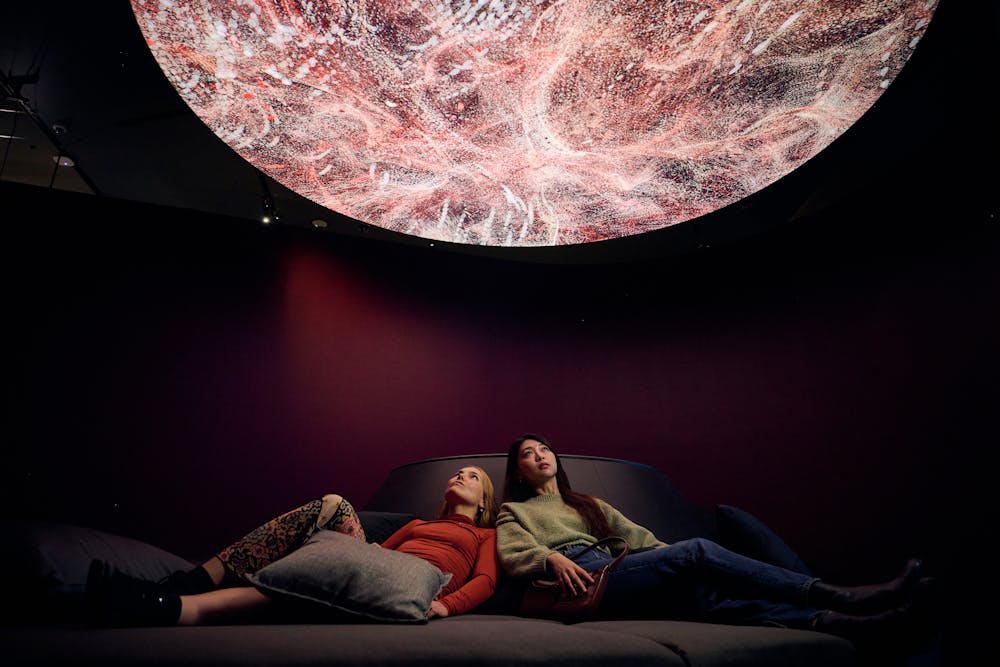 We loll on the comfortable furnishings.
Eugene Hyland/ACMI
We loll on the comfortable furnishings.
Eugene Hyland/ACMI
It tells, it doesn’t ask
After a room of prints, we travel into illustrations of cosmological phenomena.
While I appreciate the design conceit that led to this decision in an exhibition replete with mirror motifs, aesthetically, it did seem a little tacked on relative to the very unified earlier rooms. It was also the first use of interactivity, a type of chase-the-mouse atom cloud which failed to meet the grandeur of much of the rest of the work.
 Moments of interactivity don’t match the grandeur of the rest of the work.
Eugene Hyland/ACMI
Moments of interactivity don’t match the grandeur of the rest of the work.
Eugene Hyland/ACMI
Finally, we encounter another scanned tree, a sequoia. After vertiginous tilting and thunderous rumblings, we head up the tree and inside its glowing heart, a transcendent moment in which we are shown once again all in nature is in flow and flux.
The appearance of birdsong here is a delight and a welcome change from the massaging synth; a sombrely cinematic harmonic sequence which stands out among the rest of the music.
The exhibition is most definitely a spectacular achievement for ACMI and the many (many!) people it took to pull this all together (witness the pages of credits in the final room). Works of Nature, however, sits firmly within the museological remit of ACMI and is distinct from the far more open, ambiguous and troubling works ACMI also commissions. Works of Nature is clearly in the business of knowledge transfer: it tells, it doesn’t ask.
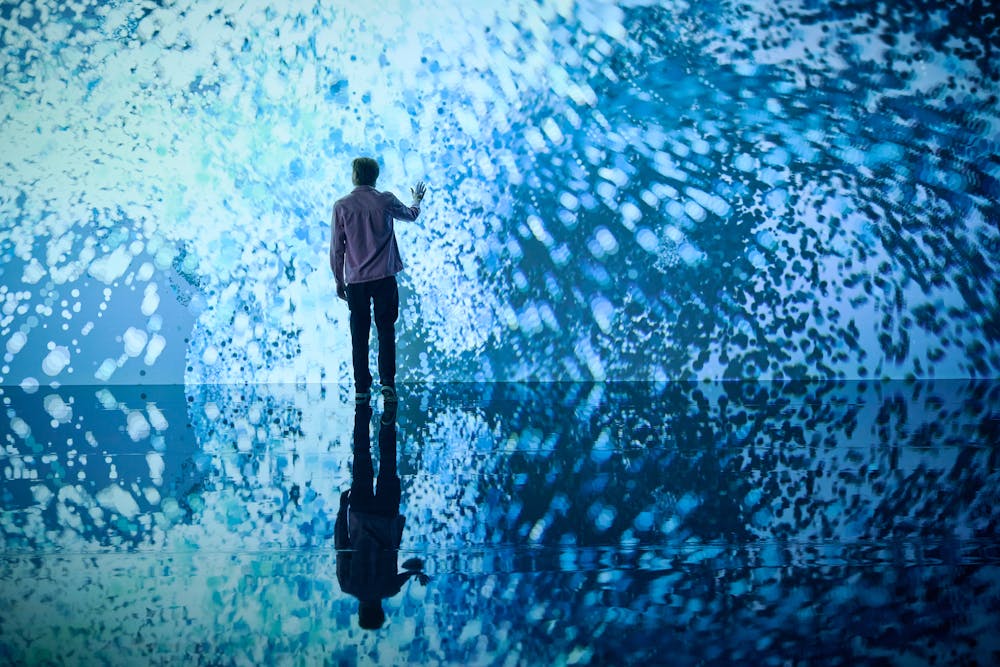 This is information design, rather than art at its more ambiguous, troubling task.
Eugene Hyland/ACMI
This is information design, rather than art at its more ambiguous, troubling task.
Eugene Hyland/ACMI
As was eloquently stated by Ersin Han Ersin, the director of Marshmallow Laser Feast, in his opening remarks at the launch, here art’s role was to make us feel something: feel the significance and wonder of our inescapable entanglement with the entirety of the biosphere.
It achieved this most certainly, but I was left with the impression that this was information design – rather than art at its more ambiguous, troubling task.
Read more: Vivid Sydney: contemporary art – or just a bright night out?[4]
References
- ^ collaboration (www.youtube.com)
- ^ Light: Works from the Tate's Collection honours the body and its sensations – this is art which is meant to be felt (theconversation.com)
- ^ photogrammetric point-cloud images (www.gim-international.com)
- ^ Vivid Sydney: contemporary art – or just a bright night out? (theconversation.com)