Google AI
The Times Australia

Times Media Advertising

Optus said it didn't have the 'soundbite' to explain the crisis. We should expect better

  • Written by: Peter Roberts, Lecturer, School of the Arts and Media, UNSW Sydney

Optus said it didn't have the 'soundbite' to explain the crisis. We should expect better

Asked on Wednesday to explain why Optus broadband and mobile services had been simultaneously knocked out for five hours, its chief executive Kelly Bayer Rosmarin blamed a “technical network fault[1]”, and then added:

There is no soundbite that is going to do it justice, so we want to really bottom-out the root cause, and when we have that very clear and in a digestible form, we will be forthcoming.

There are a couple of ways to interpret this statement. Either she didn’t want to indicate what her engineers really thought had happened, or she believed Optus users wouldn’t be able to understand the truth.

Or she might not have been thinking about Optus users.

Her reference to a “soundbite[2]” seems to suggest Optus regards its key audience as the media rather than its customers.

Optus is baked into too much of what we do

With more than 10 million[3] mobile customers alone, accounting for more than one-third of Australia’s population, the Singapore-owned[4] Optus has become integrated into almost everything[5] Australia does, from the operation of railways to automatic teller machines, to hospitals to emergency services.

Its customers, both corporate and personal, have become increasingly familiar with technical terms and technical explanations.

Those customers not only know more than they did – understanding many of the terms that apply to both software and hardware – but they expect more from technology, knowing that even some of their own jobs can potentially be replaced by artificially intelligent algorithms.

Many of those customers would be not only be asking “how did this happen”, but also “how could this be allowed to happen, given what technology is capable of”.
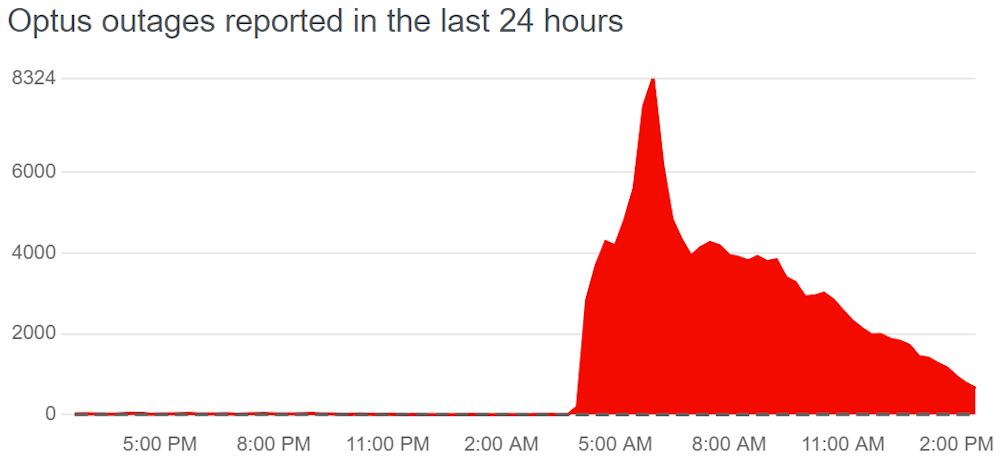
DownDetector, November 8 2023[6] The golden hour Crisis communicators have long spoken of the need to respond within the so-called “golden hour[7]”, a concept taken from the emergency services where it is important to get to the injured party promptly. In an increasingly automated world, that’s what Optus ought to have been able to do. Its core business is using technology for communications. If it couldn’t use its mobile network, it ought to have been ready to use something else, even email. Technology firms have built-in intensifiers Crisis communications expert Timothy Coombs argues that the damage done to reputations during a crisis can be worsened by “intensifiers[8]”, such as the organisation’s past history of crises, its track record, and sometimes the severity of damage caused. Significantly, he finds no “halo effect” from having handled things well in the past, only a “Velcro effect” from having handled things badly. Read more: In a crisis, Optus appears to be ignoring Communications 101[9] To that I would add that a further intensifier is the extent to which an organisation suffering from a technology failure is itself a technology organisation. It’s hard to argue you are a victim of something you have put yourself forward as a master of. Sharing what it knows, on the assumption that at least some of its users will understand it, would be one way of indicating that Optus trusts its customers and is worthy of their trust. References^ technical network fault (www.afr.com)^ soundbite (dictionary.cambridge.org)^ 10 million (treasury.gov.au)^ Singapore-owned (www.singtel.com)^ almost everything (www.9news.com.au)^ DownDetector, November 8 2023 (downdetector.com.au)^ golden hour (www.linkedin.com)^ intensifiers (journals.sagepub.com)^ In a crisis, Optus appears to be ignoring Communications 101 (theconversation.com)

Read more https://theconversation.com/optus-said-it-didnt-have-the-soundbite-to-explain-the-crisis-we-should-expect-better-217302

Find out more. Get in touch with The Times.

Invalid Input
Invalid Input
Invalid Input
Invalid Input

Times Magazine

Offshore vs Inshore Centre Console Boats: Which One Should You Buy?

Centre console boats have become one of the most popular choices among modern anglers. Their open ...

Why Australian Enterprises Are Rethinking Their Core Communication Technologies

The corporate landscape in Australia has undergone a permanent structural shift over the past few ...

Road safety risk: New data reveals almost 2 in 3 Australian drivers are letting car maintenance slide as cost of living pressures bite

Australians are putting off vehicle maintenance and new research released on the eve of National R...

Technology

Why Australian Enterprises Are Reth…

The corporate landscape in Australia has undergone a permanent structural shift over the past few ...

Local News

QLD Day

On Saturday 6 June, parkrun events across the state will be a sea of maroon, with communities  str...

Culture

Bacteria Found in Baby Wipes: Should Australi…

Parents rely on baby wipes every day. Whether changing nappies, cleaning little hands or wiping me...

Travel

Sri Lanka: An Island Adventure That Delivers …

For Australian travellers looking for a destination that combines tropical beaches, ancient histor...

The Times Features

Australia's Property Market Is Adjusting. So Are B…

Australia's housing market is entering a new phase. For much of the past decade, buyers became ac...

Bacteria Found in Baby Wipes: Should Australian Parents…

Parents rely on baby wipes every day. Whether changing nappies, cleaning little hands or wiping me...

Melbourne Real Estate Road Trip: North of the Yarra

Part Two of The Times' Melbourne property road trip series. Last week we explored Melbourne south...