


The Conversation launches in Brazil
- Written by: Misha Ketchell, Editor, The Conversation
In a recent article[1] in the Sydney Morning Herald, Alan Sunderland, a former editorial director at the ABC, put his finger on the ethical crisis facing the media: “In 2023, you can’t talk about the problems of the world without talking about polarisation, disinformation and conflict. The media, far from being seen as a solution to those problems, is generally recognised as being part of them.”
Everyone paying any attention knows he’s right. According to the latest Reuters Digital New report[2] trust in news is falling and active avoidance of the news media remains high. When Q&A presenter Stan Grant recently quit the ABC he said he feared that by working in the media he was becoming part of the problem. (He’s since signed up to lead a project at Monash University[3] aimed at furthering constructive journalism.)
Much of what we read online is determined by algorithms that reward conflict but never contemplation. Everywhere people are talking about whether we have lost our ability to talk to each other in a way that is respectful and constructive. (Read, for example, the terrific Quarterly Essay by Scott Stephens and Waleed Aly[4] on the lack of civility in public debate).
The Voice debate is already showing signs of rancour. We tolerate robust discourse as the price of deliberative democracy, but we have a problem if we can’t disagree without attacking the other side’s intelligence, morality, or right to exist. When did we lose the ability to give fellow human beings the benefit of the doubt? Accusing those with whom we disagree of elitism, ignorance or cynicism gets us nowhere.
At The Conversation we have been working to bring about a better informed and more constructive public discourse since we launched in 2011. Our mission is to help people make more informed decisions by providing access to the best information and analysis from academic experts.
But there’s a bit more to it than that. We aim to be impartial while presenting a range of perspectives. We aim to serve our readers by informing them. We place a high value on being constructive, showing respect and contributing to a strong social fabric while trying hard not to take sides. We know we will never get it exactly right in everyone’s eyes – but the pursuit of this Sisepheyan challenge is what drives us.
And every now and then you have a little win and it all seems worthwhile. Since The Conversation launched in Melbourne in 2011 we have grown around the world, with teams in New Zealand, large parts of Africa, Spain, France, the UK, US, Indonesia and Canada.
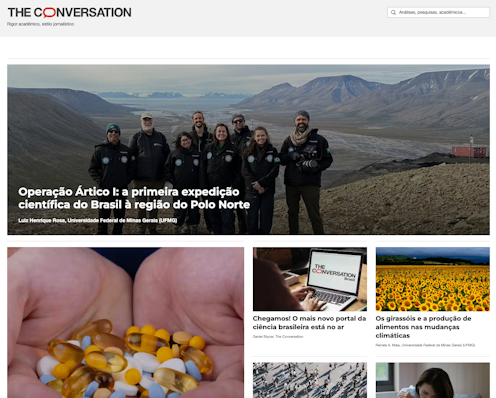
Yesterday we welcomed a new team to our fold, working in Brazil[5] and publishing in Portuguese, our fifth language. Our new colleagues in Brazil join a growing global network of journalists and academics trying to be part of the solution to the problems facing journalism and the societies we serve. We wish them well.
Ps. While I’m on the topic of not always getting it exactly right, we’d love to hear how you think we’re going and where we could improve. Please take a few minutes to respond to our reader survey[6].
References
- ^ recent article (www.smh.com.au)
- ^ Reuters Digital New report (reutersinstitute.politics.ox.ac.uk)
- ^ a project at Monash University (www.monash.edu)
- ^ Quarterly Essay by Scott Stephens and Waleed Aly (www.quarterlyessay.com.au)
- ^ working in Brazil (theconversation.com)
- ^ reader survey (www.surveymonkey.com)
Read more https://theconversation.com/the-conversation-launches-in-brazil-212963










