How can I get better sleep on long-haul flights?
- Written by: Leigh Signal, Professor in Fatigue Management and Sleep Health/Associate Dean, Research, Massey University
For most of us, the prospect of a long-haul flight is exciting, mixed with a few nerves. We’re off somewhere different – perhaps a holiday, maybe to catch up with friends or family. Even work can be more interesting when you’re in a new location.
Of course, you want to arrive fully rested and ready to go. But by its very definition, a long-haul flight involves travelling for a long period of time, often more than 12 hours. If you’re on a flight from New York to Singapore, it can be close to 19 hours.
All that time you’re confined in a seat that’s supposed to recline but feels like it hardly moves, while the seat in front seems to recline ten times lower than yours.
So, what can you do to get a a decent rest?
Accept the situation
The first tip for sleep in this setting is to relax your expectations a little.
Humans are just not well designed to sleep in an almost upright position. Unless you’re lucky to fly in a class with a lie-flat seat, you’re very unlikely to step off a long-haul flight having had a solid eight hours of sleep.
Research by colleagues and myself has shown[1] pilots – who get a bunk to sleep in during their in-flight rest breaks – have light and fragmented sleep. Despite not having great quality sleep, you can be assured our research[2] also shows[3] pilots remain very good at their job throughout a long-haul flight. This, plus findings[4] from many other lab-based studies[5], tells us that even a short amount of light sleep has benefits.
So, even if you can’t get your usual eight hours during the flight, any sleep you do get will help you feel and function better at your destination.
Also, we’re not great at judging how much sleep we’ve had, particularly if our sleep is light and broken. So you’re likely to have slept more than you think.

Time your sleep and drinks
The timing of your flight, and consumption of alcohol and caffeine will directly impact your ability to sleep on an aircraft.
Assuming you’re adjusted to the time zone the flight departs from, daytime flights will make sleep on board much harder, whereas nighttime flights make sleep easier.
All humans have a circadian (24-hour) time-keeping system, which programs us for sleep at night and wakefulness during the day. Sleeping (or waking) against this biological time-keeping system poses significant challenges.
We do have a natural decrease of alertness in the middle of the afternoon, which makes this a good time to try for sleep on a daytime flight. On nighttime flights it will be easier to sleep once the dinner service is finished, otherwise you will be battling noise, light and the movement of people around you.
Read more: Explainer: can you pay off your 'sleep debt'?[6]
As a stimulant, caffeine helps us stay alert. Even if you’re a regular coffee drinker and can fall asleep after drinking caffeine, your sleep will be lighter and you’ll be more easily woken[7].
On the other hand, alcohol makes us feel sleepy, but it interferes with our brains’ ability to have REM sleep (also known as dreaming sleep). Although you may fall asleep more easily after consuming alcohol, your sleep will be more disturbed once your body metabolises the alcohol and attempts to catch up[8] on the REM sleep it’s missed out on.
What about taking melatonin or other drugs?
Some people find taking a sleeping tablet or melatonin can help on a plane. This is a very personal choice.
Before taking sleeping medication or melatonin you should see your doctor, and only take what’s prescribed for you. Many sleeping medications do not allow perfectly normal sleep to occur[9] and can make you feel groggy and drowsy[10] after waking.
Read more: I can't sleep. What drugs can I (safely) take?[11]
Importantly, melatonin is a hormone our brains use to tell us it’s nighttime. Melatonin can assist with sleep, but depending on when and how much you take, it can also shift your circadian clock. This could shift you further away from being aligned with the destination time zone.
Taking melatonin in your biological afternoon and evening will shift your circadian time-keeping system east (or earlier) and taking it toward the end of your biological night and in your biological morning will shift the circadian time-keeping system west (or later). It gets complicated very quickly!
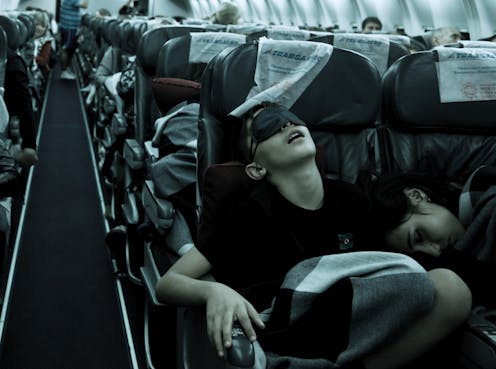
 Our muscles naturally relax when we’re asleep, making it difficult to keep the head supported.
Shutterstock[12]
Our muscles naturally relax when we’re asleep, making it difficult to keep the head supported.
Shutterstock[12]
Prepare your clothes and accessories
Be prepared so you can create the best possible sleep situation within the constraints of an aircraft seat.
Wear comfy layers, so you can take things off if you get too hot or put things on when you cool down, and hang on to that blanket instead of losing it under your seat.
Light and noise disturb sleep, so pack eye shades and earplugs (or a noise cancelling headset) to block these out. Practice with eye shades and earplugs at home, as it can take a few sleeps to get used to them.
A normal and necessary part of the falling asleep process is relaxation, including our neck muscles. When sitting up, this means our heavy heads will no longer be well supported, resulting in that horrible head-dropping experience most of us have had. Try supporting your head with a neck pillow or, if you have a window seat, against the aircraft wall. (Unless you know the person in the next seat well, they are probably not a good option to prop you up.)
Don’t try to force it
Finally, if you wake up and are struggling to go back to sleep, don’t fight it.
Take advantage of the in-flight entertainment. This is one of the few times sleep scientists will tell you it’s okay to turn on the technology – watch a movie, binge-watch a TV series, or if you prefer, listen to music or read a good book.
When you feel sleepy, you can try going back to sleep, but don’t get stressed or worried about getting enough sleep. Our brains are very good at sleeping – trust that your body will catch you up when it can.
Read more: Jetlag hits differently depending on your travel direction. Here are 6 tips to get over it[13]
References
- ^ has shown (academic.oup.com)
- ^ our research (onlinelibrary.wiley.com)
- ^ also shows (www.ingentaconnect.com)
- ^ plus findings (www.tandfonline.com)
- ^ many other lab-based studies (www.sciencedirect.com)
- ^ Explainer: can you pay off your 'sleep debt'? (theconversation.com)
- ^ you’ll be more easily woken (doi.org)
- ^ attempts to catch up (www.ncbi.nlm.nih.gov)
- ^ do not allow perfectly normal sleep to occur (www.ingentaconnect.com)
- ^ groggy and drowsy (www.ncbi.nlm.nih.gov)
- ^ I can't sleep. What drugs can I (safely) take? (theconversation.com)
- ^ Shutterstock (www.shutterstock.com)
- ^ Jetlag hits differently depending on your travel direction. Here are 6 tips to get over it (theconversation.com)
Read more https://theconversation.com/how-can-i-get-better-sleep-on-long-haul-flights-211821