Why are Taylor Swift tickets so hard to get? The economics are complicated
- Written by: Paul Crosby, Senior Lecturer, Department of Economics, Macquarie University
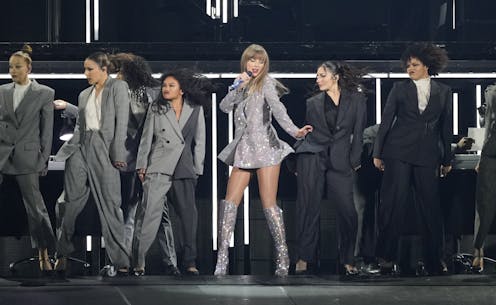
Desire, anticipation, frustration and disappointment – any time tickets for a Taylor Swift tour go on sale there is Bad Blood.
The release of tickets for the Australian leg of Swift’s Eras world tour has been far smoother than the debacle in the United States, which led to calls for greater regulation[1] of the US ticketing industry. Even so, hundreds of thousands – possibly millions – of Australian “Swifties” will miss out, or resort to paying hundreds or thousands of dollars extra to secure a ticket.
It’s a function of the idiosyncrasies of the concert-ticketing industry, amplified by the cultural phenomenon that is Taylor Swift.
More than 1 million people reportedly registered[2] for a presale code within 12 hours of the Australian concert dates being announced. When tickets went on sale on Wednesday morning, more than 4 million users[3] reportedly queued.
But no more than 450,000 tickets are available for Taylor’s five Australian shows (three at Sydney’s Accor Stadium and two at the Melbourne Cricket Ground). The maths are simple. Most people wanting tickets will miss out.
The economics of this scenario, however, are a bit more complicated.
Supply and demand
Typically when demand outstrips supply, suppliers will – in the interest of maximising profit – look to do one of two things: increase supply, or increase the price.
Compared with most other markets, however, suppliers of concerts have less capacity to respond to demand signals.
For Swift’s US tour[4], 17 concerts were added to the originally planned 35. But the juggernaut of her world tour, playing more than 100 shows in 18 countries, makes adding shows more logistically complex.
This is apparently the reason Brisbane missed out on a Swift concert. Though the management of Brisbane’s Lang Park stadium (capacity 52,500) reportedly held open dates, organisers considered it impractical with the Australian tour “being sandwiched” between dates in Japan and Singapore.
Even without these logistical issues, and with venues and other infrastructure being available, matching supply to demand is an inexact science, and organisers will prefer sold-out shows[5] and to avoid the risk of a half-empty auditorium.
Pricing tickets
When demand outstrips supply, economics says the way to reduce demand and achieve market equilibrium is to increase the price.
Concert organisers do this to some extent by offering tickets at a range of price points.
For the vast bulk of tickets for Sydney and Melbourne, there are seven price points, ranging from A$79.90 (for “back row” seats) to A$379.90 for “A Reserve” seats in front of the stage. There are also VIP packages, ranging from $349.90 (for a ticket in a section otherwise costing A$159.90, plus merchandise) to $1,250 for the “It’s Been A Long Time Coming” package (for which you get an “A Reserve” seat plus merch).
Read more: How does a Taylor Swift fan prove their love? Money[6]
Organisers could feasibly increase all these prices and still sell out (according to a survey by a US consulting firm, 45% of Swift fans are millennials and just 11% Gen Z, that is aged less than 24).
Taylor Swift’s American fan demographics

Typically, however, artists are reluctant to be seen to be ripping off their fans, and their most loyal and enthusiastic fans are not necessarily the ones that can afford to pay the most for tickets.
Dynamic pricing
Ticket sellers such as Ticketmaster have also been experimenting with maximising allocative efficiency[9] (and profits) through “dynamic pricing” – charging higher prices when demand is high. This is similar to the way the cost of airline tickets[10] or Uber rides[11] fluctuate according to demand.
But Ticketmaster says it only uses dynamic pricing if the artist agrees – and for good reason.
Rocker Bruce Springsteen allowed about 11% of tickets for his 2023 tour to be sold this way. Reports of “platinum seat” tickets costing as much as US$4,000[12] outraged fans (though Ticketmaster says the average ticket price was US$262). Fanzine Backstreets announced it would close[13] after 43 years, citing disillusionment over the ticket prices. Publisher Christopher Phillips declared
These are concerts that we can hardly afford; that many of our readers cannot afford; and that a good portion of our readership has lost interest in as a result.
Swift’s fans may be more tolerant. She has been allowing[14] dynamic pricing since at least 2018[15]. But no tickets for the Australian concerts are being sold using dynamic pricing.
Enter the scalpers
With demand outstripping supply and the reticence of artists to charge as much as they possibly can, a perfect opportunity is created for reselling tickets at a higher price.
Economists call this a “secondary market”, and see it as sign a product or service has been undersupplied or underpriced (or both). It’s more commonly called “ticket scalping” or “ticket touting”, and condemned as opportunistic and unethical.
Read more: The economics of ticket scalping[16]
After reports that tickets offered exclusively to American Express customers were being resold for up to A$3,000[17], the Victorian government declared Swift’s two Melbourne shows “major events[18]” to trigger a law prohibiting resale at more than 110% of the purchase price. (NSW has had a law applying to all tickets since 2018[19].)
But the rise of ticket bots, which can flood ticketing websites with millions of requests, and online markets that allow sellers to be anonymous, makes stopping scalpers increasingly difficult. (Ticketmaster blamed scalping bots[20] for its US site crashing in November.)
Ticket company efforts to combat scalping include limiting the number of tickets that can be bought at one time, and requiring customers to verify their identity when buying the ticket and attending the show. They have also set up “fan to fan” platforms for secondary sales, recognising there can be legitimate reasons to sell tickets.
Swifties who want to resell their Australian tour ticket will be able to do so using a platform provided by Ticketek – but for no more than 110% of the purchase price.
Read more: Ticket touts have been around for centuries – but the tide could be turning against them[21]
Rock band Rage Against the Machine has sought to combat scalping with its own form of dynamic pricing. This involves holding back 10% of show tickets, which are then sold at a higher price but undercutting scalpers, with the the extra profit going to “charities and/or activist organizations[22]”. The band reckons this has reduced scalping by 85%[23] and raised millions for charity.
US singer Maggie Rogers has gone altogether more analogue by skipping online presale and selling tickets at box offices.
But these strategies will not help overcome the iron laws of supply and demand for Taylor Swift fans. They can only hope Karma is on their side.
References
- ^ calls for greater regulation (www.nytimes.com)
- ^ reportedly registered (www.smh.com.au)
- ^ more than 4 million users (www.theguardian.com)
- ^ US tour (variety.com)
- ^ prefer sold-out shows (journals.sagepub.com)
- ^ How does a Taylor Swift fan prove their love? Money (theconversation.com)
- ^ Morning Consult (pro.morningconsult.com)
- ^ CC BY (creativecommons.org)
- ^ allocative efficiency (www.intelligenteconomist.com)
- ^ airline tickets (insights.som.yale.edu)
- ^ Uber rides (medium.com)
- ^ as much as US$4,000 (www.theguardian.com)
- ^ announced it would close (www.backstreets.com)
- ^ been allowing (newrepublic.com)
- ^ since at least 2018 (www.rollingstone.com)
- ^ The economics of ticket scalping (theconversation.com)
- ^ up to A$3,000 (www.abc.net.au)
- ^ major events (www.abc.net.au)
- ^ since 2018 (www.fairtrading.nsw.gov.au)
- ^ blamed scalping bots (www.nytimes.com)
- ^ Ticket touts have been around for centuries – but the tide could be turning against them (theconversation.com)
- ^ charities and/or activist organizations (loudwire.com)
- ^ scalping by 85% (www.spin.com)