American Born Chinese challenges the model minority myth
- Written by: Shih-Wen Sue Chen, Associate professor, Deakin University
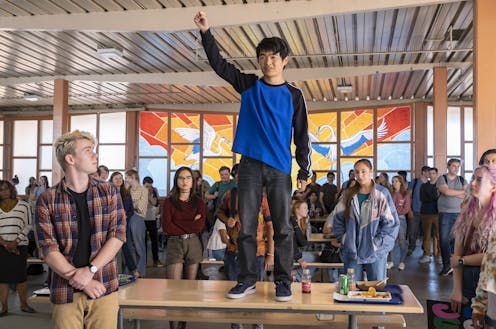
There’s trouble brewing in Heaven. This has implications for an average teenage boy Jin Wang (Ben Wang), the protagonist of the Disney+ series American Born Chinese (2023).
The series is an adaptation of Gene Luen Yang’s graphic novel[1] of the same name. It features many actors from the Oscar-winning film Everything Everywhere All at Once[2], such as Michelle Yeoh and Ke Huy Quan.
American Born Chinese has attracted the attention and praise of major news outlets such as The Washington Post[3], The New York Times[4] and The Atlantic[5]. It also appears on several lists of the best Disney+ shows[6].
Viewers may have encountered variations of the Monkey King character from the 16th-century Chinese classic Journey to the West[7] in TV shows, such as Monkey (1978)[8].
American Born Chinese focuses on Wei-Chen (Jimmy Liu), son of the Monkey King. He comes to earth in the form of a new student at Jin’s high school. Wei-Chen is determined to find the Fourth Scroll which will stop the Bull Demon from taking control of Heaven. Jin is reluctant to reciprocate the friendship extended by Wei-Chen. He just wants to fit into his predominantly white high school.
American Born Chinese is a recent addition to stories of young people who grapple with what it means to be successful.
Success, youth, and the model minority stereotype
For Jin, being popular and joining the soccer team is more important than excelling academically. He doesn’t fit into the model minority stereotype[9] which essentialises Asian Americans as hardworking, docile and family-oriented high achievers.
The model minority can be found in films such as The Joy Luck Club[10] (1993) and young adult novels like Girl in Translation[11] (2010).
In his attempts to gain popularity, Jin reveals he is a flawed character[12]. He steals, lies, betrays his friends and remains silent when he is bullied by racist classmates.
Read more: More than 'model minorities': in Netflix's Beef, Asian migrants are allowed to have real emotions[13]
As immigrants, Jin’s parents embarked on their own “journey to the West,” hoping to achieve the American Dream. However, they are unlike stereotypical Asian American “tiger” parents[14] because they do not pressure him to do well at school. Neither do they insist on Jin learning Mandarin.
However, Jin’s mother Christine (Yeo Yann Yann) constantly nags her husband Simon (Chin Han) to ask for a promotion at work even though the family is financially comfortable. Hardworking Simon is silent, nonthreatening and quietly does his work without challenging his boss’s decisions. He finds it difficult to speak up for himself both at work and at home.
This character fits stereotypes of Asian American men[15] as effeminate, emasculated and failing the standards of ideal white masculinity.
In Christine’s eyes, Simon has not achieved the American Dream. Unlike Simon, Christine has an entrepreneurial spirit. She takes out the family’s savings to invest in an herbal powder business without consulting her husband. This leads to a crisis in the family when Simon wants to quit his job. It is only when he stands up for his wife at the principal’s office that their relationship improves.

A hero without superpowers
Wei-Chen disrupts Jin’s life by challenging his narrow definition of success as popularity. Self-assured Wei-Chen does not care what others think of him. Likewise, their Japanese American classmate Suzy Nakamura is a confident leader of the Culture Club who rallies students to protest against racist behaviour. Her outspokenness challenges model minority stereotypes.
While Jin tries to distance himself from both Suzy and Wei-Chen, the latter believes in his friend and trusts that Jin will help him. Wei-Chen’s determination and faith in Jin is the catalyst for Jin’s self-transformation. Through this unlikely friendship, Jin comes to believe Wei-chen’s claim that the heavenly rebellion is real.
The Goddess of Mercy Guanyin (Michelle Yeoh) entrusts Jin with the mission to stop the Bull Demon. Jin refuses and Freddy Wong (Ke Huy Quan), a sitcom character, appears to him in a dream. Freddy tells him,
a hero doesn’t always have to have superpowers. A hero is someone who goes on a journey, shows courage, helps others.
 American Born Chinese brings mythology into a modern setting.
Disney
American Born Chinese brings mythology into a modern setting.
Disney
Redefining Success
Our research[16] on conceptualisations of children and success in Asia has shown that media representations about young people have moved beyond narrow definitions of achievements as academically oriented. It encompasses the cultivation of positive personal qualities and good morals for the benefit of the community.
Jin exemplifies this shift beyond the Asian context. He transforms from an individual hyper-focused on personal desires into a brave friend who is willing to sacrifice himself to save his community.
In the season one finale, Jin embraces a new definition of success. Instead of taking part in his first soccer match in front of the school, he steps out of his comfort zone to help his unpopular friends.
For Jin, being popular is no longer his first priority. His refusal to be docile challenges the model minority stereotype. He has truly become a hero.
References
- ^ graphic novel (www.latimes.com)
- ^ Everything Everywhere All at Once (www.theguardian.com)
- ^ The Washington Post (www.washingtonpost.com)
- ^ The New York Times (www.nytimes.com)
- ^ The Atlantic (www.theatlantic.com)
- ^ best Disney+ shows (collider.com)
- ^ Journey to the West (www.britannica.com)
- ^ Monkey (1978) (www.youtube.com)
- ^ model minority stereotype (faculty.umb.edu)
- ^ The Joy Luck Club (www.imdb.com)
- ^ Girl in Translation (doi.org)
- ^ flawed character (theconversation.com)
- ^ More than 'model minorities': in Netflix's Beef, Asian migrants are allowed to have real emotions (theconversation.com)
- ^ “tiger” parents (www.theguardian.com)
- ^ stereotypes of Asian American men (www.washingtonpost.com)
- ^ research (www.routledge.com)