Smoke from the Black Summer fires could have made the triple La Niña more likely
- Written by: Martin Jucker, Lecturer in Atmospheric Dynamics, UNSW Sydney
The 2019-2020 bushfire season was devastating. Vast areas of pristine forest burned, many for the first time in memory. By some estimates, a billion native animals died up and down Australia’s east coast. Dozens of people died.
While Sydney’s skies are blue again, Australia’s Black Summer has kept scientists around the globe busy. The sheer size of these megafires produced startling effects. Recently, researchers found the huge volumes of smoke ate away[1] at our protective ozone layer.
Now, new research[2] by American scientists suggests the Black Summer fires were massive enough to influence the El Niño Southern Oscillation cycle[3]. It’s one of the most important drivers of unusual weather over the entire globe – and one which Australians know intimately.
The three successive years[4] of La Niña we just had? They could have been made more likely by the Black Summer fires. The reason, strangely enough, is the smoke.
But it’s important not to say the link is proven. While groundbreaking, this research relies on a single model. It’s too early to clearly say bushfire smoke can trigger La Niña.

Where there’s fire, there’s smoke
We’ve long known that the huge volume of ash blown high into the upper atmosphere by a big volcanic eruption can cool Earth’s surface for many months, or even years[5].
We also know volcanoes can influence[6] the tropical Pacific, and thus affect whether an El Niño or a La Niña phase develops.
How? By blocking light. Particles of ash reduce how much light gets to the surface.
Volcanic ash gets blown high into the stratosphere, the part of the atmosphere just above the clouds where long-haul airplanes fly. Then, sunlight gets reflected before it reaches the ground, thus cooling the surface much like an umbrella can.
Is bushfire smoke the same as volcanic ash?
It’s tempting to equate smoke with ash, and assume a large enough bushfire would have similar effects to a volcano.
But there are important differences. Most obviously, a bushfire does not smell of rotten eggs.
That might sound unimportant, but the rotten egg smell – which comes from sulfur – indicates major differences in the composition of volcanic ash and bushfire smoke.
Different chemicals could mean very different responses to sunlight once in the atmosphere, which in turn could affect how much light is reflected.
Second, bushfires don’t explode.
A decent volcano erupts with enough force to blast smoke high into the stratosphere. Bushfires don’t have the same propulsive force.
Bushfire smoke is hot, though, and hot smoke rises well. Some of the smoke from the Black Summer fires reached the stratosphere[7], although after a much longer interval than for volcanic eruptions.
So, does a large bushfire have the same effect on climate as a volcano?
The American researchers begin by checking the similarities using climate model simulations. They found bushfire smoke does indeed shade the surface from sunlight in these simulations.
Read more: Australia's Black Summer of fire was not normal – and we can prove it[8]
How much? Over a region of the south-eastern Pacific, about 150 terawatts of sunlight bounced back to space – the equivalent of about 100,000 coal power plants.
Clouds matter
The surprising finding is how it happens. In contrast to eruptions, bushfire smoke didn’t reflect the sunlight directly. Instead, clouds were responsible.
How does that work? This is where the magic of the climate system kicks in. Our atmosphere, oceans and lands are constantly interacting with each other.
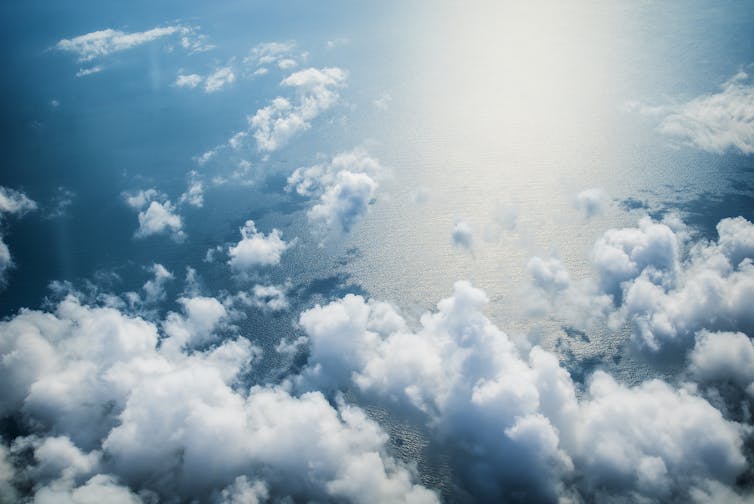
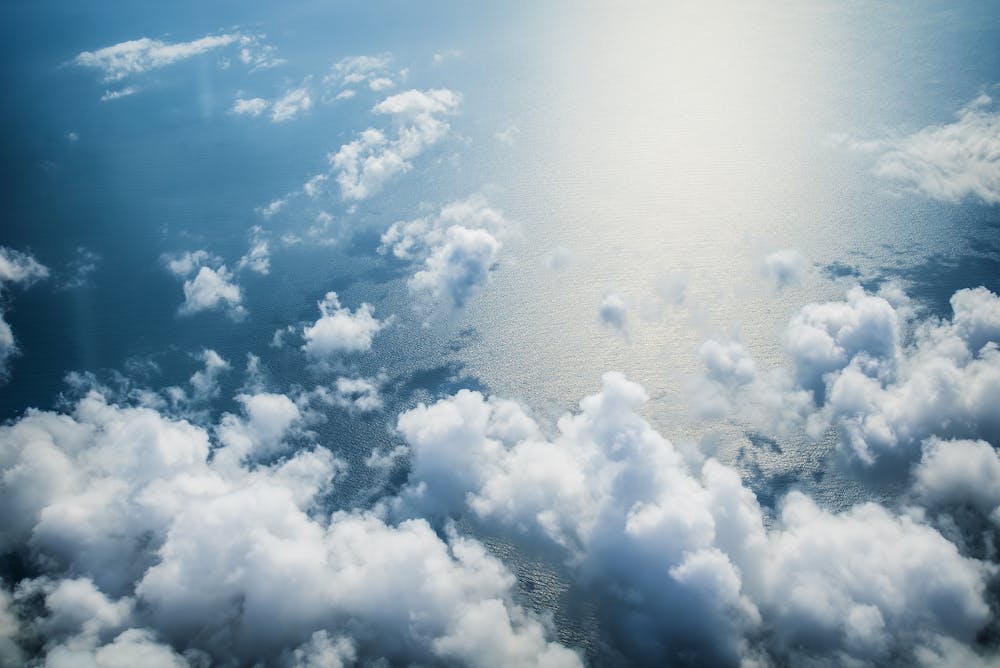 Whiter, thicker clouds make the surface of the ocean cooler.
Shutterstock
Whiter, thicker clouds make the surface of the ocean cooler.
Shutterstock
In their simulations, Black Summer smoke was first blown eastward by strong winds in the atmosphere. Under specific conditions, some smoke particles can interact with droplets in clouds and make clouds thicker and brighter. One region where this can happen is the subtropical south-eastern Pacific.
The researchers were able to show the brightness of the clouds over this area increased considerably just around the time when the smoke particles arrived.
These brighter, whiter clouds reflected more sunlight back into space and shaded the surface underneath. The net effect: cooler seawater.
The effect was particularly important because of the timing. Smoke-whitened clouds emerged around our summer solstice in late December, which is the same time of year when the strength of the incoming sunlight peaks in the southern hemisphere.
How is this linked to La Niña?
Follow the chain: huge volumes of smoke blow east where they whiten clouds, cool the seawater, and cause less water to evaporate.
Surface winds carried this cooler, drier air over the tropical Pacific, where it cooled the ocean surface again, and made it harder for tropical storms to form.
A cooler sea surface in the tropical Pacific is a hallmark of La Niña, the cold phase of the El Niño Southern Oscillation cycle.
That’s how this research was able to trace a link between Black Summer smoke and the rare back-to-back La Niña events in 2019-20 and 2020-21. As you know, we ended up having an even rarer triple La Niña in 2021-22, though the research period ends before this.
 Smoke plumes reached as far as South America.
NASA
Smoke plumes reached as far as South America.
NASA
Is the link now proven? Not quite
This study offers a consistent physical explanation for how bushfires might influence the El Niño cycle.
It’s yet another example of how complex climate science can be, and how much we can still be surprised and challenged by what mother nature presents us.
But there are a few caveats to keep in mind.
For one, the ENSO cycle in the simulation was heading for a double La Niña even without the impact of the smoke. The simulation stops in the winter of 2021, which is before the real-world ENSO tipped into a third La Niña.
What does that mean? In short, we can’t know for sure if the effect of the bushfire smoke really did cause the triple La Niña.
Another caveat is the fact the study relied on a single climate model, and relies heavily on the representation of clouds in that model.
That’s a potential problem, because we know clouds – and especially their interactions with aerosols like smoke – are still the largest source of uncertainties and model errors.
To prove or disprove the link, we’ll have to simulate the impact of ballooning Black Summer smoke plumes across many different models.
Read more: Smoke from the Black Summer fires created an algal bloom bigger than Australia in the Southern Ocean[9]
References
- ^ ate away (www.abc.net.au)
- ^ new research (dx.doi.org)
- ^ El Niño Southern Oscillation cycle (cosmosmagazine.com)
- ^ three successive years (theconversation.com)
- ^ even years (www.ipcc.ch)
- ^ can influence (doi.org)
- ^ reached the stratosphere (www.science.org)
- ^ Australia's Black Summer of fire was not normal – and we can prove it (theconversation.com)
- ^ Smoke from the Black Summer fires created an algal bloom bigger than Australia in the Southern Ocean (theconversation.com)