Why has the West given billions in military aid to Ukraine, but virtually ignored Myanmar?
- Written by: Nicholas Farrelly, Professor and Head of Social Sciences, University of Tasmania
Two years after Myanmar’s coup on February 1 2021[1], the country’s large and growing resistance forces receive almost no attention outside the country.
The democratic opposition, fronted by the National Unity Government (NUG), but comprising many different groups, armies, militias and individuals, has also struggled to gain awareness, even for its substantial battlefield successes.
And perhaps most notably, the opposition’s pleas for weapons[2] from the West to fight against an increasingly brutal crackdown by the military junta have gone unheeded.
The difference with the West’s response to Ukraine’s war against Russia could not be more stark. While the two conflicts are not completely analogous, it is nonetheless striking how much Ukraine has galvanised the international community, while Myanmar has almost completely been ignored.
No charismatic, wartime figure
Part of this has to do with the visibility of a central, iconic leader. With ousted leader Aung San Suu Kyi[3] and other public figures locked up, Myanmar’s resistance forces have no recognisable public face.
The NUG has an acting president, Duwa Lashi La, who makes occasional YouTube[4] and social media appearances. While he enjoys a strong reputation among ethnic Kachin in the country’s north, he is barely recognised on the global, or even national, stage.
NUG President Duwa Lashi La announcing a people’s defensive war against the military junta in September 2021.By contrast, Ukrainian President Volodymyr Zelensky’s transformation into a wartime commander has resulted in a huge global profile. He has given carefully scripted speeches to foreign parliaments[5] and rousing addresses to both the Ukrainian people and key international meetings[6].
His constant efforts to refocus attention on the next phase of fighting in Ukraine have inspired his own people, and have made the Ukrainian flag a potent symbol of defiance in the face of tyranny.
Volodymyr Zelensky addressing the Australian parliament.A lack of a simple narrative
Ukraine has mastered the digital battlefield, too. Its leaders have simplified the narrative and calibrated it in a powerful way to emphasise a “good” versus “evil” struggle in which Western democracies are compelled to offer both symbolic and material support.
The complexities in Myanmar – ethnic, linguistic, geographic, ideological, historical and more – make such a narrative much harder to muster and sustain.
The genocide of the Rohingya[7] in 2017, which took place under the Suu Kyi-led government[8], also muddied the waters of the previously simplistic tale of a Nobel Peace laureate facing off against a brutal Myanmar military.
Suu Kyi’s government did not have oversight or control over the military that carried out the bloody purge, but this hardly seemed to matter. Suu Kyi’s decision to offer a stubborn defence[9] of the military’s actions at the International Court of Justice in 2019 dramatically shifted international opinion.
Now, with Myanmar’s treatment of the Rohingya still such a raw issue, it’s unclear whether Suu Kyi – or her democratically elected government – deserves the sympathy and support from the West they once received.
Read more: Aung San Suu Kyi's extraordinary fall from grace[10]
A fringe actor on the global stage
Geography matters, too. In a global strategic sense, Myanmar has almost always been an afterthought in the West.
In contrast, for a century or more, Ukraine has been a constant site for strategic competition, especially in the duels between Western powers and the government in Moscow. The attacks on Ukraine over the past decade by a nuclear-armed Russia are therefore seen by Western powers as a first-order geopolitical threat.
As such, the US alone committed[11] about US$50 billion in total assistance to Ukraine in 2022, about half of which was military aid.
Read more: US will give military tanks to Ukraine, signaling Western powers' long-term commitment to thwarting Russia[12]
With Myanmar a far less important site of conflict, most of the international community (including the regional body of Southeast Asian states, ASEAN) have been reluctant to provide military support for the resistance fighters.
Historically, weapons smuggled into Myanmar[13] to support anti-government armies have used neighbouring countries, most notably Thailand and India, as the gateways. Today, however, the leaders in Bangkok and New Delhi are reluctant to get too entangled in Myanmar’s mess. They also have their own insurgencies to keep an eye on.
When weapons and materiel do flow into Myanmar today, they are moved quietly, with as much deniability as can be marshalled. With no Western government publicly supplying the resistance with weapons[14], the fighters are resorting[15] to crowdfunding to buy weapons and using explosives pieced together with salvaged metal.
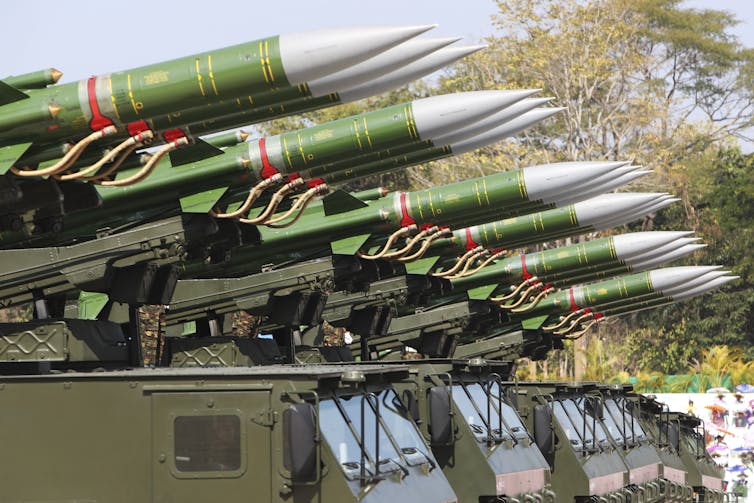
Meanwhile, the military junta has built up a huge arsenal of weapons[16] purchased from Russia and China, or made domestically using supplies from companies in countries like the US, Japan and France[17].
Geopolitics may also matter when it comes to the international courts, as well.
There are two parallel genocide cases relating to Myanmar and Ukraine winding their way through the International Court of Justice in The Hague. The Ukraine case, still less than 12 months old, has received formal interventions by almost all Western states, 33 in total[18].
By contrast, the Myanmar case relating to the Rohingya was launched in 2019 and not a single country[19] has formally intervened, despite several countries indicating they may do so.
An opportunity to support democracy
Another reason for the tentative international response to the Myanmar conflict is the expectation, particularly in ASEAN, that Myanmar’s coup-makers will, in the end, hold enough ground and continue to control the levers of power.
But we should ask if this assessment is correct. In early 2023, after two years of protest and violence, the junta looks especially vulnerable.
For example, influential voices within ASEAN, notably from Malaysia[20] and Indonesia[21], have begun strongly rebuking the Myanmar military.
They seemingly no longer want the entire region’s reputation tarred by the junta’s brutal mismanagement of Myanmar. They are also aware that anti-regime forces are taking and holding significant ground.
Under these conditions, the international community needs to move more quickly to consider a future for Myanmar after this war ends. That means dramatically limiting the military’s ability to gain international legitimacy, ramping up efforts to starve the generals of weapons and financial resources, and supporting war crimes prosecutions in international courts.
At the same time, Myanmar’s revolutionary forces need support – both on the battlefield and in civilian efforts to rebuild a traumatised society.
The invasion of Ukraine has clearly demonstrated, for the first time in many years, that Western military force can be successfully used to support a democracy under siege. If only a small fraction of the support to Ukraine was provided to Myanmar’s resistance fighters, they could be given the chance to one day build a thriving democratic state in the heart of Asia.
References
- ^ Myanmar’s coup on February 1 2021 (theconversation.com)
- ^ opposition’s pleas for weapons (www.irrawaddy.com)
- ^ ousted leader Aung San Suu Kyi (www.theguardian.com)
- ^ YouTube (www.youtube.com)
- ^ foreign parliaments (www.youtube.com)
- ^ key international meetings (www.bbc.com)
- ^ genocide of the Rohingya (www.bbc.com)
- ^ took place under the Suu Kyi-led government (theconversation.com)
- ^ stubborn defence (www.eastasiaforum.org)
- ^ Aung San Suu Kyi's extraordinary fall from grace (theconversation.com)
- ^ committed (theconversation.com)
- ^ US will give military tanks to Ukraine, signaling Western powers' long-term commitment to thwarting Russia (theconversation.com)
- ^ weapons smuggled into Myanmar (www.thedefensepost.com)
- ^ supplying the resistance with weapons (thediplomat.com)
- ^ resorting (www.aljazeera.com)
- ^ huge arsenal of weapons (www.dw.com)
- ^ supplies from companies in countries like the US, Japan and France (www.bbc.com)
- ^ almost all Western states, 33 in total (www.icj-cij.org)
- ^ single country (www.icj-cij.org)
- ^ Malaysia (www.benarnews.org)
- ^ Indonesia (thediplomat.com)