Chris Hipkins becomes NZ’s new prime minister – there are two ways it can go from here
- Written by: Grant Duncan, Associate Professor, School of People, Environment and Planning, Massey University
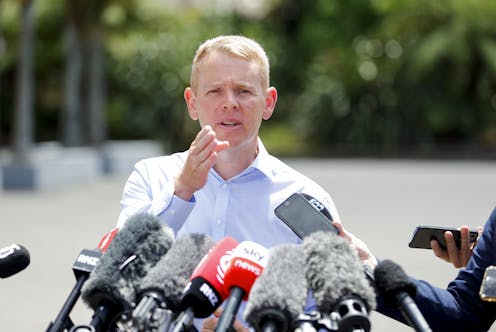
Following the surprise resignation[1] of Jacinda Ardern on January 19, the New Zealand Labour Party already has a new leader[2]: Chris Hipkins. The handover from Ardern to Hipkins has been achieved with the same efficiency as the handover from Andrew Little to Ardern in 2017. But will it be as successful?
Hipkins entered parliament in 2008 – along with Ardern. Under Ardern’s leadership, he held ministerial portfolios in education, police and public services, and was Leader of the House.
His role as education minister includes a (not altogether successful) centralisation of all the country’s polytechnics under one administrative umbrella – a form of restructuring typical of this Labour government.
He distinguished himself during the COVID pandemic as a hard-working and competent leader who contributed a much-needed clarity and common sense. He’s a dependable and intelligent politician who doesn’t mind being an attack dog when it’s called for.
As leader, however, Hipkins now faces an uphill battle, with his party trailing the opposition National Party in the most recent published polls. But he lacks Ardern’s charisma.
In 2017, there was an instant “Jacindamania” effect when she took the party leadership, and Labour’s polling shot up. One simply can’t imagine a “Chris-mania”, however. But maybe that’s not a bad thing right now.
Game over?
There are two ways this could go now. First, the nightmare scenario for Labour: the government continues to be sniped at over controversial and unpopular policies such as the Three Waters[3] programme and the income insurance scheme[4], economic problems continue to damage household budgets, the opposition leaders (both National’s Christopher Luxon and ACT’s David Seymour) have a field day.
In head-to-head debates with Luxon once the election campaign begins, Hipkins lacks the fire that Ardern was able to show when she needed it, and becomes political roadkill at the ballot box on October 14. Labour supporters wake up in a cold sweat.
Read more: ‘The shoes needing filling are on the large side of big’ – Jacinda Ardern’s legacy and Labour’s new challenge[5]
With Labour’s ongoing slump in the polls, trailing National by around five or six percentage points, this scenario can’t be ruled out. Following defeat, Labour could go into the kind of spiral it endured after Helen Clark’s loss in 2008, with one unsuccessful leader after another.
We can recall the defeat of Labour’s Phil Goff in 2011 and David Cunliffe in 2014 when up against National’s John Key. And, to be fair, National suffered a similarly bad run after Bill English stood down in 2018 and until Luxon became leader in November 2021.
A new hope?
So is there a dream scenario for Labour? With Ardern’s charismatic – and now rather polarising – personality heading for the exit, the party could turn things around.
New leadership licences a significant cabinet reshuffle and (more importantly) a refresh of policy. Labour could now neutralise (or even dump) some policy proposals that are presently causing public dissatisfaction.
Rather than Hipkins having somehow to fill Ardern’s shoes, he could follow his own path in his own trusty trainers.
Read more: Ardern's resignation as New Zealand prime minister is a game changer for the 2023 election[6]
An advantage he has is an apparent unanimity of support from his caucus. This suggests his team is focused on beating National rather than beating one another.
But can Labour win back the support of those middle-ground voters who’ve shifted to the centre-right? It appears many of those who’ve swung away from Labour actually liked Ardern[7]. And Ardern remained on top in preferred prime minister polls[8] right up until days before she resigned.
We could infer from this that a leadership change on its own won’t suffice to woo these voters back. The loss of Ardern could indeed precipitate a further drop in polling for Labour.
Read more: Jacinda Ardern's resignation: gender and the toll of strong, compassionate leadership[9]
A policy reset
Late in 2022, Ardern had stated that the government’s focus this year would be the economy. And National will inevitably use the line that they (National) are the more competent when it comes to “managing the economy”.
If Labour is serious about winning the 2023 election, then, they need to convince enough voters of the following:
they are addressing the real economic concerns that are affecting people presently
they have taken heed of people’s disquiet over some current policy changes and are prepared to revise them
and they are not going any further with controversial matters, especially co-governance[10] with Māori, without first seeking a wider public understanding and consensus.
Hipkins is a competent and reliable person. If he has his party’s backing to revise or backtrack on policy, then he may have some success. With less focus on personalities this time around, his best hope may be to convince people his government is serious about resetting the country’s direction.
References
- ^ surprise resignation (www.theguardian.com)
- ^ new leader (www.1news.co.nz)
- ^ Three Waters (www.threewaters.govt.nz)
- ^ income insurance scheme (www.mbie.govt.nz)
- ^ ‘The shoes needing filling are on the large side of big’ – Jacinda Ardern’s legacy and Labour’s new challenge (theconversation.com)
- ^ Ardern's resignation as New Zealand prime minister is a game changer for the 2023 election (theconversation.com)
- ^ actually liked Ardern (thespinoff.co.nz)
- ^ preferred prime minister polls (en.wikipedia.org)
- ^ Jacinda Ardern's resignation: gender and the toll of strong, compassionate leadership (theconversation.com)
- ^ co-governance (www.1news.co.nz)