Black Snow, a new pacy murder mystery, addresses the complicated legacy of slavery in Australia
- Written by: Clare Corbould, Associate Professor, Contemporary Histories Research Group, Deakin University
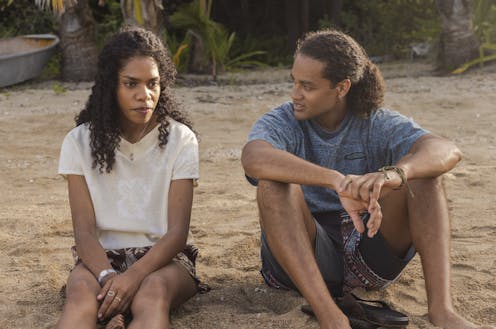
In 1994, the Australian federal government finally extended recognition[1] to Australian South Sea Islander people as a distinct cultural group. This recognition was important: racism put Australian South Sea Islanders at a disadvantage, yet there was little public recognition of the unique circumstances they and their ancestors had experienced and survived.
The same year opens Black Snow, a six-part drama on Stan. Isabel “Izzy” Baker (Talijah Blackman-Corowa) is murdered on the way home from her school formal. Local cops decide the murderer was likely a seasonal worker passing through town, and drop the case.
But when a time capsule created by the school leavers is opened 25 years later, a letter from Isabel provides new leads.
The action unfolds in the shadow of a bronze statue of sugar planter James Ashford – a stand-in for Robert Towns[2] for whom Townsville is named.
Isabel’s death, the botched investigation and cover-up reflect that 1994 was only the beginning of a much-needed reckoning with the history of forced labour in Australia.
An Australian history of slavery
Isabel’s letter brings detective James Cormack (Travis Fimmel) to town. He’s a cold-case specialist from the city with baggage of his own. Cormack butts heads with the local senior sergeant who would rather the skeletons of the past stay firmly in the closet.
But Cormack befriends the town’s rookie cop, Dale Quinn (Gulliver McGrath). Quinn conveys to the audience both police procedure, and the appalling labour practices of the 19th century and the more recent past.
Despite having grown up in the town, Quinn has to google James Ashford when the statue is vandalised. “I never knew we had slavery in Australia,” he says mournfully.
There was plenty of forced labour in Australia, not least of Indigenous people[3]. Also at the heart of Australia’s history of slavery are the lives of South Sea Islanders.
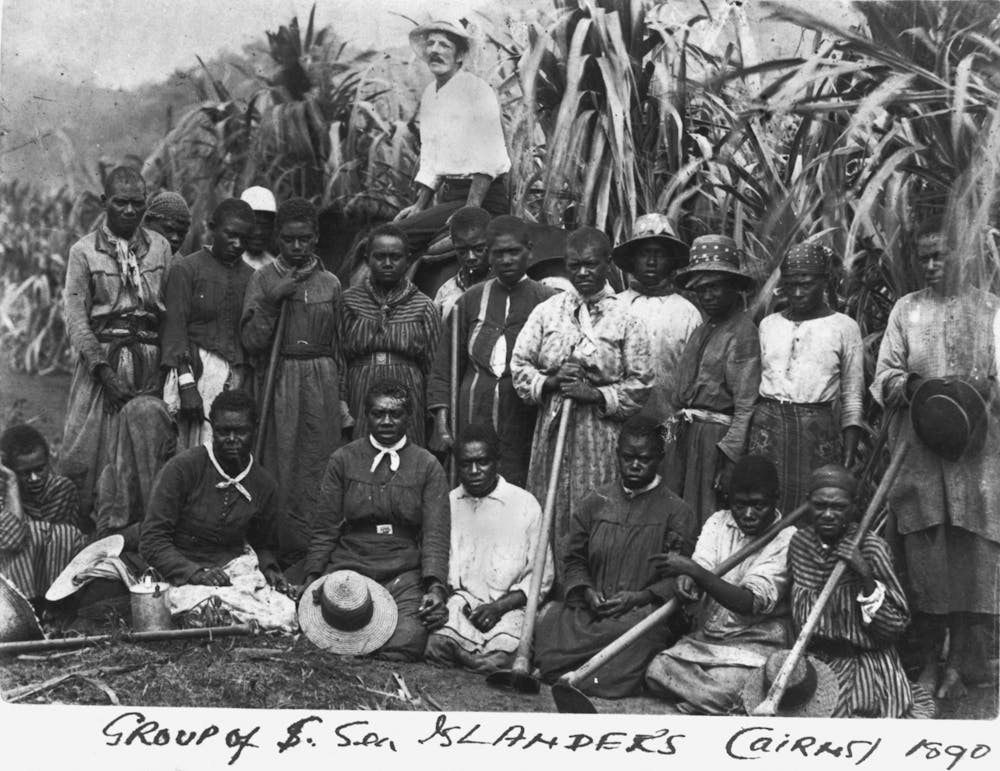
Some 62,000 people were shipped to Australia between 1863 and 1904, mostly to Queensland, where they worked mainly in the sugar trade.
These workers hailed from islands[4] in what are now New Caledonia, Vanuatu, the Solomon Islands and east of Papua New Guinea. Some were abducted, while others came after signing dubious contracts.
All were treated[5] somewhere between poorly and viciously. They suffered the highest death rate by far[6] of any contemporaneous immigrant group to Australia.
Such ignorance of this history is not for a lack of trying on the part of Australian South Sea Islander people.
In the nearly 30 years since government recognition, they have made a concerted effort to educate[7] people in Australia and beyond about their history[8] and culture[9].
Read more: Was there slavery in Australia? Yes. It shouldn't even be up for debate[10]
The voice of the community
The creator and initial producers, who are white, strove to make Black Snow a genuinely collaborative effort.
Kaylene Butler, a descendant of a trafficked man from Vanuatu, signed on as a producer. Boyd Quakawoot, of mixed Indigenous and South Sea Islander ancestry, joined the writing team. Cinematographer Murray Lui was born and raised in the Torres Strait. Marion Healy contributed her valuable expertise as a cultural and historical consultant.
 There is a sense of a genuine collaborative effort behind Black Snow.
Stan
There is a sense of a genuine collaborative effort behind Black Snow.
Stan
The involvement of Australian South Sea Islander creatives is evident right from the title sequence, co-designed by Australian South Sea Islander visual artist Jasmine Togo-Brisby.
Singer-songwriter Ziggy Ramo, who also appears as the character Ezekiel, created the music with composer Jed Palmer. Their work included a recording trip to Tanna Island, Vanuatu.
The cast includes 14 Australian South Sea Islander actors. Considering that 12 of them are appearing on screen for the first time, the power of the acting – especially leads Talijah Blackman-Corowa (Isabel) and Jemmason Power (Hazel) – is remarkable.
The show portrays the central place of faith and the church in the community. And although the pastor is Isabel’s father, the community really revolves around the Australian South Sea Islander women.
The gentle and deep friendship between Isabel’s mother (Seini Willett) and aunt (Lisa Blackman), and the way they resolve conflicts between others, is particularly affecting.
A fight for recognition
The scenes in 1994 showcase the Australian South Sea Islander community, but in the present-day scenes Cormack takes centre stage. The casting of Fimmel risked a problematic “white saviour[11]” narrative, but the show carefully balances the two timelines to centre the stories of the Australian South Sea Islanders.
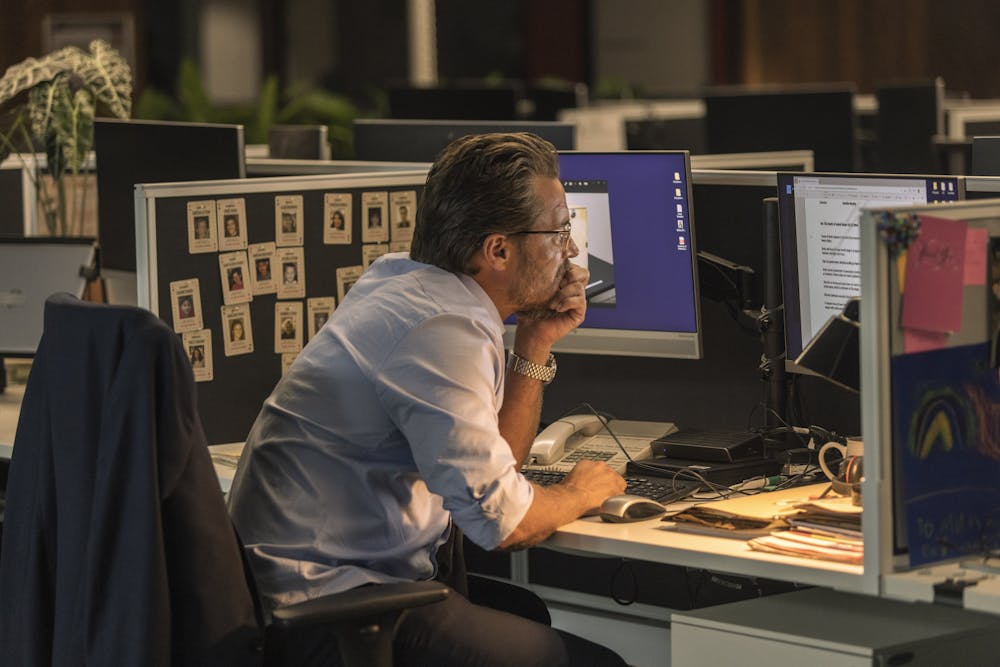 Black Snow steers away from a white saviour narrative.
Stan
Black Snow steers away from a white saviour narrative.
Stan
It has been a long fight for recognition in Australia.
Women like Faith Bandler and Patricia “Patsy” Corowa were a part of[12] an intricately connected global Black Power movement. From the late 1960s, activists in Australia collaborated with Black activists in the Pacific, Caribbean, United States and elsewhere to fight for rights and power.
This struggle is ongoing and remains global. Isabel includes a Black Power salute in a mural she paints in her last weeks alive. In the present-day, Isabel’s niece Kalana (an excellent Eden Cassady) expresses solidarity with the Black Lives Matter movement. She leads a small group of teenage activists to repeatedly graffiti Ashford’s statue with red paint and the chilling figure of 62,000.
Our hauntings
The show has an important message about conditions[13] today for Pacific workers who are vital to Australia’s farming sector.
Current labour regulation[14] prioritises employers’ profit[15] over seasonal Pacific workers’ rights.
This pacy murder mystery reminds us slavery and exploitation are not safely in the past. Their legacies remain, and should haunt us all.
Black Snow is streaming on Stan from January 1.
Read more: New Pacific Australia Labour Mobility scheme offers more flexibility ... for employers[16]
References
- ^ extended recognition (humanrights.gov.au)
- ^ Robert Towns (en.wikipedia.org)
- ^ Indigenous people (theconversation.com)
- ^ hailed from islands (www.assipj.com.au)
- ^ treated (uhpress.hawaii.edu)
- ^ highest death rate by far (blogs.archives.qld.gov.au)
- ^ educate (www.assipj.com.au)
- ^ history (www.slq.qld.gov.au)
- ^ culture (www.flickr.com)
- ^ Was there slavery in Australia? Yes. It shouldn't even be up for debate (theconversation.com)
- ^ white saviour (www.teenvogue.com)
- ^ part of (www.cambridge.org)
- ^ conditions (theconversation.com)
- ^ labour regulation (theconversation.com)
- ^ profit (theconversation.com)
- ^ New Pacific Australia Labour Mobility scheme offers more flexibility ... for employers (theconversation.com)