


Is my RAT actually working? How to tell if your COVID test can detect Omicron
- Written by: Thea van de Mortel, Professor, Nursing, School of Nursing and Midwifery, Griffith University
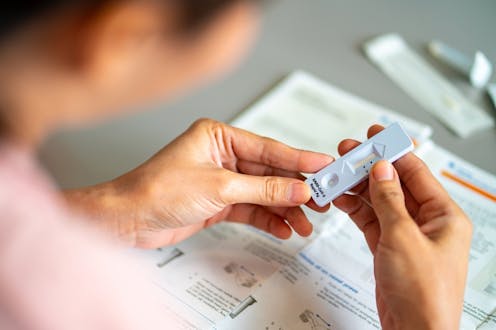
You’ve tested negative for COVID using a rapid antigen test (RAT), but are a close contact of a positive family member and have symptoms. So you might be wondering if you’re really COVID-negative or if the test is working as well as it should.
There are many reasons why your RAT may not give you the results[1] you expect[2]. But one factor is whether RATs can detect the Omicron variant of SARS-CoV-2 (the virus that causes COVID).
We know the virus has mutated during the pandemic. So health authorities and researchers are investigating whether RATs can still detect the more recent versions[3] of the virus.
The good news is, based on the limited data released[4], all RATs meant for use at home in Australia that have been independently tested so far seem to be able to detect Omicron. The bad news is that not all RATs have been independently tested yet. Yours might be one of those.
Read more: 15 things not to do when using a rapid antigen test, from storing in the freezer to sampling snot[5]
What do mutations have to do with RATs?
RATs diagnose COVID infection by detecting specific viral proteins. So there are concerns that as the virus evolves and produces altered viral proteins, this may affect the tests’ ability to diagnose COVID as well as they detected previous variants.
Whether RATs can adequately detect Omicron has been raised by authorities and researchers in various countries including The Netherlands[6], Belgium[7] and Chile[8], as well as Australia.
One Australian study[9] tested six RATs on Delta, and Omicron lineages BA.4, BA.5 and BA.2.75. The researchers found the kits performed equally well across the different samples at higher viral loads (higher concentrations of the virus), although one kit’s overall sensitivity fell below minimum sensitivity requirements.
However, some international studies[10] have found RATs are less able to detect Omicron, particularly when viral loads are lower[11].
Read more: My RATs are negative but I still think I might have COVID. Should I get a PCR test?[12]
So what’s the case in Australia?
Australia’s regulator, the Therapeutic Goods Administration (TGA), initially relied on test data[13] provided by RAT manufacturers to determine the test kit met World Health Organization standards[14] for acceptable sensitivity (ability to detect a positive case).
The TGA also requires manufacturers to send updated test data as new variants arise to demonstrate their test still meets those WHO standards.
But the TGA has also commissioned independent testing of RATs[15] to verify how well they detect the more recent COVID variants.
They are tested for their ability to detect the wild-type virus (the original strain), the Delta variant, and the Omicron variant. The TGA does not state which specific lineages (descendents) of Omicron are included in the testing.
As it completes its analysis on individual tests (or groups of tests), the TGA reports them in a table that’s publicly available[16], which will be updated as more data come in.
Read more: From Centaurus to XBB: your handy guide to the latest COVID subvariants (and why some are more worrying than others)[17]
What does the table tell us?
You can look up the brand name, manufacturer and batch number of the RAT you have at home. Look for those labelled “self-tests” (more on the different types of tests and their results later).
The most important columns in the table are those that indicate whether the kit passed its independent validation. Look for four ticks to indicate the kit meets minimum standards for detecting the original virus, Delta and Omicron variants, and has passed the quality test. A cross indicates is has not passed that component of the validation.
Haven’t found a result for your RAT?
If a product comes in two versions – a self-test and a type of test used in health-care facilities known as a point-of-care test (POCT in the table) – only one may be tested.
If that’s the case, the symbol † means testing was only done on one version and you can use those results for your test. Look for a matching registration number to make sure you’re comparing like with like.
The final column indicates what type of data the manufacturer has provided. Some manufacturers have tested the sensitivity of their kits for Omicron lineages BA.4 and BA.5.
Read more: Why are there so many new Omicron sub-variants, like BA.4 and BA.5? Will I be reinfected? Is the virus mutating faster?[18]
What does the table not tell us?
Just because your test has no ticks or crosses against it, this doesn’t mean it can’t detect Omicron. It could be that the independent validation has yet to be completed or uploaded to the table. So the jury is out.
The table also does not tell us what lineages of Omicron were tested for, although in some cases the manufacturer has supplied clinical test data.
The table data were only current as of October. Seeing as the number of cases of sub-variant infections has risen since then[19], so we don’t really know if that is impacting on the sensitivity of even those tests that have recently been validated.
Read more: What can we expect from this latest COVID wave? And how long is it likely to last?[20]
I’ve grappled with the table, now what?
If your brand of RAT has the ticks, particularly for Omicron, it has been assessed has having an acceptable sensitivity. If you are buying a RAT, check the table to see if that brand has been tested for sensitivity to the Omicron variant.
If your test has been sitting in a cupboard for months, check the expiry date before you use it. Also consider whether it has been stored at the correct temperature during that time (the instruction leaflet will tell you what that is).
Read more: How accurate is your RAT? 3 scenarios show it's about more than looking for lines[21]
References
- ^ the results (theconversation.com)
- ^ you expect (theconversation.com)
- ^ more recent versions (www.who.int)
- ^ limited data released (www.tga.gov.au)
- ^ 15 things not to do when using a rapid antigen test, from storing in the freezer to sampling snot (theconversation.com)
- ^ The Netherlands (www.bmj.com)
- ^ Belgium (pubmed.ncbi.nlm.nih.gov)
- ^ Chile (pubmed.ncbi.nlm.nih.gov)
- ^ Australian study (journals.asm.org)
- ^ some international studies (pubmed.ncbi.nlm.nih.gov)
- ^ viral loads are lower (pubmed.ncbi.nlm.nih.gov)
- ^ My RATs are negative but I still think I might have COVID. Should I get a PCR test? (theconversation.com)
- ^ test data (www.tga.gov.au)
- ^ standards (www.who.int)
- ^ independent testing of RATs (www.tga.gov.au)
- ^ table that’s publicly available (www.tga.gov.au)
- ^ From Centaurus to XBB: your handy guide to the latest COVID subvariants (and why some are more worrying than others) (theconversation.com)
- ^ Why are there so many new Omicron sub-variants, like BA.4 and BA.5? Will I be reinfected? Is the virus mutating faster? (theconversation.com)
- ^ has risen since then (theconversation.com)
- ^ What can we expect from this latest COVID wave? And how long is it likely to last? (theconversation.com)
- ^ How accurate is your RAT? 3 scenarios show it's about more than looking for lines (theconversation.com)










