Socceroos' best ever performance, and what it means for the game in Australia ahead of hosting the Women's World Cup
- Written by: David Rowe, Emeritus Professor of Cultural Research, Institute for Culture and Society, Western Sydney University
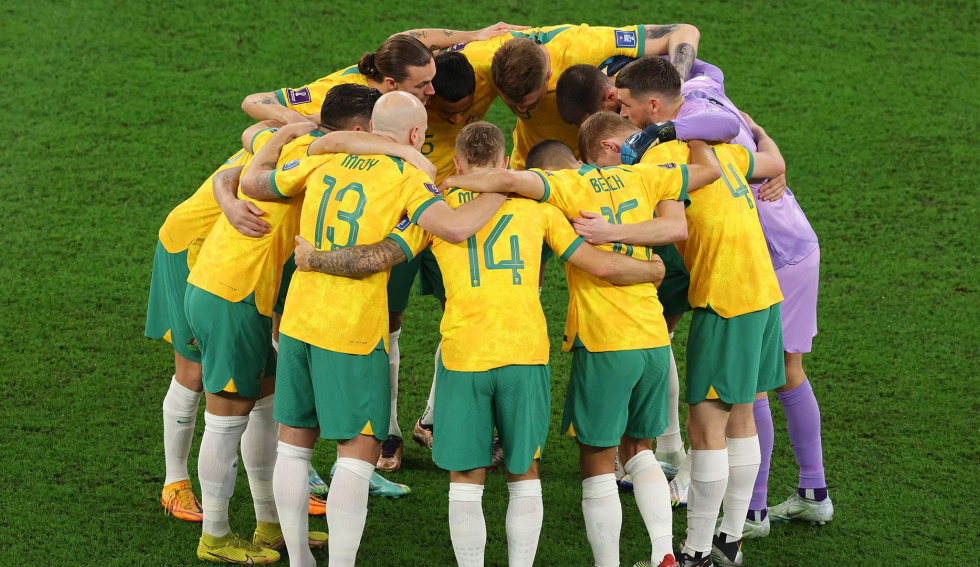
Before the men’s FIFA World Cup commenced, the Socceroos’ most noteworthy contribution seemed likely to be their pre-emptive video campaign on human rights[1] in host country Qatar.
The political debate receded somewhat once the action on the field kicked off. After losing[2] their opening game heavily to world champions France, the focus was set to be on the deficiencies of the team, coach and organisation of the game in Australia.
But unexpectedly, the Socceroos, ranked 38th in the world by FIFA, won two consecutive games for the first time in their World Cup history, and qualified for the knockout stages for the first time since 2006. There, they faced Lionel Messi’s Argentina, ranked 3rd in the world.
While their 2022 World Cup road then ended in an honourable 2-1 defeat[3], their historic run is a chance to reflect on the meaning of the Qatar experience for football in Australia, which has a troubled local history, as we look ahead to co-hosting the Women’s World Cup next year.
Taking on the world game
Those in Australia who only pay attention to football (or soccer) because of noisy World Cup intrusion tend to underestimate such effort and accomplishment.
The two biggest football codes in the country, Australian rules and rugby league, are far less globally significant. Australian rules is played professionally only in Australia, while rugby league is dominated by Australasia.
The recent Rugby League World Cup[4] in the UK saw the Australian men’s team win it for the 12th time in 16 attempts, while the women’s team have won the last three successive tournaments.
By contrast, the Socceroos have never come close to winning the football World Cup. This is unsurprising given FIFA has 211 affiliated national teams[5], compared to the International Rugby League’s[6] 34 with two pending.
After first qualifying in 1974 and losing all three games without scoring, Australia didn’t return to the FIFA World Cup for 32 years. Before Qatar, the Socceroos had won only two out of 13 World Cup games since 2006[7], conceding twice as many goals as they’d scored.
To win consecutive games in Qatar and progress to the last 16 for only the second time was impressive, especially as the current team consists mostly of “journeymen” and has no outright stars[8].
Being on the same pitch as superstars like Kylian Mbappé and Lionel Messi, both of whom scored against the Socceroos in Qatar, signalled both the scale of this achievement and the tough task ahead for a game with a troubled history[9] in Australia.
Multicultural stigma and football diplomacy
The late Socceroo and commentator Johnny Warren[10] observed that men’s football in Australia has been widely stigmatised as feminised, fey and foreign. This prejudice[11] sometimes resurfaces, especially when any cases of crowd disorder[12] generate tabloid headlines[13] about mob violence and old ethnic enmities being imported to Australia.
Ethnic community clubs have been the cradle of football[14] in Australia. But when football became fully professional in 2004, this contribution was actively repressed under its new regime, which was run by the mega-rich Frank Lowy at the urging of Prime Minister John Howard[15]. A condition of public funding was the “de-ethnicisation[16]” of the game, which included banning ethnic-related names, emblems and chants.
The attempted erasure of the local game’s cultural history and present[17] is at odds with its officially-sanctioned use in football diplomacy[18].
Australia left the small Oceania Football Confederation in 2006 for the bigger stage of its Asian[19] counterpart, the Asian Football Confederation. But the move had long been opposed[20] by some Asian nations. Australia was seen, especially in the Middle East, as an affluent agent of the West.
Ironically, Qatar comprehensively defeated Australia in FIFA’s now-discredited bidding process[21] for hosting the 2022 World Cup. A further irony is that in countering China’s ambitions in the region, Australia is enthusiastically using sports diplomacy[22] to mend fences with the same Pacific nations it previously abandoned in the football world.
Up next: co-hosting the FIFA Women’s World Cup
Still, following the Socceroos’ success in Qatar there will soon be plentiful opportunities for regional sports diplomacy when Australia and Aotearoa-New Zealand host the 2023 FIFA Women’s World Cup[23].
The Australian women’s soccer team, the Matildas, has a higher ranking in world football than the national men’s team – 13th compared to 38th.
Australia’s Sam Kerr[24] has a much higher global profile than any current Socceroo. She’s currently playing for London club Chelsea in the top division of women’s football in England, and has finished third in the women’s Ballon d'Or (the prize for the world’s best player) in both the last two years.
This World Cup will be the biggest sport event in Australia since the 2000 Sydney Olympics. It will also be a major indicator of the post-peak pandemic[25] resurgence of women’s sport and its challenge to traditional male domination.
Australia’s treatment of Aboriginal and Torres Strait Islander people, refugees, and the environment, among other major political issues, are likely to be subjected to increased global scrutiny.
The Socceroos earned respect for how they began and finished their 2022 World Cup campaign. But as I suspect Australia will discover in 2023, when it comes to hosting mega sport events, it’s not only illiberal countries like Qatar that feel the heat.
References
- ^ human rights (www.theguardian.com)
- ^ losing (euroweeklynews.com)
- ^ honourable 2-1 defeat (au.sports.yahoo.com)
- ^ Rugby League World Cup (www.rlwc2021.com)
- ^ national teams (www.fifa.com)
- ^ International Rugby League’s (www.intrl.sport)
- ^ since 2006 (www.sportingnews.com)
- ^ no outright stars (www.abc.net.au)
- ^ troubled history (www.joegorman.com.au)
- ^ Johnny Warren (www.penguin.com.au)
- ^ prejudice (www.routledge.com)
- ^ crowd disorder (www.tandfonline.com)
- ^ headlines (journals.sagepub.com)
- ^ the cradle of football (www.taylorfrancis.com)
- ^ John Howard (www.theage.com.au)
- ^ de-ethnicisation (opus.lib.uts.edu.au)
- ^ cultural history and present (www.tandfonline.com)
- ^ football diplomacy (www.lowyinstitute.org)
- ^ Asian (www.taylorfrancis.com)
- ^ opposed (www.manchesterhive.com)
- ^ bidding process (www.fairplaypublishing.com.au)
- ^ sports diplomacy (www.dfat.gov.au)
- ^ Women’s World Cup (www.fifa.com)
- ^ Sam Kerr (www.chelseafc.com)
- ^ post-peak pandemic (www.tandfonline.com)