the calculations already influencing next year’s NZ election
- Written by: Grant Duncan, Associate Professor, School of People, Environment and Planning, Massey University
Sometimes it feels as if election year has begun already.
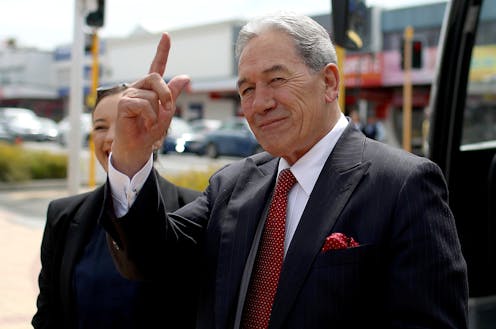
Winston Peters has declared New Zealand First won’t join a governing coalition[1] with Labour after the 2023 election. He wants to win back those who abandoned him in 2020 by effectively saying a vote for him isn’t a vote for another Labour-led government. But he didn’t explicitly back National either.
In reply, National leader Christopher Luxon was evasive but didn’t rule out[2] working with Peters. As in 2017, when Bill English led National, Luxon may be willing to negotiate. He may have to.
Though still under 5% in most opinion polls, New Zealand First does have a chance of returning to parliament next year. Peters will try to repeat the trick he pulled off in 2011: after winning no seats in 2008 and suffering a term in the wilderness, he asked voters to put him into opposition, not the Beehive. He achieved that goal with 6.6%.
Many voters will recall Peters explicitly ruled out National before the 1996 election and then formed a coalition with them anyway. So they may not take his present rejection of Labour very seriously. And anyway, the parties will do what they must to form a government, if they can.
Return of the kingmaker
What of other scenarios? Could Te Pāti Māori play a role in government, assuming they win at least one of the Māori electorates? Their Tiriti-centric vision makes them more compatible with the left-wing bloc, especially the Greens, but quite incompatible with both ACT and NZ First.
It looks unlikely, then, that the party could be the kingmaker, as they couldn’t play one side off against the other in a hung parliament. For now, the real jockeying is on the right.
National’s decision to review its tax-cut policies makes the party look more compatible with New Zealand First and less so with ACT. Spotting an opportunity to steal more National voters, ACT’s David Seymour taunted[3]: “We don’t need Labour with blue paint.”
Read more: Refusing to rule out working with Brian Tamaki, Luxon gives NZ’s populist right a ‘sniff of credibility’[4]
So, Peters has kicked off the game, but others are joining in. Parties to a pre-election coalition could make a written agreement, as Labour and the Greens[5] did in 2016. Or they could make an informal concession, as National does to allow ACT to win the Epsom electorate. Between the Labour-Green and National-ACT blocs it’s anyone’s race at this stage.
But what if neither team gets a majority of seats? Depending on final election results, a minority coalition could form a government if it has the support of another party (or parties) on confidence and supply votes. That could even mean a minor party abstains on motions of no confidence.
And it’s possible to have a neutral party on the cross-bench that agrees to support a minority government on confidence and supply only, takes no ministerial portfolios, and keeps its options open to vote with or against the government in the House. Could that be a role for New Zealand First?
The basic criterion for forming the government is that a prime minister-designate can assure the governor-general that they lead a party or coalition of parties that has the confidence of the House.
The bounce of the ball
And then there’s the rugby. Since 2011, prime ministers have normally announced the election date early in the year. New Zealand hosted the 2011 Rugby World Cup, so it made sense to clarify whether we’d go to the polls before or after that tournament, rather in the middle of it.
After the All Blacks won the final against France on October 23, it was straight into the election campaign. Polling day was November 26.
As it happens, the All Blacks and France will kick off the 2023 Rugby World Cup on the morning of September 9 (New Zealand time). The final is October 29 and the entire tournament will occupy a lot of media attention.
If the election dates set in 2014, 2017 and 2020 (before COVID intervened) are any guide, we’d expect the election to be on September 23. Fortunately, New Zealand doesn’t have a pool match scheduled around that day.
Read more: Labour makes it easier to change leaders, but Jacinda Ardern has no reason to go – yet[6]
The latest possible date for the next election is January 13 2024. And putting the election off again until November 25 to accommodate the World Cup final is well within the rules. But the final vote count and the government formation negotiations (which could be drawn out) would then come close to the Christmas break.
In any case, while wins and losses in major sporting events do affect people’s moods, there’s no consistent evidence[7] they affect support for incumbent parties. The choice of election date shouldn’t be seen as a bet on the All Blacks’ performance.
In 2020, the prime minister first announced polling day would be September 19. But a pandemic intervened, and the second lockdown meant some parties felt they’d be denied a free and fair campaign, so the whole thing was delayed by four weeks. The turnout, though, was relatively high. Labour won an outright majority and we knew on the night who’d form the government.
In 2023, there could be some weeks of negotiations before we know who’ll be prime minister. It’s not really over until the government’s sworn in. Between now and then, expect the unexpected.
References
- ^ won’t join a governing coalition (www.nzherald.co.nz)
- ^ didn’t rule out (www.newshub.co.nz)
- ^ David Seymour taunted (twitter.com)
- ^ Refusing to rule out working with Brian Tamaki, Luxon gives NZ’s populist right a ‘sniff of credibility’ (theconversation.com)
- ^ Labour and the Greens (www.rnz.co.nz)
- ^ Labour makes it easier to change leaders, but Jacinda Ardern has no reason to go – yet (theconversation.com)
- ^ no consistent evidence (www.cambridge.org)