Why has my cold dragged on so long? And how do I know when it's morphed into something more serious?
- Written by: David King, Senior Lecturer in General Practice, The University of Queensland

Common colds are caused by viruses. There are no effective cures, and antibiotics do not work on viruses, so treatment is targeted at managing the symptoms until your immune system has cleared the cold.
So why might someone go to a doctor at all for a cold?
Well, occasionally a cold might turn into something more serious requiring assessment and specific treatment, and a GP visit could be warranted. Or you may just want reassurance and advice.
Read more: Sore throats suck. Do throat lozenges help at all?[1]
Don’t rush to the GP for something totally normal
Problems arise when there too many unwarranted visits to GPs for cold symptoms.
Studies have shown antibiotics[4] are still prescribed widely[5] for viral colds, even though they don’t help, and this contributes to antibiotic resistance. It hastens the arrival of an era when many antibiotics simply don’t work at all.
On average, children have four to six colds[6] per year, while in adults the average is two to three[7].
Some people are more prone[8] to colds, but we don’t know exactly why.
The usual cold persists about one week, although 25% last two weeks. In one study[9] with 346 adults, the infection lasted 9.5 to 11 days.
Cold symptoms may last longer in younger children. One study[10] showed an average duration of colds ranged from 6.6 to 9 days. But symptoms lasted more than 15 days in 6.5% of 1-3 year old children in home care, and 13.1% of 2-3 year old children in day care.
A cough tends to last longer than other symptoms, and often beyond the actual viral infection. The average duration[11] of a cough is about 17.8 days.
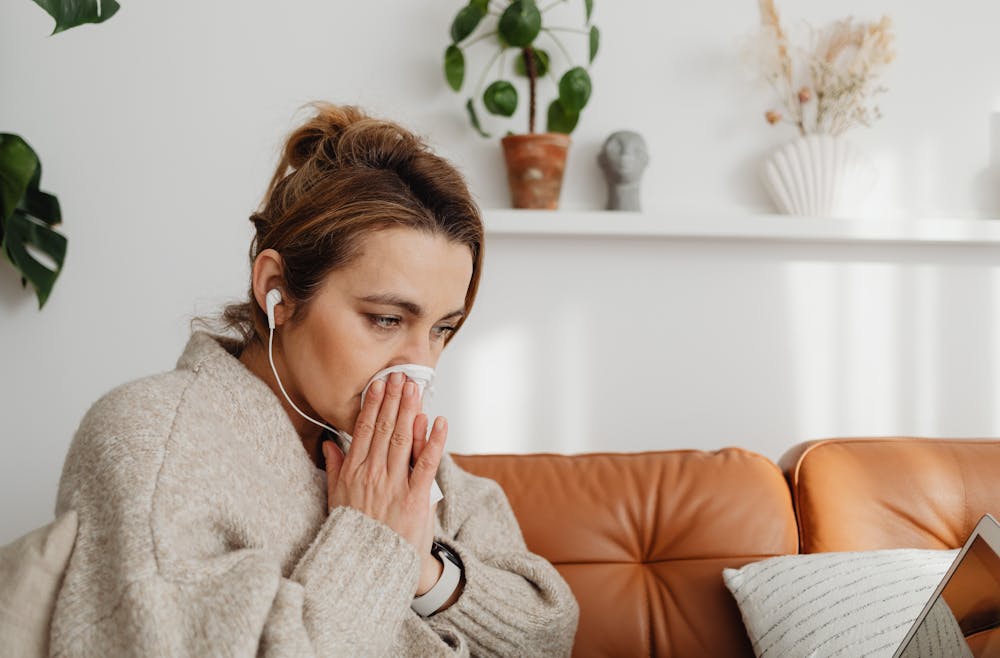
 A cough tends to last longer than other symptoms.
Photo by Edward Jenner/Pexels, CC BY[12][13]
A cough tends to last longer than other symptoms.
Photo by Edward Jenner/Pexels, CC BY[12][13]
Discoloured sputum, cough or snot
Discoloured mucus in snot or cough is a common trigger for requesting antibiotics from a GP. But as we know, antibiotics are useless against a virus. They only work against bacterial infection.
In fact, thick or coloured nasal mucus secretion is common following colds. Only a tiny proportion involve[14] bacterial infection.
When it happens, this is termed acute rhinosinusitis[15]. But antibiotics are not recommended unless it lasts more than ten to 14 days and there are signs[16] of bacterial sinusitis infection, such as:
- symptoms worsening after improvement in the original cold
- return of fever and
- strong facial pain.
A prolonged cough after colds is usually caused by an irritated throat or the clearing of sticky mucus coming down from the nose. The cough may sound moist (so wrongly called “chesty”) due to the phlegm, but only small amounts of phlegm are coughed up.
Yellow or green coloured mucus is often interpreted as a sign[17] of bacterial infection.
But yellow or green sputum alone does not[18] mean you have a serious bacterial infection. One study found being prescribed antibiotics under these circumstances failed[19] to shorten recovery time.
Nasal saline sprays and washes can be used to rinse out the nose and sinuses and possibly shorten[20] rhinosinusitis and cough after colds.
 A cold can make you feel rubbish for quite a while.
Photo by Pixabay, via Pexels, CC BY[21][22]
A cold can make you feel rubbish for quite a while.
Photo by Pixabay, via Pexels, CC BY[21][22]
Could it just be hayfever, or another underlying issue?
Hayfever or allergic rhinitis is a common cause for prolonged symptoms after a cold, especially cough and nasal congestion and maybe also sneezing.
The damage in the upper airways following a viral infection may allow airborne allergens to trigger hayfever. Self-medicating with antihistamines, nasal saline spray or intranasal steroids is worthwhile if allergic rhinitis[23] is suspected.
There may be other reasons for persistence of cough, such as exacerbation of underlying asthma or chronic lung disease. If so, this may require a visit to your GP.
What about bronchitis or pneumonia?
Many people worry about developing a chest infection after a cold.
Acute bronchitis is a self-limiting infectious disease characterised by acute cough with or without sputum but without signs of pneumonia[24] (such as high temperatures and feeling breathless). Most acute bronchitis cases are caused by viruses. Antibiotics are often prescribed, but produce no significant clinical improvement[25] compared with placebo, so are not recommended.
Pneumonia is a potentially serious secondary disease that may follow[26] an episode of flu in a small number of cases, but is relatively rare[27] following a cold. Symptoms and signs of pneumonia feature heavily in the list of warning signs that signal the need for a medical assessment.
 Sometimes, contacting your GP is a good idea.
Shutterstock
Sometimes, contacting your GP is a good idea.
Shutterstock
When should I seek medical help for a cough or a cold?
Contact a GP if you experience:
- shortness of breath or trouble breathing
- feeling faint or dizzy
- chest pain
- dehydration
- fever or cough symptoms that improve but then return or worsen
- worsening of chronic medical conditions such as asthma.
This is not a complete list, but may guide you on what to expect and what to watch out for.
You might also contact your GP (perhaps for a telehealth consult) if you are finding your symptoms very unpleasant, or are concerned your condition is more serious or prolonged than expected. You might just need reassurance and education about self care options.
Read more: Forget nose spray, good sex clears a stuffy nose just as effectively — and is a lot more fun[28]
References
- ^ Sore throats suck. Do throat lozenges help at all? (theconversation.com)
- ^ Photo by Karolina Grabowska/Pexels (www.pexels.com)
- ^ CC BY (creativecommons.org)
- ^ antibiotics (www.annfammed.org)
- ^ still prescribed widely (onlinelibrary.wiley.com)
- ^ four to six colds (www.ncbi.nlm.nih.gov)
- ^ two to three (www.ncbi.nlm.nih.gov)
- ^ prone (www.sciencedirect.com)
- ^ study (journals.asm.org)
- ^ study (publications.aap.org)
- ^ duration (www.annfammed.org)
- ^ Photo by Edward Jenner/Pexels (www.pexels.com)
- ^ CC BY (creativecommons.org)
- ^ involve (europepmc.org)
- ^ acute rhinosinusitis (www.nps.org.au)
- ^ signs (europepmc.org)
- ^ sign (theconversation.com)
- ^ does not (www.tandfonline.com)
- ^ failed (erj.ersjournals.com)
- ^ shorten (dtb.bmj.com)
- ^ Photo by Pixabay, via Pexels (www.pexels.com)
- ^ CC BY (creativecommons.org)
- ^ allergic rhinitis (theconversation.com)
- ^ signs of pneumonia (www.nhs.uk)
- ^ no significant clinical improvement (www.tandfonline.com)
- ^ may follow (pubmed.ncbi.nlm.nih.gov)
- ^ relatively rare (www.ncbi.nlm.nih.gov)
- ^ Forget nose spray, good sex clears a stuffy nose just as effectively — and is a lot more fun (theconversation.com)