From evolving colony to bicultural nation, Queen Elizabeth II walked a long road with Aotearoa New Zealand
- Written by: Katie Pickles, Professor of History, University of Canterbury
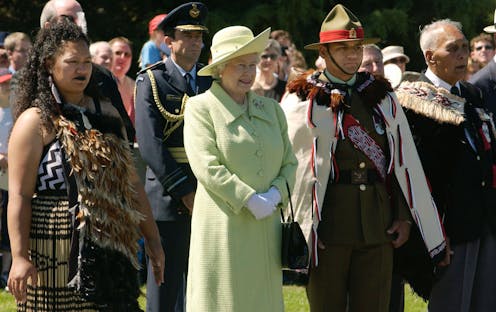
The death of Queen Elizabeth II brings to an end a long, complex and remarkable chapter in the history of Aotearoa New Zealand’s evolution from colony to independent, bicultural and multicultural nation.
Throughout that period, however, New Zealanders have generally admired and even loved the monarch herself, even if the institution she represented lay at the centre of a vexed, often traumatic, reckoning with the colonial past.
If there was a highpoint in New Zealand royalism, it was witnessed during the first visit by the young Queen and Duke of Edinburgh between December 23 1953 and January 30 1954. An estimated three in every four people turned out to see the royal couple in what historian Jock Phillips has called “the most elaborate and most whole-hearted public occasion in New Zealand history”.
After decades of economic depression and war, Elizabeth’s June 1953 coronation heralded an optimistic postwar atmosphere. Following the conquest of Mount Everest by Edmund Hillary and Tenzing Norgay – claimed as a jewel in the new Queen’s crown – the royal tour was the perfect moment for New Zealand to celebrate.
The Queen’s presence also fulfilled the long anticipated wish that a reigning British monarch would visit. War, then bad health, had previously dashed hopes for a tour by George VI.
Elizabeth II made a huge impression. She appeared as a youthful, radiant, even magical queen, one dedicated to serving her people. She charmed an older generation and embedded herself in the memories of the children who lined up to see her. They would all grow up to be, one way or another, “royal watchers”, aware of her reign and its milestones, keeping up with the lives of her children, their spouses and her grandchildren.
And then, less than 40 hours after her arrival, the young Queen’s leadership was put to the test when 151 people died in the Tangiwai rail disaster[1] on Christmas Eve. She visited survivors and included words of comfort in her speeches, cementing her connection to the grieving, and to the country.
The female crown
Remarkably, it was not until 2011 that females became equal to males in the rules of British royal succession. Queens only came to power in the absence of a male heir. And yet, this historical sexism also endowed queens with an exceptional quality – strong mother figures presiding over their subjects.
Indeed, in the past two centuries of the British monarchy, it is Queen Victoria (who reigned for almost 64 years) and Queen Elizabeth II (reigning for 70 years) who stand out as not just the longest-serving, but also most significant monarchs. Both played a crucial part in New Zealand’s history.
Read more: Queen Elizabeth II: the end of the 'new Elizabethan age'[2]
In my work as a historian I have argued that the politically conservative “female imperialism”, emblemised in the reigns of Victoria and Elizabeth, encouraged women to support the British Empire and Commonwealth. In turn, it helped raise women’s status in society.
For example, both queens inspired women to “take up their mantle” and work for empire and nation: often in maternal roles with children as teachers and nurses. The female crown encouraged citizenship based on British values, offering school prizes and support for migrants.
The young Elizabeth’s volunteer work during the second world war set an example for youth, as did her longtime role as patron of the Girl Guides. The gender-power of the Queen was already on display during the 1952-53 tour when she visited servicewomen, nurses and mothers with new babies, and was given presents for her own children.
Celebrity status
Over the past 70 years, the Queen also became something of a modern celebrity, a fixture in women’s magazines, on radio, television and now social media. As well as turning out to see her in person during her ten visits, New Zealanders “took her into their homes” with press clippings, souvenir pictures and keepsakes.
During that first tour, the New Zealand Woman’s Weekly pronounced upon the Queen’s role in the enduring relationship with Britain:
An even stronger link will be consolidated and spiritual stimulus given to life by the influence of one who is an inspiration to all.
She was described as “enchanting”, with her “exquisite complexion, her eyes like sapphires […] and her beautiful mobile mouth as she talked and smiled”. In 1963 she was “lovely” with “the breathtaking brilliance of [her] peacock silk outfit against the broad canvas of sea and sky”.
In 1970 she was “a fairytale Queen – a glittering image such as children visualise when they think of the word Queen”. In 1977, “The Queen is perfection”. On a 1986 visit she was reportedly closer and more familiar than ever, but at nearly 60 her “movements are inclined to be slower, her smile reflects more understanding than youthful sparkle […] and there were times when she looked as if she would rather kick off her shoes and have a cup of tea”.
By the 1980s, the glamour baton had passed to the next generation, notably the hugely popular Diana, Princess of Wales. Proving that royalty was not immune from modern life, three of the Queen’s four children divorced, most publicly and scandalously. Ironically (perhaps absurdly), there were accusations the Queen was out of touch with the times.
Relationship with a colony
As power devolved around the Commonwealth during the Queen’s reign, the relationship with New Zealand inevitably changed too. Notions of a settler colony of Anglo-Celtic descendants emulating a “superior” British imperial economy, politics and culture – with a distant monarch as head of state – became outmoded.
Most importantly, the colonisation and assimilation of Indigenous peoples were challenged.
As historian Michael Dawson has shown, Māori involvement was minimal at the 1950 Commonwealth Games in Auckland. There was no Māori welcome or presence in the opening or closing ceremonies, with only a musical performance as athletes and officials arrived in the country.
It was left to King Korokī and Te Puea Herangi to hold their own welcome for athletes at Ngāruawāhia. The prime minister of the day, Sidney Holland, attended and considered the event an excellent example of good race relations. But rather than Māori being partners in the planning of the first royal tour, they were largely expected to fit in, mostly providing entertainment.
In the original tour plans, Arawa were expected to represent all Māori during a lunch stop. Only when they asked for more time were plans changed. Meanwhile, the Kīngitanga had to lobby hard for the Queen to visit Ngāruawāhia. This eventually happened, with the Queen and Duke spontaneously deciding to spend more time there than had been allocated.
Importantly, through the Queen’s reign, the Crown’s role in redressing the past became an essential part of New Zealand’s post-colonial development. After much agitation, the Waitangi Tribunal was set up in 1975 to investigate Crown breaches of the Treaty of Waitangi.
In 1987, Māori became an official language. Rather than assimilating into a devolved settler state, decolonisation came to mean mana motuhake[3] for Māori.
By the 1974 Commonwealth Games – the “friendly games” – in Christchurch, Māori “were centrally incorporated” into the festivities, including a leading role in the opening ceremony. By the 1990 games in Auckland, also the 150th anniversary of signing of the Treaty, emerging biculturalism was evident in the medals incorporating Māori design.
Abandoning Britain?
In late 20th century New Zealand there were simmering republican sentiments. At the same time, because of the regenerating Iwi-Crown relationship under the Treaty, there was a reluctance to move away from Britain constitutionally.
Ironically, it was Britain going its own way – most notably by joining the EEC in 1973 – that moved the issue along. Symbolically, the number and length of temporary working visas for New Zealanders were cut back, despite an “OE” in the “mother country” being still viewed as a rite of passage.
There were other reasons republicanism was not a priority for the state. The shift towards a laissez-faire, free-market economic ideology shifted the ground; the move to a new electoral system in the 1990s underscored New Zealand’s growing independence.
Read more: What would King Charles mean for the monarchy, Australia and the republican movement?[4]
But through those decades of change, the popularity of the Queen provided a constant. If there was a moment when the republican break might have happened, it was missed. New Zealand has been more reticent than Australia, where a referendum on becoming a republic was only narrowly defeated in 1999.
New Zealand has also retired and then later reinstated the royal honours system. Attempts to change the flag and remove the Union Jack from its corner came to nothing in a 2016 referendum.
And New Zealand still doesn’t have its own constitution outlining its fundamental laws of government. Rather, we rely on a conglomerate constitution, messily located in 45 acts of parliament. And of course, the head of state remains a hereditary monarch who lives half a world away.
Aotearoa after Elizabeth
The Queen’s death presents another opportunity for New Zealand to reassess its nationhood – and perhaps be creative.
King Charles and the Queen Consort Camilla simply don’t have the appeal of Elizabeth II. But postcolonial Britain and the modern, diverse Commonwealth still have much to offer an increasingly multicultural New Zealand.
Read more: Prince Charles: the conventions that will stop him from meddling as King[5]
Most importantly, it is time for a broad conversation about how the various dymamics of contemporary Aotearoa New Zealand – liberal and egalitarian traditions, Pākeha settler notions of governance, Te Ao Māori, and the special Iwi-Crown connection – might work together in the future.
After all, Māori signed the Treaty with Queen Victoria at least in part as protection from the behaviour of unruly settlers. Does 21st-century New Zealand still need a monarch to protect against settler colonialism?
Whatever the answer, any move away from the Crown needs to honour the history of which Elizabeth II has been such a significant part.
References
- ^ Tangiwai rail disaster (nzhistory.govt.nz)
- ^ Queen Elizabeth II: the end of the 'new Elizabethan age' (theconversation.com)
- ^ mana motuhake (maoridictionary.co.nz)
- ^ What would King Charles mean for the monarchy, Australia and the republican movement? (theconversation.com)
- ^ Prince Charles: the conventions that will stop him from meddling as King (theconversation.com)