The Times Australia
Google AI
The Times World News

.

Amid death and destruction, the latest conflict in Gaza highlights the depths of its humanitarian crisis

  • Written by Amy Maguire, Associate Professor in Human Rights and International Law, University of Newcastle
Amid death and destruction, the latest conflict in Gaza highlights the depths of its humanitarian crisis

Israel launched multiple air strikes on Gaza on August 5, in another eruption of open warfare between Israel and Palestinian militants. The latest attacks come just over a year after hundreds were killed in an intense period of conflict[1] in the territory.

Israel announced[2] its missile strikes were targeting military leaders of the al-Quds Brigades, the military wing of the Islamic Jihad militant organisation in Gaza. Israel alleged Islamic Jihad forces were making “threatening movements” near the Israeli border.

Israel’s strikes killed[3] two key leaders of Islamic Jihad in Gaza and severely damaged its military capabilities.

Palestinian Islamic Jihad responded by launching hundreds of rockets into Israel. The Israel Defence Forces reported[4] its Iron Dome missile defence system was operating at a 97% success rate in intercepting rockets launched from Gaza. No Israelis had been killed or seriously injured.

But the past three days of intense conflict have extracted a very heavy civilian toll in Gaza. The Palestinian Health Ministry reports at least 44 dead and over 350 civilians wounded. Reportedly among the dead were 15 Palestinian children[5], including five boys killed by a missile strike as they visited their grandfather’s grave.

An Egyptian-brokered ceasefire[6] between Israel and Islamic Jihad has now begun. It is too early to say whether the ceasefire will hold, or for how long.

The Palestinian governing authority in Gaza is Hamas[7], which was elected in 2006. Hamas does not recognise the legitimacy of the Israeli state and aims to liberate Palestine through armed resistance. Yet Hamas has not engaged[8] in the most recent outbreak of warfare.

Blockaded Gaza in humanitarian crisis

The Gaza Strip[9] is a 365-square-kilometre territory that has been under Israeli control since 1967, along with the other Palestinian territories of the West Bank and East Jerusalem. Over 2 million Palestinians live in the densely populated territory. Nearly 80%[10] depend on aid[11] to survive.

Gaza has been under blockade[12] for 15 years. Israel controls its airspace and territorial waters, along with two of three border crossings (Egypt controls the third). Gaza is often referred to as “the world’s largest open-air prison”.

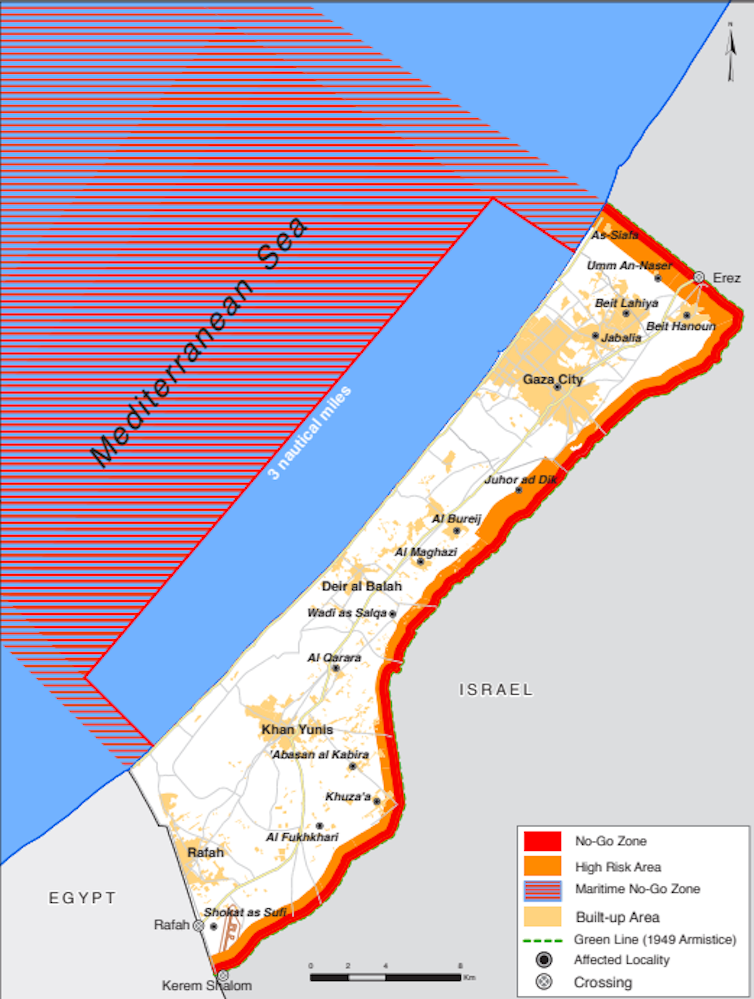
A map showing the Gaza Strip and the 1949 Armistice green line, as well as key cities, no-go zones and high-risk areas.
United Nations Office for the Co-ordination of Humanitarian Affairs Humanitarian organisations blame the blockade for the extreme humanitarian crisis in Gaza. Statistics tell a dire story of life in Gaza today: around two-thirds of the Palestinian population of Gaza are refugees[13], with over 500,000 living in eight refugee camps[14] across the Gaza Strip, in some of the highest population densities[15] in the world 97% of Gaza’s water is undrinkable[16], and contaminated water is poisoning people people in Gaza receive a daily average of 12 hours of electricity supply[17] and are subject to rolling power cuts healthcare[18] services in Gaza are in perpetual crisis, starved of power[19], vital equipment, staff and essential medicines 39% of patients needing specialist care in the West Bank or Israel were denied or delayed permission to leave[20] Gaza by Israel this year the unemployment rate[21] is 46.6%, and over 62% for young people four in five children in Gaza report[22] living with fear, grief and depression, often manifesting in self-harm tens of thousands are displaced within Gaza due to the bombardment and ruin of their homes[23]. What hope for a solution? The UN special rapporteur on human rights in the occupied Palestinian territories, Francesca Albanese, has called the latest Israeli strikes on the territory illegal and irresponsible[24]. Her predecessor, S. Michael Lynk, concluded earlier this year that Israel’s occupation of Palestine constitutes apartheid[25]. He accused the international community of failing to hold Israel to account for breaching fundamental international norms over its 55-year occupation, saying: For more than 40 years, the UN Security Council and General Assembly have stated in hundreds of resolutions that Israel’s annexation of occupied territory is unlawful, its construction of hundreds of Jewish settlements are illegal, and its denial of Palestinian self-determination breaches international law. The Council and the Assembly have repeatedly criticized Israel for defying their resolutions. They have threatened consequences. But no accountability has ever followed. If the international community had truly acted on its resolutions 40 or 30 years ago, we would not be talking about apartheid today. Israel’s most powerful ally, the United States, rejects such characterisations. In relation to the most recent warfare, the US ambassador to Israel, Tom Nides, tweeted: British Foreign Secretary Liz Truss echoed this position: There is no sign that the most recent outbreak of warfare has or will alter the status quo[26]. No peace process is operating to find durable solutions to the conflict. Recent years show no trend away from perpetual conflict[27] and entrenchment of positions anathema to a two-state solution for Palestine and Israel. For the people of Gaza, the stalemate becomes increasingly untenable every day.

References

  1. ^ intense period of conflict (www.bbc.com)
  2. ^ announced (www.washingtonpost.com)
  3. ^ killed (www.nytimes.com)
  4. ^ reported (www.timesofisrael.com)
  5. ^ 15 Palestinian children (www.middleeasteye.net)
  6. ^ ceasefire (www.aljazeera.com)
  7. ^ Hamas (www.cfr.org)
  8. ^ not engaged (apnews.com)
  9. ^ Gaza Strip (www.aljazeera.com)
  10. ^ Nearly 80% (www.unicef.org)
  11. ^ aid (reliefweb.int)
  12. ^ under blockade (www.un.org)
  13. ^ refugees (www.unrwa.org)
  14. ^ refugee camps (www.un.org)
  15. ^ highest population densities (www.unrwa.org)
  16. ^ undrinkable (www.trtworld.com)
  17. ^ electricity supply (www.ochaopt.org)
  18. ^ healthcare (www.map.org.uk)
  19. ^ power (www.nytimes.com)
  20. ^ permission to leave (www.ochaopt.org)
  21. ^ unemployment rate (reliefweb.int)
  22. ^ report (reliefweb.int)
  23. ^ their homes (www.reuters.com)
  24. ^ illegal and irresponsible (www.aljazeera.com)
  25. ^ apartheid (www.ohchr.org)
  26. ^ status quo (www.nytimes.com)
  27. ^ perpetual conflict (www.usip.org)

Read more https://theconversation.com/amid-death-and-destruction-the-latest-conflict-in-gaza-highlights-the-depths-of-its-humanitarian-crisis-188351

Times Magazine

AI is failing ‘Humanity’s Last Exam’. So what does that mean for machine intelligence?

How do you translate ancient Palmyrene script from a Roman tombstone? How many paired tendons ...

Does Cloud Accounting Provide Adequate Security for Australian Businesses?

Today, many Australian businesses rely on cloud accounting platforms to manage their finances. Bec...

Freak Weather Spikes ‘Allergic Disease’ and Eczema As Temperatures Dip

“Allergic disease” and eczema cases are spiking due to the current freak weather as the Bureau o...

IPECS Phone System in 2026: The Future of Smart Business Communication

By 2026, business communication is no longer just about making and receiving calls. It’s about speed...

With Nvidia’s second-best AI chips headed for China, the US shifts priorities from security to trade

This week, US President Donald Trump approved previously banned exports[1] of Nvidia’s powerful ...

Navman MiVue™ True 4K PRO Surround honest review

If you drive a car, you should have a dashcam. Need convincing? All I ask that you do is search fo...

The Times Features

What’s behind the surge in the price of gold and silver?

Gold and silver don’t usually move like meme stocks. They grind. They trend. They react to inflati...

State of Play: Nationals vs Liberals

The State of Play with the National Party and How Things Stand with the Liberal Party Australia’s...

SMEs face growing payroll challenges one year in on wage theft reforms

A year after wage theft reforms came into effect, Australian SMEs are confronting a new reality. P...

Evil Ray declares war on the sun

Australia's boldest sunscreen brand Australians love the sun. The sun doesn't love them back. Mela...

Resolutions for Renovations? What to do before renovating in 2026

Rolling into the New Year means many Aussies have fresh plans for their homes with renovat...

Designing an Eco Conscious Kitchen That Lasts

Sustainable kitchens are no longer a passing trend in Australia. They reflect a growing shift towa...

Why Sydney Entrepreneur Aleesha Naxakis is Trading the Boardroom for a Purpose-Driven Crown

Roselands local Aleesha Naxakis is on a mission to prove that life is a gift...

New Year, New Keys: 2026 Strategies for First Home Buyers

We are already over midway through January, and if 2025 was anything to go by, this year will be o...

How to get managers to say yes to flexible work arrangements, according to new research

In the modern workplace, flexible arrangements can be as important as salary[1] for some. For ma...