an offbeat and generous Australian director and writer
- Written by: Kirsten Stevens, Lecturer in Arts and Cultural Management, The University of Melbourne
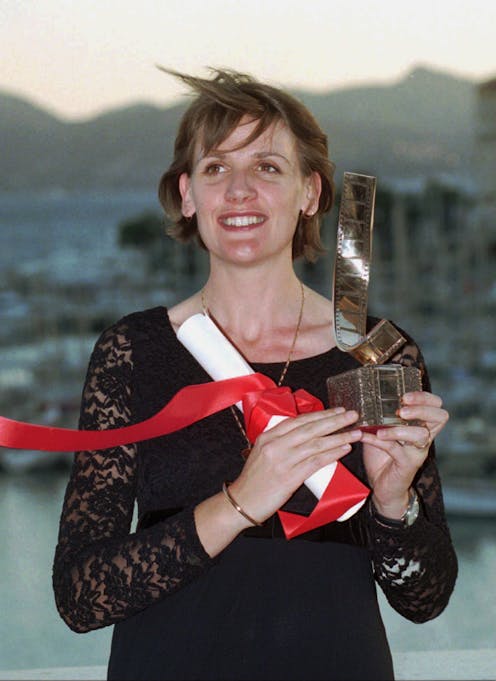
Australia, and the world, has lost a unique voice with the passing last week of acclaimed director and writer Shirley Barrett.
Barrett gained international fame in 1996 when she won the Caméra d’Or – Cannes Film Festival’s award for best first feature – for Love Serenade. Following growing global attention, by 1997 the New York Times[1] would celebrate her as “a pragmatic Australian with an offbeat take on the world.”
Barrett’s offbeat take infused her work[2], including two more films – Walk the Talk (2000) and South Solitary (2010) – recognisable television dramas such as Love My Way, Offspring and A Place to Call Home, and novels Rush Oh! and The Bus on Thursday.
Barrett passed away peacefully in her sleep at her home in Sydney at age 60, following a battle with metastatic breast cancer.
A social media post[3] from Barrett’s daughter Emmeline Norris confirmed the passing of her mother on Wednesday morning.
In the post, Norris marked the loss of
not only a brilliant filmmaker and writer, but more importantly a loving mother to me and my sister, the lifelong soulmate of our dad, and the best friend one could ask for.“
Exploring desire in wayward places
Barrett’s films presented a unique perspective on love, desire, and the workings of life at the margins – both social and geographic – of Australian society.
Between 1996 and 2010 Barrett wrote and directed three films, an accomplishment in the Australian industry where second features can be difficult to make[4] (especially for women).
From the isolated tedium of geographically remote settings of Love Serenade and South Solitary, and the more seedy fringes of fame on the RSL circuits of the Gold Coast in Walk the Talk, these films were marked by the power of their locations to shape the stories and desires of their characters.
Love Serenade, selected for Un Certain Regard[5] – the Cannes Film Festival’s program for exploring new cinematic horizons – highlights Barrett’s unique perspective on storytelling.
Celebrated for one of the most un-erotic stripteases[6] in cinema history, Love Serenade subtly subverted the conventions of the romantic comedy genre. The film follows sisters Vicki-Ann and Dimity Hurley, played by Rebecca Frith and Miranda Otto respectively, through their misguided seductions, and later disposal, of new-in-town Brisbane radio DJ Ken Sherry.
Far from indulging the expected love triangle and romantic tensions, the film instead focuses on the oppressiveness of the film’s setting: the middle-of-nowhere town of Sunray.
In this place, the sister’s desiring of Ken stands in for a wider set of longings; a "yearning for something else”, as Barrett described it[7].
Barrett would return to the themes of female desire and the power of (social) geography to shape it in her third feature, South Solitary, released in 2010. Again starring Otto, this time as the spinster niece of a lighthouse operator, South Solitary examined the lives of the tiny communities that tend the lighthouse islands in the Tasman Sea.
Diving into the archives to research the film, Barrett noted the appeal of this isolated setting where humans were forced to rely on unruly animals and even more unruly neighbours to survive.
there are fascinating accounts of tension that would quickly develop between people, in this setting, with nothing else to alleviate them. Things would often go badly awry.
South Solitary was more than simply a story about an isolated community, it was a film made by and for women. With a creative team mainly composed of women, Barrett would joke[9] it was “a film written for middle-aged women, by middle aged-women.”
Even today, such a description is considered a risky[10] proposition for a film’s success.
Read more: We're right to make a scene about gender equity in the Australian screen industry[11]
From the screen to the page
In 2014 Barrett released her first novel, Rush Oh!, with a backdrop telling the true story of a symbiotic relationship between a whaling town on the NSW south coast and a pod of killer whales, which aided the whalers’ work.
The story of Eden had begun life as a film script, developed through the years that Barrett worked on seeing South Solitary to the big screen. After languishing[12] as an unrealised project for several years, Barrett transformed the story into a book.
Following Rush Oh! Barrett would continue to write work for beyond the screen, releasing The Bus on Thursday in 2018 and drafting another manuscript over recent years.
Earlier this year Barrett wrote two articles for The Guardian about her experience with cancer and her terminal diagnosis.
By March[13], Barrett observed the strangeness of the passing of her last lychee season and the task of planning her funeral. She wrote, “it gets to a point where you just can’t do it any more, and I am at that point now. I just want to fade quietly into oblivion.”
Read more: 'I want to stare death in the eye': why dying inspires so many writers and artists[14]
A source of inspiration
In 2018 I was lucky enough to meet Shirley Barrett, when we screened Love Serenade as the opening night film of the Melbourne Women in Film Festival.
Barrett, alongside the film’s producer Jan Chapman and editor Denise Haratzis, introduced their film and spoke with audience members at the after-film party.
Although brief, this meeting had an impact on myself as well as many emerging filmmakers in the room. Barrett’s generosity of time and spirit were incredible gifts. Her passing has resulted in an outpouring of memories and grief from the people she encountered.
Barrett’s films and novels leave a legacy that lies in her unique perspective and engaging storytelling, and in her generosity as an artist to encourage and inspire.
References
- ^ New York Times (www.nytimes.com)
- ^ work (shirleybarrett.com)
- ^ social media post (twitter.com)
- ^ difficult to make (if.com.au)
- ^ Un Certain Regard (www.nytimes.com)
- ^ un-erotic stripteases (www.sensesofcinema.com)
- ^ Barrett described it (archive.org)
- ^ Barrett explained (www.academia.edu)
- ^ Barrett would joke (www.academia.edu)
- ^ considered a risky (seejane.org)
- ^ We're right to make a scene about gender equity in the Australian screen industry (theconversation.com)
- ^ languishing (www.smh.com.au)
- ^ By March (www.theguardian.com)
- ^ 'I want to stare death in the eye': why dying inspires so many writers and artists (theconversation.com)