This surgical procedure to impregnate greyhounds in Australia is a major animal welfare issue
- Written by: Sarah Pollard Williams, Adjunct lecturer, Charles Sturt University
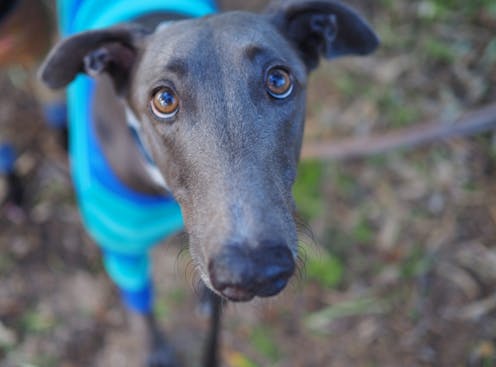
Greyhounds in Australia will continue to be impregnated via a procedure that’s illegal in other countries, after a provision to ban it was recently overturned in a New South Wales government bill[1].
This procedure, known as “surgical artificial insemination”, is unnecessary and unethical, as it is highly invasive and often painful[2] for dogs.
An estimated 80%[3] of greyhound breeding in the state involves surgical artificial insemination. The practice is legal throughout Australia.
The procedure is not only used in racing greyhounds, but also flat-faced breeds[4], such as the French bulldog. These dogs are physically challenged, with airway issues that place them at a higher risk for undergoing anaesthesia.
I am a veterinarian with over 30 years experience, with particular interest in welfare and ethics in animal ownership and veterinary practice. I believe this procedure is an animal welfare issue and must not continue, especially when safer alternatives are available.
What is surgical artificial insemination?
Surgical artificial insemination involves anaesthetising a female dog at the time of ovulation and incising her abdomen. The surgeon locates her uterus in order to inject semen, before returning the uterus to the abdomen.
It is not to be confused with “artificial insemination”, a safer procedure used around the world, including in humans. In most cases, it involves the relatively benign deposition of sperm into the uterus through the vagina and cervix (called “transcervical insemination”).
The proposal to prohibit surgical artificial insemination was contained in an early draft of the Animal Welfare Bill 2022, after two rounds of public consultation.

Steep opposition to the ban followed, such as from the NSW greyhound racing industry[5]. The NSW government confirmed to The Conversation that after receiving further feedback, the provision will not be included[6] in the final version of the Animal Welfare Bill.
It pointed to a different law[7] that already regulates artificial insemination of racing greyhounds. This requires that surgical artificial insemination can only be performed by a veterinarian using general anaesthetic, with appropriate pain relief during and post-surgery.
But this is only a minimal concession, given major procedures on animals are performed by veterinary surgeons as regulated by state veterinary boards.
Read more: Greyhound racing: despite waning public support, governments are spending big to keep the industry running[8]
Many veterinary surgeons oppose it
Surgical artificial insemination has been under scrutiny in Europe for over a decade. The ethical issues stem from the fact the dogs undergo a highly invasive surgery to ensure pregnancy, presenting an unacceptable level of risk for dogs.
A British paper from 2008[9] suggested using an ethical matrix[10] to assess reproductive intervention in dogs. An ethical matrix is a tool that integrates values from those with different opinions in order to make a major decision.
More recently, a European survey[11] of 83 veterinary surgeons in 2022 found 80% working in assisted reproduction in dogs felt significant ethical conflict related to the practices some breeders requested. Over 62% stated that surgical insemination is not ethical.
Read more: New South Wales overturns greyhound ban: a win for the industry, but a massive loss for the dogs[12]
The United Kingdom banned the procedure in 2019[13], as have Norway, Sweden and the Netherlands.
There are additional risks from the surgery for greyhounds, in particular. Greyhounds are often at slightly more risk for general anaesthetic than most other dog breeds, as the anaesthetic effects last longer.
They are also at a greater risk of blood clotting failure[14] if there’s a minor surgical bleed related to the procedure. This is due to a breed-related tendency to break down clots quickly in the body.
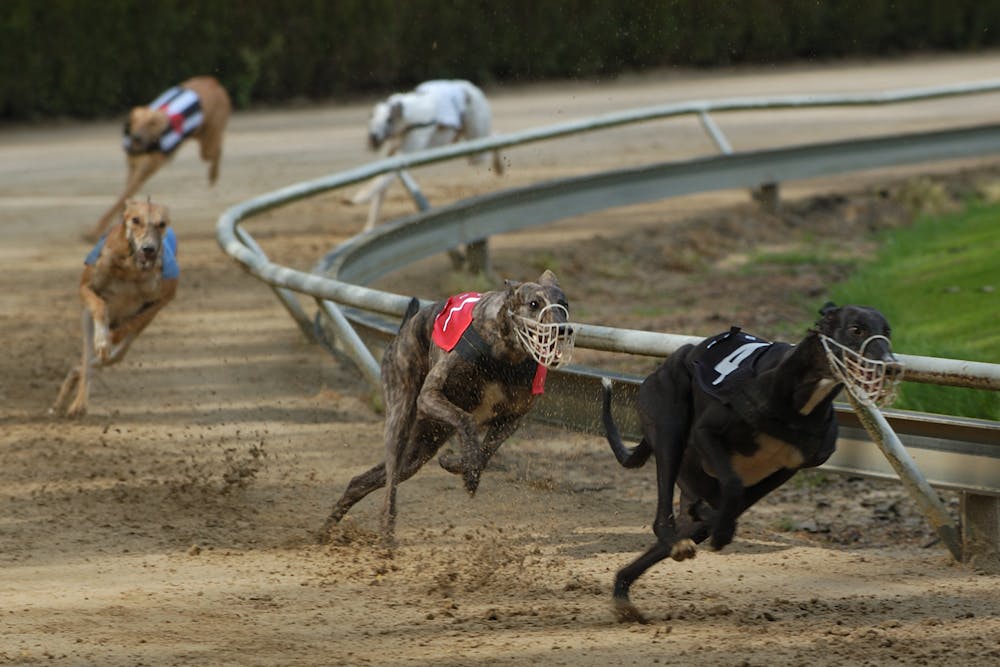 The greyhound racing industry in Australia uses surgical artificial insemination.
Shutterstock
The greyhound racing industry in Australia uses surgical artificial insemination.
Shutterstock
A safer, effective alternative
One reason surgical artificial insemination is so widely used is because it supposedly leads to multiple large litters. But there are alternative methods that are far safer for greyhounds and give good, if not better, results.
In particular, many specialists in veterinary reproduction advocate for transcervical insemination as the most effective way of inseminating a greyhound. This method of insemination is widely used worldwide, and occurs via a vaginal and cervical catheter.
It can be done in a matter of minutes with the dog fully conscious, avoiding the risks associated with general anaesthesia and open abdominal surgery.
A letter[15] from veterinary reproductive specialists to the Australian Veterinary Journal last year argued that surgical artificial insemination should cease in Australia, with transcervical insemination used instead.
As they write, it’s important for veterinary surgeons to “protect the deservedly attained privilege to be the guardians of animal health and welfare”.
Read more: To pat or not to pat? How to keep interactions between kids and dogs safe[16]
Numerous reports have shown transcervical insemination is as productive as surgical artificial insemination, especially when using frozen-thawed semen.
In particular, a nine-year study[17] from New Zealand on 1,146 dogs objectively concluded that there is “no difference in whelping rate” after either transcervical insemination or surgical artificial insemination. Another scientific paper[18] from 2018 also confirmed that the risk to the dog is far lower.
If surgical artificial insemination continues to be used despite the evidence, welfare and ethical viewpoints that render it redundant, Australia’s standard of animal welfare will stay disastrously and embarrassingly low.
References
- ^ bill (www.dpi.nsw.gov.au)
- ^ often painful (kb.rspca.org.au)
- ^ estimated 80% (www.grnsw.com.au)
- ^ flat-faced breeds (www.parliament.nsw.gov.au)
- ^ NSW greyhound racing industry (www.parliament.nsw.gov.au)
- ^ will not be included (www.grnsw.com.au)
- ^ different law (legislation.nsw.gov.au)
- ^ Greyhound racing: despite waning public support, governments are spending big to keep the industry running (theconversation.com)
- ^ paper from 2008 (onlinelibrary.wiley.com)
- ^ ethical matrix (press-files.anu.edu.au)
- ^ European survey (pubmed.ncbi.nlm.nih.gov)
- ^ New South Wales overturns greyhound ban: a win for the industry, but a massive loss for the dogs (theconversation.com)
- ^ in 2019 (www.rcvs.org.uk)
- ^ blood clotting failure (onlinelibrary.wiley.com)
- ^ A letter (pubmed.ncbi.nlm.nih.gov)
- ^ To pat or not to pat? How to keep interactions between kids and dogs safe (theconversation.com)
- ^ a nine-year study (pubmed.ncbi.nlm.nih.gov)
- ^ scientific paper (www.sciencedirect.com)