The Times Australia
Google AI
The Times World News

.

When can I get my next COVID booster or fourth dose? What if I've recently had COVID? Can I get my flu shot at the same time?

  • Written by Jack Feehan, Research Officer - Immunology and Translational Research, Victoria University

When can I get my next COVID booster or fourth dose? What if I've recently had COVID? Can I get my flu shot at the same time?

COVID cases are surging across Australia. The rise of the BA.4 and BA.5 sub-variants of Omicron, and the rapid increase in COVID hospitalisations[1], has prompted policymakers to expand fourth dose vaccine[2] eligibility.

If you’re aged 30 or over, you can now receive an additional COVID booster (a fourth dose), three months after your first booster (third dose). And you can get it at the same time[3] as your flu shot.

If you’ve recently had COVID, you’ll need to wait three months before getting boosted.

If you’re aged under 30, you’re not yet eligible.

Read more: Access to a second COVID booster vaccine has been expanded to people 30 years and over[4]

New variants present new challenges

The current COVID vaccines are based on the original strain of SARS-CoV-2, the virus that causes COVID. The more mutations the variants amass, the less the antibodies produced by vaccination can target it.

In the context of the BA.4 and BA.5 variants, this is exacerbated further, as even immunity from previous Omicron infection is less effective at protecting against future infections. This makes it possible for people with so called “hybrid” immunity – from vaccines and infection – to be re-infected[5].

This has driven the government to revise the timeframes[6] around post-infectious immunity, as we are likely to see significant numbers of people reinfected[7] after only a short period of time.

Immunity wanes after your third dose

Immunity provided by COVID vaccines diminishes over time. A third dose of vaccine provides good initial protection against Omicron. But immunity wanes after three to six months[8], meaning it’s less able to prevent infection.

Protection against severe disease remains stronger[9] but still reduces slowly over time.

Waning immunity from vaccination is a particular concern for those aged over 55, as immunity in older age groups decreases faster[10] and further.

Protection from a fourth dose

Given neither three doses nor infection appears to offer significant protection[11] against BA.4 and BA.5, a fourth dose is the best way to prevent infection and severe disease, as well as helping to manage health system demand.

Initial data from Israel, which has been very aggressive in its roll out of additional doses, shows[12] rates of Omicron infection and severe disease are lower after a fourth dose, compared with after three doses.

The protection against infection decreased rapidly, however. After six weeks, it had diminished, but still offered some protection. Importantly, protection against severe disease did not decrease over the six-week study period.

Israelis in masks get on and off a train
Israel has led the world in distributing fourth doses. Shutterstock[13]

As yet, there is no evidence available on the direct effects of a fourth vaccine dose on BA.4 and BA.5, (as the Isaeli study covered the original Omicron variant). A first booster (third dose) has been shown in preliminary data to generate immunity against the new variants, but it waned rapidly[14].

Based on this data, and the ongoing excellent safety profile of the vaccines, Australia’s immunisation advisory group, ATAGI, recommends[15] Australians aged over 50 receive a fourth dose over winter. They join the existing eligible groups[16]: immunocompromised adults, those living in care facilities, and adults with chronic or complex health conditions.

ATAGI has also authorised the vaccine to be given to those from 30-49, as it is safe and likely to be effective. However, it notes the benefits in this cohort[17], on a population level, are less certain. People in this age bracket are advised to consider personal circumstances when deciding whether to get a second booster – such as vulnerable people around them and occupations where they are at high risk of contracting or transmitting disease, such as aged care or hospitality.

Read more: Here's why you might need a 4th COVID vaccine dose this winter[18]

When should I get it?

The best time to get your fourth dose is as soon as you’re eligible and able to, as COVID case numbers are currently rising across Australia.
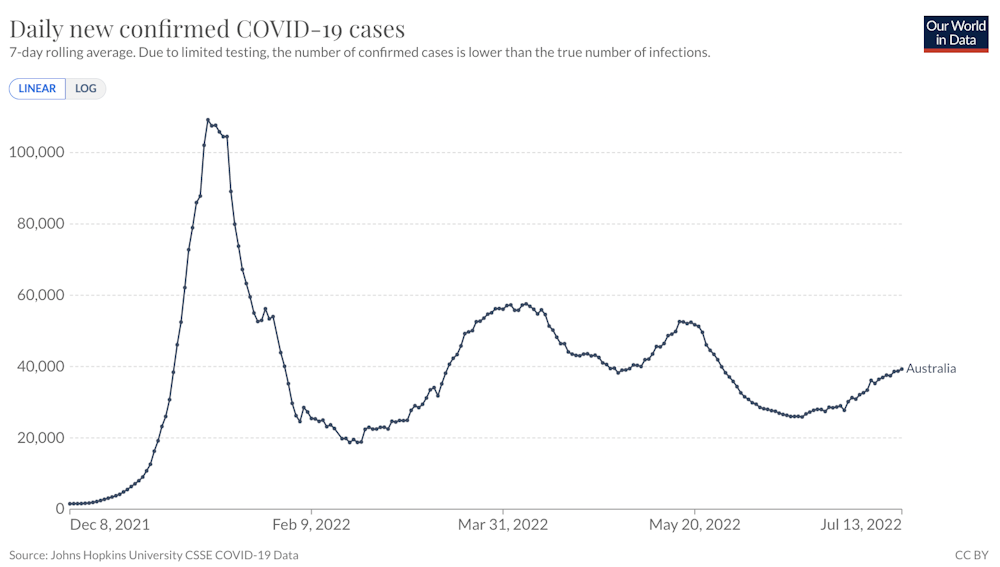
Our World in Data[19] Don’t wait to get a booster so you’re better protected at the end of winter. This may lead to a more rapid community spread in the meantime, and blunt the impact of the booster campaign. The infection risk is already high, making rapid action more important, particularly for those over 50, whose immunity from boosters administered in 2021 is already significantly diminished. Being vaccinated now will confer at least some immunity[20] throughout winter. What if I’ve recently had COVID? If you have recently had COVID, you need to wait at least three months[21] before receiving a fourth dose. In this period, immunity is likely to be similar or greater than those who have been vaccinated, so you are still protected to a degree, but it’s possible to be infected. Once the three months have passed, you can, and should, get a booster, as reinfection rates[22] with BA.4 and BA.5 are high. What about the flu? The 2022 influenza season in Australia[23] has been a particularly bad one thus far. The good news is that you can safely receive both[24] the COVID and flu vaccines together – at the same time. Decreasing rates of the flu in the community will relieve significant pressure on a health care system already stretched by COVID, making it a strong priority. Read more: Flu may be back, but COVID is far from over. How do they compare?[25] References^ COVID hospitalisations (www.covid19data.com.au)^ expand fourth dose vaccine (www.health.gov.au)^ same time (www.health.gov.au)^ Access to a second COVID booster vaccine has been expanded to people 30 years and over (theconversation.com)^ be re-infected (www.nature.com)^ revise the timeframes (www.ecdc.europa.eu)^ reinfected (theconversation.com)^ three to six months (www.cdc.gov)^ remains stronger (www.cdc.gov)^ decreases faster (www.thelancet.com)^ protection (www.nature.com)^ shows (www.nejm.org)^ Shutterstock (www.shutterstock.com)^ but it waned rapidly (www.nejm.org)^ recommends (www.health.gov.au)^ existing eligible groups (www.health.gov.au)^ benefits in this cohort (www.health.gov.au)^ Here's why you might need a 4th COVID vaccine dose this winter (theconversation.com)^ Our World in Data (ourworldindata.org)^ least some immunity (www.nejm.org)^ at least three months (www.health.gov.au)^ as reinfection rates (www.ecdc.europa.eu)^ 2022 influenza season in Australia (hudson.org.au)^ can safely receive both (www.thelancet.com)^ Flu may be back, but COVID is far from over. How do they compare? (theconversation.com)

Read more https://theconversation.com/when-can-i-get-my-next-covid-booster-or-fourth-dose-what-if-ive-recently-had-covid-can-i-get-my-flu-shot-at-the-same-time-186830

Times Magazine

Australia’s electric vehicle surge — EVs and hybrids hit record levels

Australians are increasingly embracing electric and hybrid cars, with 2025 shaping up as the str...

Tim Ayres on the AI rollout’s looming ‘bumps and glitches’

The federal government released its National AI Strategy[1] this week, confirming it has dropped...

Seven in Ten Australian Workers Say Employers Are Failing to Prepare Them for AI Future

As artificial intelligence (AI) accelerates across industries, a growing number of Australian work...

Mapping for Trucks: More Than Directions, It’s Optimisation

Daniel Antonello, General Manager Oceania, HERE Technologies At the end of June this year, Hampden ...

Can bigger-is-better ‘scaling laws’ keep AI improving forever? History says we can’t be too sure

OpenAI chief executive Sam Altman – perhaps the most prominent face of the artificial intellig...

A backlash against AI imagery in ads may have begun as brands promote ‘human-made’

In a wave of new ads, brands like Heineken, Polaroid and Cadbury have started hating on artifici...

The Times Features

Groundbreaking Trial: Fish Oil Slashes Heart Complications in Dialysis Patients

A significant development for patients undergoing dialysis for kidney failure—a group with an except...

Worried after sunscreen recalls? Here’s how to choose a safe one

Most of us know sunscreen is a key way[1] to protect areas of our skin not easily covered by c...

Buying a property soon? What predictions are out there for mortgage interest rates?

As Australians eye the property market, one of the biggest questions is where mortgage interest ...

Last-Minute Christmas Holiday Ideas for Sydney Families

Perfect escapes you can still book — without blowing the budget or travelling too far Christmas...

98 Lygon St Melbourne’s New Mediterranean Hideaway

Brunswick East has just picked up a serious summer upgrade. Neighbourhood favourite 98 Lygon St B...

How Australians can stay healthier for longer

Australians face a decade of poor health unless they close the gap between living longer and sta...

The Origin of Human Life — Is Intelligent Design Worth Taking Seriously?

For more than a century, the debate about how human life began has been framed as a binary: evol...

The way Australia produces food is unique. Our updated dietary guidelines have to recognise this

You might know Australia’s dietary guidelines[1] from the famous infographics[2] showing the typ...

Why a Holiday or Short Break in the Noosa Region Is an Ideal Getaway

Few Australian destinations capture the imagination quite like Noosa. With its calm turquoise ba...