Hip flexors get weak when we sit too much – but simple stretches and strengthening exercises can leave you less stiff
- Written by: Andrew Lavender, Senior Lecturer, Institute of Health and Wellbeing, Federation University Australia
I am sure you’ve been told you should stand up and move away from your work stations or use a standing desk where possible. One of the major benefits of doing this is to activate and stretch the hip flexor area.
But what are the hip flexors, and why are they so important – and what happens if we let them get weak and stiff?
Read more: Why do I grunt when I bend over?[1]
What are hip flexors?
Hip flexors are the powerful muscles located at the front of your hip. They include:
-
the psoas major and psoas minor, which connect the femur to the spine, and
-
the iliacus, which runs from the pelvis to the femur.
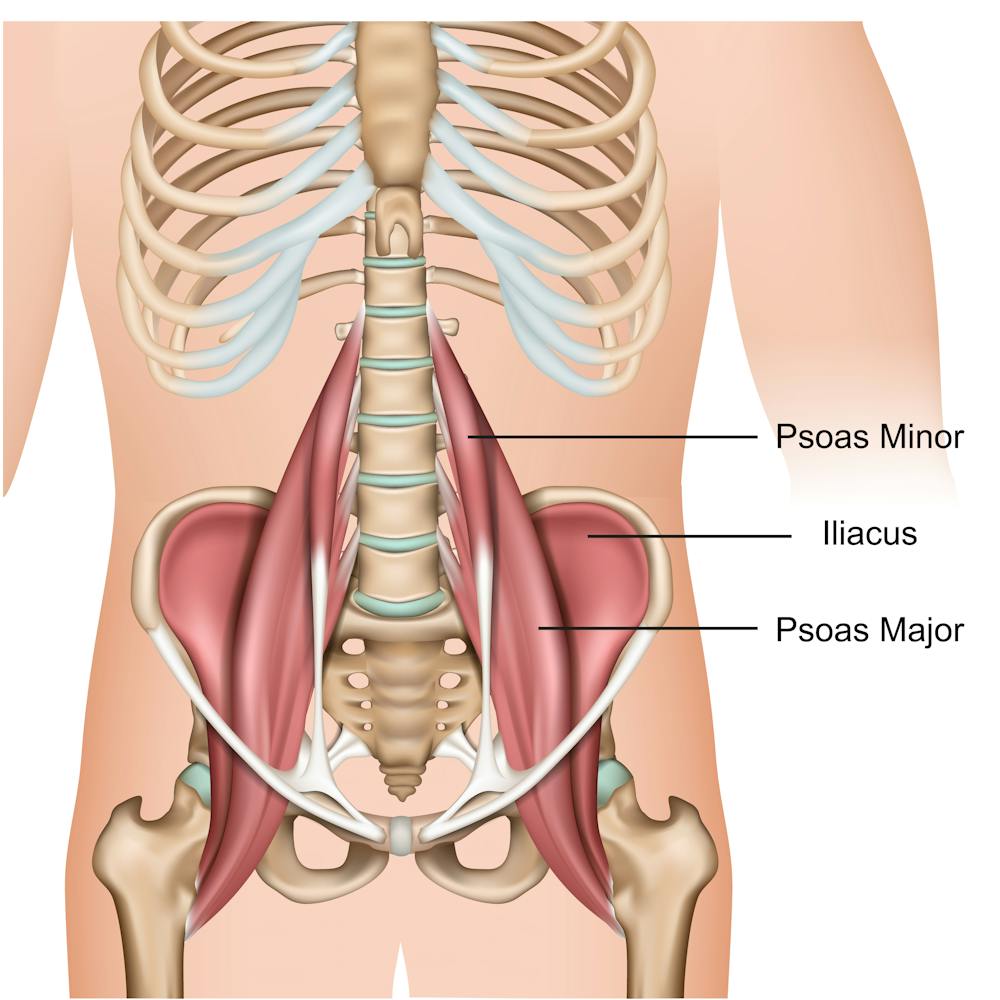
Hip flexors are activated when you draw your knee towards your chest. They are important for walking and running.
They’re also very important in sport, as they flex the hip, and work with the quadraceps to extend your knee when you need to sprint or kick.
An athlete with an injured hip flexor will have great difficulty running or kicking.
The hip flexors also work with the glutes and other muscles of the torso to stabilise the spine – which makes them important for posture.
What happens when they’re weak or stiff?
Weak hip flexors may make climbing stairs, running or even walking on a flat surface difficult or painful. It can also can cause other muscles in the area to work hard to compensate. This changes your gait (the way you walk).
Tight hip flexors can make walking and standing difficult because they pull your spine down. This makes you lean forward, which puts strain on your lower back muscles (which work in opposition to keep you upright).
An imbalance between the hip flexors and the opposing muscles pulling your torso in the opposite direction can lead to lower back pain.
Tight hip flexors can reduce the range of motion of the knee. This can result in a stiff knee gait, where the knee doesn’t bend as much as it should. After some time, it can lead to knee pain.
All in all, weak or tight hip flexors can cause your joints or muscles to function in an abnormal way and this can lead to injury.
How can I keep my hip flexors in good shape?
As with all muscles, hip flexors lose strength and mass through lack of exercise.
Another contributing factor is sitting for long periods, which keeps the psoas muscles relaxed in a shortened position for a long time.
This is particularly important for those of us who spend long periods seated at a work desk, and is why many health-care professionals advise taking a break from sitting or opting for a standing desk.
Hip flexors should be kept both flexible and strong.
Stretching exercises to improve flexibility of the hip flexors include:
-
lying on your side and pulling one foot to your butt, while keeping your knees close together
-
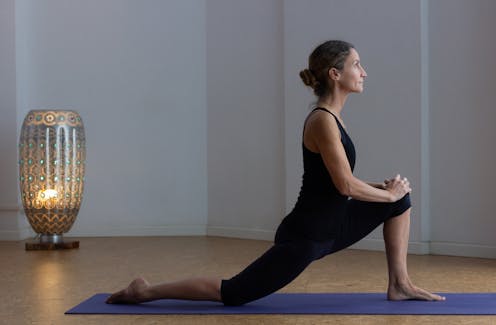
stepping forward into a lunge, going as low as you can while keeping your torso upright.
Both should cause you to feel the stretch along the front of your upper thigh.
Stretches should be held for about 30 seconds and repeated two to three times each side. They can be done daily or at least three times weekly to gradually improve flexibility.
If you work at a desk for long periods, try to do some stretching in short breaks during the day.
To strengthen the hip flexors you can lie face up on the floor and do straight leg raises[2] (one leg at a time), while keeping your arms on the floor alongside your torso.
This takes the strain off your lower back and is easier to do one at a time to start with.
Another great hip flexor exercise is called mountain climbers[3]. For this exercise, take the push-up position and bring one leg at a time to your chest. This can be done slowly to begin with, or quickly as you gain strength and fitness.
Strong and flexible hip flexors
So, hip flexors are relatively easy to train. If you are doing any exercise at all you are likely already keeping your hip flexors strong and flexible.
If you are not exercising, the exercises mentioned earlier will give you a place to start.
Combine these with gentle stretches of other muscle groups and some aerobic exercise like walking, jogging, cycling or swimming.
Remember to start gently and gradually increase the intensity, duration and frequency of sessions.
Failure to look after your hip flexors can lead to an altered gait, posture problems, injury and back pain.
Read more: Core strength: why is it important and how do you maintain it?[4]
References
- ^ Why do I grunt when I bend over? (theconversation.com)
- ^ straight leg raises (www.youtube.com)
- ^ mountain climbers (www.youtube.com)
- ^ Core strength: why is it important and how do you maintain it? (theconversation.com)