Could more online learning help fix Australia's teacher shortage?
- Written by: Ken Purnell, Professor of Education, CQUniversity Australia
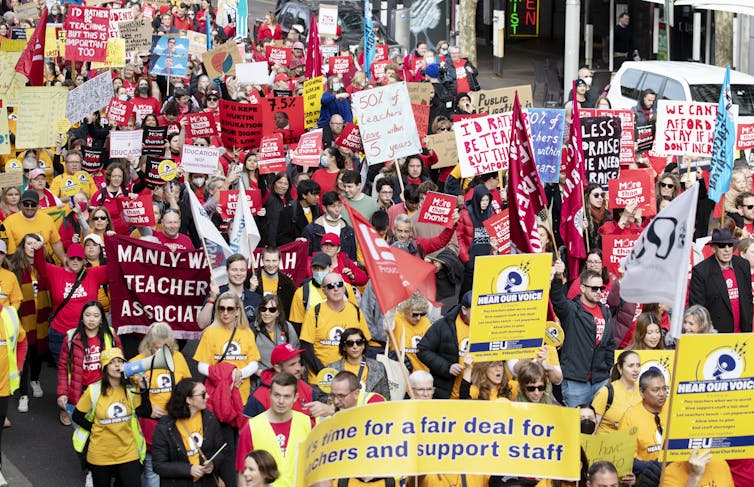
On Thursday, thousands of teachers[1] went on strike in New South Wales, over pay and “unsustainable[2]” workloads.
This comes amid increasing concerns about teacher shortages[3] around Australia.
The federal government has suggested enticing high-performing students into teaching degrees with extra payments[4], while education experts say teachers need more time, more pay and more support to do their jobs.
Read more: Read the room, Premier. Performance pay for teachers will make the crisis worse[5]
One option that could free up teacher time, and ensure students are getting the education they need, is “blended” learning, in which some learning is done online and some face-to-face. We know this can work in other settings – at the university level, I have three decades of expertise in remote and blended learning, with many thousands of students across several subjects at the undergraduate and postgraduate levels.
The crisis
The established norm in Australian schools is one teacher for every 25 students, with learning done face-to-face in a classroom, five days a week.
But a growing shortage in teacher numbers means we may no longer be able to accept this as the norm. According to a recent Monash University study[6], 59% of surveyed primary and secondary teachers said they intended to leave the profession. Heavy workloads, and health and well-being issues, were among the key reasons given for their responses.
Blended learning involves a mix of traditional face-to-face learning with remote learning. That online element may be done anywhere, such as at school, at home, or in small groups.
COVID meant remote learning hit the headlines worldwide, but it has already been happening behind the scenes for some time, particularly in remote areas in Australia through distance schools.
When learning is done remotely it still needs quality teachers. Unlike university students, school students need significant support to help them learn. Teachers need to know their students and design lessons specific to their context, whether it be in inner-city Sydney or remote Arnhem Land.
The COVID silver lining
Any teacher or parent will tell you COVID rapidly changed the way school was structured and learning was delivered.
Despite the stress of this time, the pandemic showed us it was possible to teach students online, and that despite the well-publicised challenges[7] of home learning, there were some advantages. This was the case when when remote learning is planned and delivered to a high standard, enabling students to use technologies they like.
Read more: Remote learning was even tougher for migrant parents. Here’s what they want schools to know in case lockdowns return[8]
As the World Bank recently found[9], COVID created many opportunities for “reimagining how education can be offered and enriched”.
One of my education colleagues likes to cite the example of a Rockhampton 12-year-old, who had four people who helped her learn in March 2020 when the pandemic began in Australia. This included teachers and friends.
That group became 35 during the next year, with other classmates, parents, grandparents, and other similar-aged students in her school. Her literacy, numeracy, technology and social skills skyrocketed, along with her well-being. This was a direct result of the required remote learning, as the student sought assistance from others and it soon became a snowballing effect.
This can work for all year levels
Senior educators in Queensland have told me up to a quarter of the curriculum content may be best taught online. That is for all year levels and especially from year 4 onwards, and includes basic knowledge and skills in most subject areas.
Teachers reported that students’ learning could be more personalised online. Students who have the capability to go quickly can do so – and not be bored. Students who need more time can take it.
It can also be used to facilitate peer-to-peer learning and group-based activities in ways not easily done in traditional classroom settings. This includes collaborative projects using things such as shared Google docs and educational video games.
Achievements in that learning can be assessed in the online environment using high-quality techniques that involve automated marking as well as some teacher judgements.
That has the added benefit of freeing up some teacher time with fewer face-to-face contact hours but not adding to the work of parents.
However, it does mean all students doing part of their school work by remote learning will have to have good access to a computer or tablet with good internet connection. And while that is generally the case already, some students did not have that during lockdowns and some schools need to ensure such access as they did in the online NAPLAN tests in May[10].
Lets re-imagine schools
A hybrid model will only benefit students and teachers if it set up properly.
In its assessment[11] of COVID learning at home, the World Bank found remote learning needed to have suitable technology, targeted professional development for teachers and make sure students are engaged.
Under a new, hybrid model, Australian schools would still use face-to-face when most appropriate and remote networked learning when that is most appropriate. That can free up teaching and physical resources (such as classroom space) and potentially improve student learning and teacher well-being.
As the teacher shortage continues, we need to think creatively and use existing models we have already seen work.
References
- ^ thousands of teachers (www.abc.net.au)
- ^ unsustainable (www.news.com.au)
- ^ teacher shortages (theconversation.com)
- ^ extra payments (theconversation.com)
- ^ Read the room, Premier. Performance pay for teachers will make the crisis worse (theconversation.com)
- ^ Monash University study (theconversation.com)
- ^ well-publicised challenges (journals.sagepub.com)
- ^ Remote learning was even tougher for migrant parents. Here’s what they want schools to know in case lockdowns return (theconversation.com)
- ^ recently found (documents1.worldbank.org)
- ^ online NAPLAN tests in May (www.theeducatoronline.com)
- ^ assessment (documents1.worldbank.org)
Read more https://theconversation.com/could-more-online-learning-help-fix-australias-teacher-shortage-185877