Insiders on what it takes to get social housing
- Written by: Alan Morris, Professor, Institute of Public Policy and Governance, University of Technology Sydney
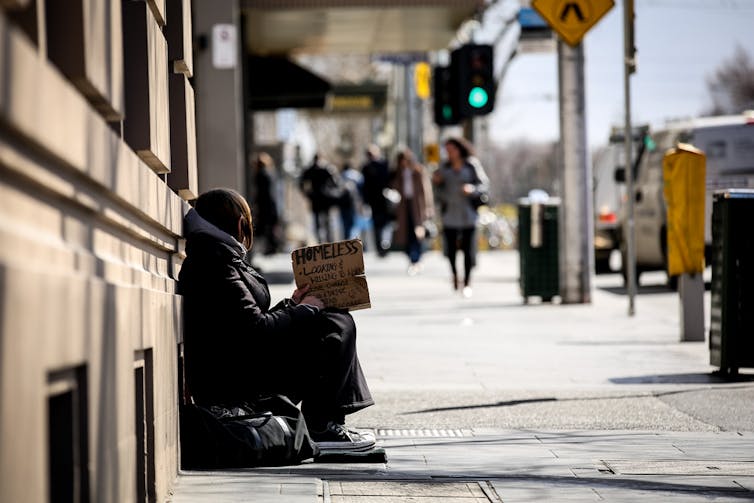
Social housing has become extremely difficult to access; in 2021 around 160,000 households[1] were on the waiting list.
To have any chance of getting a social housing spot in a reasonable time frame, applicants must be on the priority waiting list; people on the general waiting list may never get social housing[2].
However, to get on the priority list, applicants need to
- have complex needs
- not be in a position to rent privately and
- be in danger of becoming homeless[3]
- show they have tried to find private rental accommodation.
In short, they have to prove they are massively disadvantaged.
To find out more, we interviewed 43 people involved in the social housing application process in NSW, Tasmania and Queensland. This included assessment workers, support workers and government staff.
Our study[4], published in the journal Housing, Theory and Society, found an applicant’s chances of getting on the priority waiting list are much greater if they have help from advocates who know what arguments to make and how.
Success can depend on whether advocates can invest a significant amount of emotional effort to help the applicant and connect them to professionals who can track down supporting documentation.
Read more: As one gets out, another gets in: thousands of students are 'hot-bedding'[5]
‘An overwhelming process’
The application form for social housing is demanding.
In NSW it requires answering 31 questions and – depending on the applicant’s situation – up to 18 supporting documents.
Completing the form optimally requires a fair amount of literacy and “cultural capital” – things such as presenting and speaking “well” or being able to draw on the benefits of a good education.
Claire (all names used are pseudonyms), a NSW community housing provider worker, said even understanding the application form is challenging:
I think sometimes it’s the interpretation of what is actually required. What are they asking in this question? And if you don’t have the context of why that question is being asked, sometimes it can be very difficult to know how much information to put [in]. Do I just skip it or […] what do I do with that [question], or what does that even mean?
Jess, an assessment team manager in Tasmania, said:
… [the] majority would need assistance and do get help from supports, family and advocates, as it is onerous. Also literacy, language interpretation would be an issue, especially for lower socio-economic cohorts.
James, an assessment worker in NSW, said some applicants simply abandon the process:
It’s really an overwhelming process […] Sometimes people will say, “You know […] this is too much. Forget about it.”
Marie, a Queensland homelessness worker, said:
It’s more common that they won’t know how to do the process, and so I’ll go through it with them. I assist them with identifying well-being barriers, complete the application with them, get it, and then when it’s approved, also do community housing applications with them if they wish.
The challenge of gathering ‘evidence’
Producing evidence of clients’ vulnerabilities is potentially challenging.
Karim, a homelessness support worker in Queensland, said:
So, getting onto the wait list, that is a battle in itself, right? [Part of that is] getting people document ready […] So, say someone is on the streets, we know they are very, very unwell, but they don’t have documents to prove that. We have done the housing application, it’s gone to department of housing and they’re waiting for further information, because this person’s checked that they have chronic health issues. So [the department] want medical documents or confidential medical report from the GP. This person does not have a GP. What do we do? We try and link them in with the GP, take them there […]
Lots of people, their stuff’s stolen. They’re more worried about where the next meal is coming from instead of worrying about IDs. So getting ID documents, medical documents to go along with the housing application, to get it approved, is the first battle.
Susan, a women’s refuge worker in Sydney, said:
Every question has […] evidence requirements […] and they have to gather all of that and you know obviously just gathering all of that is a challenge […] But that’s definitely something that we support them with; to get all the support letters and stuff in order.
In Queensland and NSW, an applicant who needs social housing because they are fleeing domestic violence needs to provide substantiation.
Susan told us:
The types of documents people would have to collect for this question are copies of AVOs (apprehended violence orders), police event numbers, doctor reports (GP or psychiatrist), support letters from social services. So, as you can imagine, these are quite onerous as many people don’t report to police or perhaps their doctor doesn’t record the injuries as resulting from violence. On top of that, if they’ve just experienced violence they might not feel like running around.
 To get on the priority list, applicants need to be in danger of becoming homeless. Shutterstock
Emotional capital: care, empathy and compassion
Working with vulnerable people requires empathy and compassion.
Avril, an assessment worker in Tasmania, said:
So much of it is about rapport. These people who are often really sick of systems, really sick of them and they don’t want to divulge their entire life to someone that they’ve just met once. They don’t want to sit still in a small room for an hour and a half.
What we’ve found is that by having Pat, she’s our specialist rough sleeper front door worker, [and] is based in services that they know and frequent. She’s known to them and they do tend to [open up] bit by bit.
Jill, an ex-manager in a community housing provider in NSW, explained:
Also refugees or people who are trauma, torture survivors, DFV (domestic and family violence) survivors […] experience additional layers and complexities in applying.
Whilst the system aims to only ask a client to tell their story once and not multiple times, this is not always possible. So it adds further challenges to these applicants and brings up the trauma again, especially if not handled well by untrained staff.
Applying for social housing is fraught, onerous and competitive; applicants have to “prove” their vulnerability is greater than others.
Assistance from skilled advocates clearly helps get you on the priority wait list, which begs the question: what hope do others have?
Read more: Giving ex-prisoners public housing cuts crime and re-incarceration – and saves money[6]
References
- ^ 160,000 households (cityfutures.ada.unsw.edu.au)
- ^ may never get social housing (www.facs.nsw.gov.au)
- ^ of becoming homeless (www.facs.nsw.gov.au)
- ^ study (www.tandfonline.com)
- ^ As one gets out, another gets in: thousands of students are 'hot-bedding' (theconversation.com)
- ^ Giving ex-prisoners public housing cuts crime and re-incarceration – and saves money (theconversation.com)