FatBlaster Max has just been banned. Why? Here’s everything you need to know about diet supplements
- Written by: Nick Fuller, Charles Perkins Centre Research Program Leader, University of Sydney
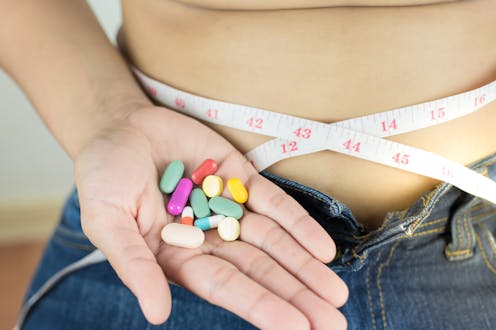
Australia’s regulator has banned FatBlaster Max[1], an over-the-counter pill that claimed (with no evidence) to be able to help you lose weight.
FatBlaster Max can no longer be purchased, after the Therapeutic Goods Administration (TGA) found the company behind the pills registered the medicine with no mention of weightloss properties and failed to produce any evidence substantiating its advertised claim it led to weight loss.
The ban has put over-the-counter weightloss pills back in the spotlight, shining light on an unregulated area that is immensely popular. Studies[2] show one in seven people have tried an over-the-counter weightloss pill, undoubtedly enticed by their promises of helping people lose weight easily and rapidly.
But do over-the-counter weightloss pills really work? Here’s everything you need to know about the weightloss supplements currently claiming a big share of Australia’s billion-dollar weight-loss industry.
What exactly are over-the-counter weightloss pills?
Broadly speaking, over-the-counter pills are anything you buy from a pharmacist without a prescription, like cold and flu remedies and paracetamol. Some over-the-counter medications are also available at retailers like supermarkets, service stations and health food stores.
Over-the-counter weightloss pills are essentially dietary and herbal supplements marketed and sold with claims of assisting with weight loss.
The important distinction between over-the-counter weightloss pills and weightloss medications prescribed by a doctor is that prescription weightloss drugs – like all pharmaceutical drugs – must go through clinical trials and provide Australia’s drug regulator with evidence of their effectiveness and safety.
Read more: 'Fat blaster' drug can give you weight loss to die for[3]
Worryingly, the distributors of over-the-counter diet pills and supplements are not required to produce any evidence of their products’ efficacy and safety before they hit the Australian market[4]. The TGA only requires them to hold, but not necessarily make freely available, evidence substantiating their claims.
How do over-the-counter weightloss pills help you lose weight?
Over-the-counter weightloss pills usually claim to have several herbal or natural ingredients that help you lose weight in one of four ways:
by suppressing your appetite or making you feel full using ingredients like a tropical fruit called Garcinia cambogia or glucomannan, a dietary fibre made from the root of the konjac plant
by speeding up your metabolism and your body’s ability to burn fat using components like the herb Ephedra sinica or a fatty acid (conjugated linoleic acid) found in meat and dairy products
by blocking your body’s ability to digest things like carbohydrates and fat using Phaseolus vulgaris (also known as the common bean) or a variety of green tea leaf called Camellia sinensis
by absorbing fat in the foods you eat, relying on ingredients like chitosan, a product created using the shells of crustaceans and insects.
Do these weightloss pills work?
In a word: no.
Most advertising for over-the-counter weightloss pills and dietary supplements will proudly claim a product’s results are backed by “clinical trials” and “scientific evidence”, but the reality is a host of independent studies don’t support these claims.
Two[5] recent studies[6] by the University of Sydney examined data from more than 120 placebo-controlled trials of herbal and dietary supplements for weight loss, including products featuring the ingredients described above. None of the supplements provided clinically meaningful weight loss.
If they don’t work, why are they allowed to be sold?
Given there are few to no checks and even less accountability when compared to prescription weightloss drugs, the researchers’ findings should come as no surprise.
Recent studies[7] suggest weightloss supplement companies have conducted very few high-quality studies. Many trials are too small, poorly designed and don’t accurately report the composition of the supplements being investigated. This is because there are no guidelines currently covering how these types of trials should be conducted.
The good news is the Australian regulator is taking some action on the claims made by distributors of these weightloss supplements, with the TGA recently banning the sale of FatBlaster Max.
Read more: Science or Snake Oil? Do the enduring Hydroxycut weight-loss products work?[8]
While the reality is the most likely thing to be damaged by over-the-counter weightloss pills is your hip pocket, the TGA’s action also serves as an important reminder that the safety[9] of over-the-counter weightloss supplements can never be guaranteed[10].
Several products have been banned from sale around the world after causing serious health problems. This includes the TGA and America’s Food and Drug Administration banning dietary supplements containing ephedra[11] in 2018, when supplements containing this stimulant herb were associated with cases of heart attack, seizure, stroke and sudden death.
Real harm is also caused by the over-the-counter weightloss industry feeding on people’s desire for a quick fix to achieve rapid weight loss.
The reality is there is no wonder pill.
Losing weight and achieving lasting results comes down to: following evidence-based care from health-care professionals and making meaningful changes to your diet, exercise and lifestyle that you can sustain for life.
A spokesperson for FatBlaster said the company is disappointed with the TGA’s decision and it is evaluating options for next steps.
It said the TGA’s requirements had changed during the years that FatBlaster Max Tablets have been on the market and the company has taken great care to update all packaging, advertising and claims to ensure compliance with these requirements.
The listing cancellation does not impact the wider FatBlaster range.
The original version of this article included a tweet from another media outlet that depicted an old version of the FatBlaster Max packaging.
References
- ^ banned FatBlaster Max (www.tga.gov.au)
- ^ Studies (pubmed.ncbi.nlm.nih.gov)
- ^ 'Fat blaster' drug can give you weight loss to die for (theconversation.com)
- ^ Australian market (onlinelibrary.wiley.com)
- ^ Two (pubmed.ncbi.nlm.nih.gov)
- ^ studies (pubmed.ncbi.nlm.nih.gov)
- ^ Recent studies (pubmed.ncbi.nlm.nih.gov)
- ^ Science or Snake Oil? Do the enduring Hydroxycut weight-loss products work? (theconversation.com)
- ^ safety (pubmed.ncbi.nlm.nih.gov)
- ^ guaranteed (casereports.bmj.com)
- ^ ephedra (www.nccih.nih.gov)