When humans compete with television, Yung Lung proves the liveness of bodies wins out
- Written by: Kate Maguire-Rosier, Honorary Associate, Department of Theatre and Performance Studies, School of Literature, Art, and Media, Faculty of Arts and Social Sciences, University of Sydney
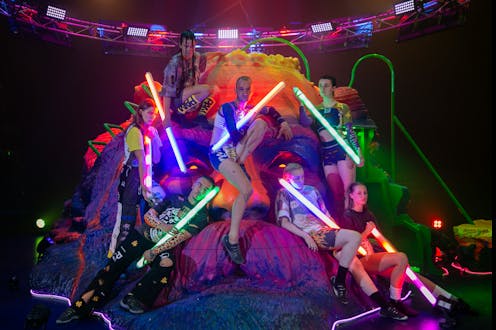
Review: Yung Lung, choreographed by Antony Hamilton, Chunky Move
The word “yung”, according to the urban language dictionary[1], variously means “dope” or “cool” as popularised in the Chico area of California, a “legend” or (my favourite) a “lowercase god”.
The lung of course is a vital organ, but also metonymic for an open space in the city[2] where dwellers may breathe fresh air.
In turn, then, the term “yung lung” might refer to a rebel’s breath – or their sanctuary.
A grand orchestral overture announces people standing like action figures atop a grotesque monster’s head-shaped rock. Oozing anarchy, the group is styled with bleached, shaved or braided hair and skintight clothing flashing neon yellow.
The aesthetic summons that of Mad Max[3] or The Bad Batch[4].
A virtual sunrise on a dozen TV monitors, displayed outwards in a panopticon-like circle surrounding the rock, accompanies the string instruments and the defiant looks on the performers’ faces.

As the bodies start to travel around the rock, we circle it too, as if two packs of wolves – cautiously suspicious, slightly hesitant but mostly curious.
Music becomes operatic and the image of gladiators at the Colosseum appears as a woman at the rock’s zenith raises her arm gloriously. Other arms stretch outwards and the figures climb, hang, swing and pose, physically domineering. Fierce facial expressions scare an absent enemy and posturing bodies overemphasise their musculature.
Chunky Move’s radical immersive experience, choreographed and directed by Antony Hamilton, is a dance manifesto that borrows from Black and Queer clubbing to expose – and make fun of – today’s existential crises.
The work’s visceral effort reasserts a shared aliveness in the here and now.
The standout element is Chiara Kickdrum’s thrashing soundscape, inviting the audience into a trance. Light by Bosco Shaw, video by Kris Moyes, Hamilton and Nickolas Moloney, costumes by P.A.M. and set design by Callum Morton work solidly together to produce surreal scenes that unfurl in the heart of the space.
But it is the fervent performance of the cast emboldened by the soundscape and punctuated by vogue[5] and waacking[6] who render the rave mesmerising and wondrously odd.
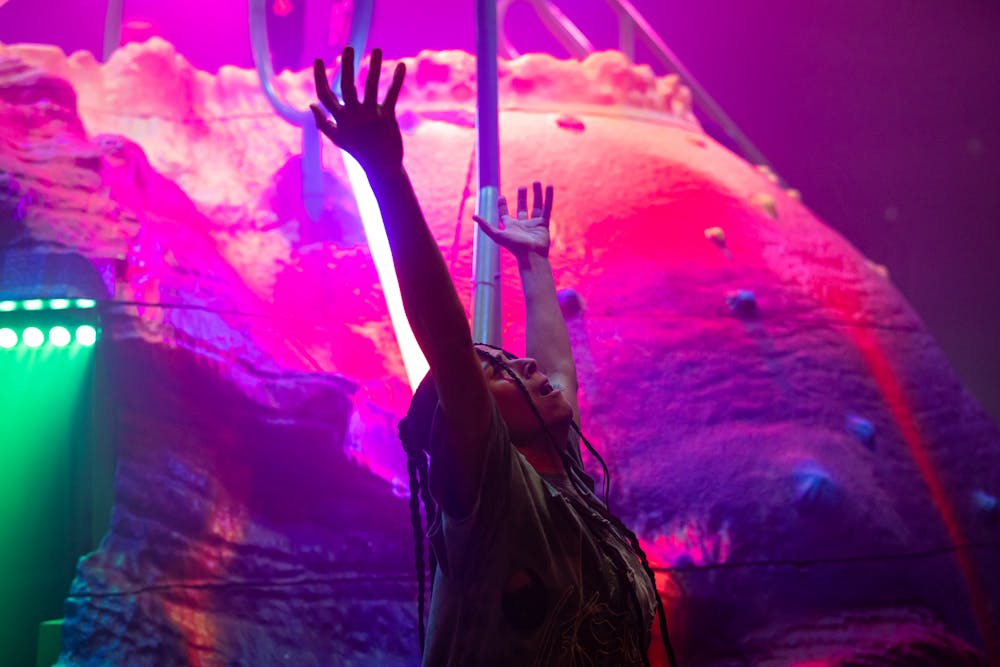 Yung Lung is mesmerising and wonderfully odd.
Jacquie Manning
Yung Lung is mesmerising and wonderfully odd.
Jacquie Manning
The mood shifts slightly when a young woman hugs herself. Another hangs suspended upside down like an infant from monkey bars in a park playground. I see now a Mardi Gras float travelling down Sydney’s Oxford Street in late summer as a slender man with a ponytail places one hand on hip looking down at the crowd, mouth ever so slightly ajar, sexually titillating.
The virtual sun repeated on the monitors has nearly set, and I notice a rainbow lightshow behind.
A woman crushes her face into a scowl and sticks out her tongue as if the star of a death metal band. We are her fans, but also the system that criticises her for glamorising violence.
Clearly, the group wants to captivate us.
My attention snaps back to the images flickering on screen. Burning cigarettes. A cityscape. Volcanic lava. The book title Devolution of Mankind. The solar system. Japanese animé. Military activities. Green palm trees against blue sky. A dead dog on a beach stared at by young boys. Later, on every second screen, Ned Kelly full body shot in the bush. Pop-art depictions of the Kremlin, unfamiliar yet quintessentially Andy Warhol. A blackout.
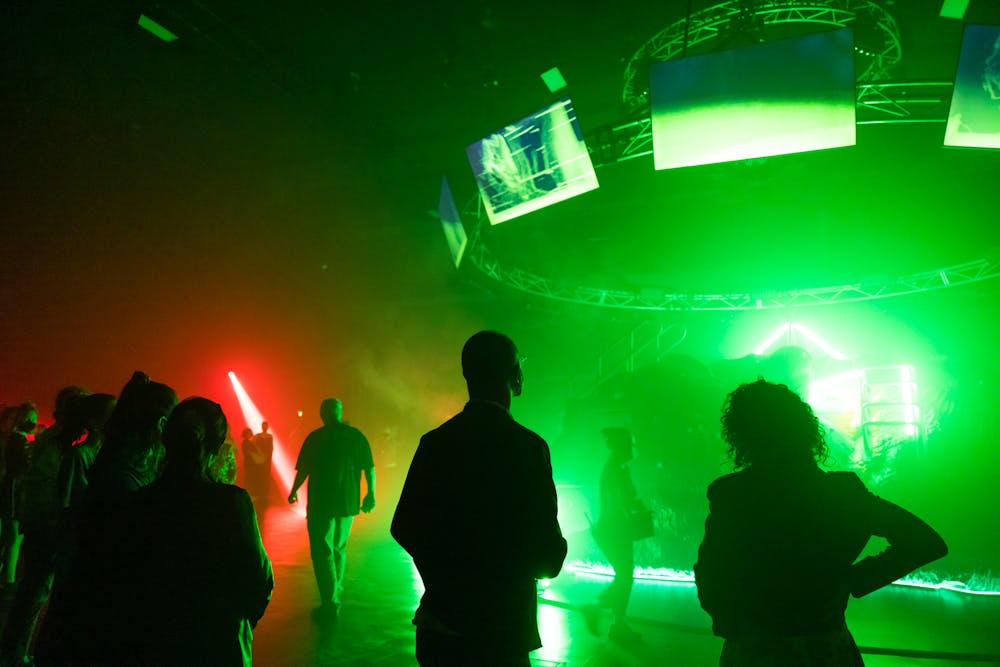 The live performers must compete with the allure of the screens.
Jacquie Manning
The live performers must compete with the allure of the screens.
Jacquie Manning
On screen, human heads mutate. On the rock, bodies pick up pace, glued to the sculpture like insects in formation. A thumping beat cuts the air in sharp bursts, speeding up the tempo and movement. Bodies bounce with hip-hop gestures. In sync, two women explicitly sign “eat my dick”.
Video recalls my gaze. The furious onslaught of images reveals otherwise non-memorable scenes from cult pop culture. One pair flashing to and fro, however, stings: a duet of sorts between a heavily pixelated quadruped robot Spot[7] and a headshot of a Black man – is it Martin Luther King? The images flicker back and forth, passing by too quickly to tell. I am acutely aware of the lure of the screen, accentuating the liveness of bodies in space. And aggressive drums storming the space now seem like gunshots.
Read more: Is 'Spot' a good dog? Why we're right to worry about unleashing robot quadrupeds[8]
The presence of the live performers is heightened by the mediatised spectacle; the relationship between[9] the two is key to the concept, integrity and rigour of this artwork. And this is in spite of their competing[10] for dominance from one moment to the next.
The slanted text disappearing into the universe at the beginning of every Star Wars movie, “Since the beginning…” gives way to the thought of science fiction creating reality. Are the dancers trying to sell us this violent world? These spoiled images, decomposed like off fruit? Dancers hold neon poles, baby blue just like Anakin Skywalker’s lightsaber. “Jupiter” reads the label graffitied on one dancer’s trouser leg. Poles now burn red like Darth Vader’s lightsaber, one raised under a dancer’s eyes like a child with a torch telling a ghost story in a circle of friends.
Dancers exit like robots streaked through the crowd. And a final question flurries through my mind: “or was the Black face George Floyd?”
Yung Lung is at Carriageworks for Sydney Festival until January 23, then at the Substation in Melbourne from February 1 to 12.
References
- ^ urban language dictionary (www.urbandictionary.com)
- ^ open space in the city (www.researchgate.net)
- ^ Mad Max (en.wikipedia.org)
- ^ The Bad Batch (en.wikipedia.org)
- ^ vogue (en.wikipedia.org)
- ^ waacking (en.wikipedia.org)
- ^ quadruped robot Spot (theconversation.com)
- ^ Is 'Spot' a good dog? Why we're right to worry about unleashing robot quadrupeds (theconversation.com)
- ^ relationship between (www.researchgate.net)
- ^ competing (brill.com)