High Court decision on $125 million fine for Volkswagen is a warning to all greenwashers
- Written by: Michael Adams, Professor of Corporate Law & Head UNE Law School, University of New England
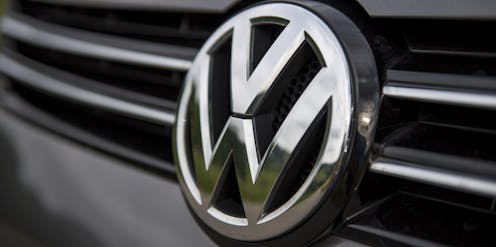
The High Court of Australia has today refused to hear Volkswagen’s appeal against the record A$125 million fine imposed on it for deliberately deceiving regulators and customers about the environmental performance of its cars.
The $125 million fine is the largest penalty ever imposed on a company in Australia for misleading consumers. It relates to the so-called “dieselgate” scandal, by which the German car company used secret software to beat emissions standards and tests in multiple countries.
This is a significant win for the Australian Competition and Consumer Commission[1] in its ongoing battle against “greenwash”, by which companies make false environmental claims to mislead consumers.
Research shows[2] greenwashing harms the market for environmentally friendly products. Without being able to distinguish between genuine and dubious claims, consumer cynicism about all claims increases.
The Australian Consumer Law[3] adequately prohibits greenwashing claims through its provisions covering false and misleading practices. But this evidence the consumer watchdog is enforcing these laws, and that the courts are upholding them, will build confidence that environmental claims can be trusted.
Background to the ‘dieselgate’ case
The ACCC initiated Federal Court proceedings against Volkswagen in September 2016, a year after the US Environmental Protection Agency revealed the car company had used “defeat” software in diesel vehicles since 2009 to produce lower greenhouse gas emissions during “laboratory” tests.
This software shut off during road use, meaning the cars performed better, but then produced nitrogen oxide pollution up to 40 times that permitted[4] by US law.
Volkswagen had used its software globally. The ACCC alleged the car maker sold 57,000 cars with these defeat devices in Australia between 2011 and 2015.
Volkswagen initially fought the case by the ACCC, but in 2019 agreed to settle[5] for a fine of $75 million (and $4 million in court costs).
Read more: Volkswagen’s record settlement payout: treating the symptom not the disease[6]
When this was taken to the Federal Court for ratification (approval) the judge, Justice Lindsay Foster, rejected the deal as “outrageous”. He called the “agreed statement of facts” about the harm caused “a bunch of weasel words[7]”. In his ruling in December 2019[8] he doubled the penalty to $125 million.
Volkswagen appealed this judgement to the full bench of the Federal Court (the equivalent of a court of appeal), arguing it was manifestly excessive. In its ruling (in April 2021) the full bench disagreed and upheld the A$125 million penalty[9].
This led to Volkswagen appealing to the High Court (Australia’s ultimate court of appeal). Today it refused “special leave” (permission to bring the whole case) to challenge the ruling and the large penalty. Which means the A$125 million fine stands.
This sends a strong message
This decision will send a very strong message to other manufacturers and sellers of products making environmental claims.
The Australian Consumer Law’s provisions against greenwashing are contained in Section 18[10] of the act, dealing with misleading or deceptive conduct.
As the market for “green products” has expanded over the past few decades, so too has the temptation for unsavoury producers and marketers to make misleading statements.
In response, some consumer groups and activists have demanded new laws to prevent greenwash. But my research[11] with Marina Nehme (now associate professor of corporate law at UNSW) led us to to the view the existing laws actually cover all the relevant situations.
The High Court decision today demonstrates this. There are hundreds of examples of the consumer watchdog successfully pursuing greenwashers, but the size of the fine in this case will stand out and serve to deter others.
References
- ^ Australian Competition and Consumer Commission (www.accc.gov.au)
- ^ Research shows (journals.sagepub.com)
- ^ Australian Consumer Law (www.australiancompetitionlaw.org)
- ^ up to 40 times that permitted (www.bbc.com)
- ^ in 2019 agreed to settle (www.smh.com.au)
- ^ Volkswagen’s record settlement payout: treating the symptom not the disease (theconversation.com)
- ^ a bunch of weasel words (www.afr.com)
- ^ December 2019 (www.austlii.edu.au)
- ^ upheld the A$125 million penalty (www.austlii.edu.au)
- ^ Section 18 (www.australiancompetitionlaw.org)
- ^ my research (www.austlii.edu.au)