Morrison to link $500 million for new technologies to easing way for carbon capture and storage
- Written by: Michelle Grattan, Professorial Fellow, University of Canberra
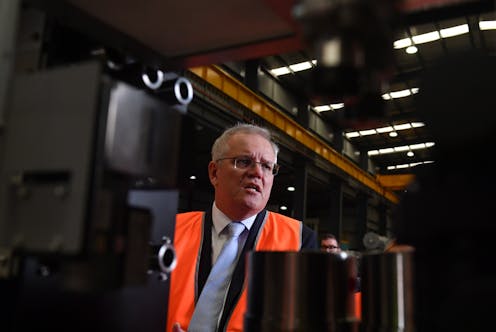
Prime Minister Scott Morrison will on Wednesday announce $500 million towards a new $1 billion fund to promote investment in Australian companies to develop low-emissions technologies.
But the government will use the legislation for the fund to try to wedge Labor.
The $500 million will be provided to the Clean Energy Finance Corporation[1], with the legislative package including the expansion of the remit of the CEFC to enable it to invest in carbon capture and storage (CCS).
The CEFC can invest in a broad range of low-emissions technologies, with the only exceptions being nuclear and CCS. The government has previously tried to remove the barrier to the CEFC investing in CCS but has been frustrated by the Senate.
By linking the $500 million to the expansion of the CEFC’s investment remit, the government believes it will put pressure on Labor, which opposed the wider brief for the corporation.
While the government’s legislation would remove the prohibition relating to CCS, there would be no change to the nuclear prohibition.
The government regards CCS, which is controversial and as yet unproven at scale, as a priority technology under its Technology Investment Roadmap.
The proposed fund is the latest in a round of announcements this week as Morrison campaigns on his technology-based energy policy for net-zero by 2050.
Read more: Word from The Hill: Scott Morrison has decided electric cars won't threaten Aussie weekends[2]
But Tuesday’s unveiling of his policy to encourage the take-up of electric vehicles – with $178 million for modest initiatives but no subsidies to assist purchasers – ran into immediate flak, with strong criticisms from experts and the opposition, who said it was totally inadequate.
NSW Environment Minister Matt Kean made it clear the Morrison government should be doing a great deal more.
He said he would like to see it directly support electric vehicles so they would be cheaper for families and businesses. A number of taxes and charges could be waived.
The federal government should also invest more heavily in in electric vehicle charging infrastructure, he told the ABC on Tuesday night.
But Kean said the biggest thing the federal government could do was deal with the issue of fuel standards – Australia had some of the worst fuel standards in the world, worse than China or India.
NSW on Wednesday will announce support for the fleet industry to purchase electric vehicles.
At a news conference on Tuesday Morrison was confronted by reporters over his 2019 trenchant attacks on Labor’s electric vehicle policy, which he said would “end the weekend”. Despite the quotes, Morrison denied he had campaigned against EVs at the election.
“I didn’t. That is just a Labor lie. I was against Bill Shorten’s mandate policy, trying to tell people what to do with their lives, what cars they were supposed to drive and where they could drive.”
The proposed “low emissions technology commercialisation fund” would include $500 million from private sector investors.
Morrison says in a statement the fund would back Australian early stage companies to develop new technologies.
Emissions reduction minister Angus Taylor says it would “address a gap in the Australian market, where currently small, complex, technology-focussed start-ups can be considered to be too risky to finance”.
The investments would be in the form of equity, not grants or loans.
Read more: As the world surges ahead on electric vehicle policy, the Morrison government's new strategy leaves Australia idling in the garage[3]
The latest initiative brings the government’s public investment commitments to low emissions technologies by 2030 to more than $21 billion.
The government will introduce legislation to establish the fund – expected to earn a positive return for taxpayers – in this term of parliament.
The government’s list of example of potential areas for the fund’s investments include:
- direct air capture of CO₂ and permanent storage underground
- materials or techniques with the potential to reduce emissions in the production in steel and aluminium
- soil carbon measurement technologies
- livestock feed technologies to reduce methane emissions from cattle
- improvements to solar panels
- lighter and smaller battery cases
- software developments to improve the operational efficiency of a variety of low-emissions technologies in all sectors of the economy.
References
- ^ Clean Energy Finance Corporation (www.cefc.com.au)
- ^ Word from The Hill: Scott Morrison has decided electric cars won't threaten Aussie weekends (theconversation.com)
- ^ As the world surges ahead on electric vehicle policy, the Morrison government's new strategy leaves Australia idling in the garage (theconversation.com)