East Coast flooding is a reminder that sea level is rising as the climate warms – here's why the ocean is pouring in more often
- Written by: Jianjun Yin, Associate Professor of Geoscience, University of Arizona
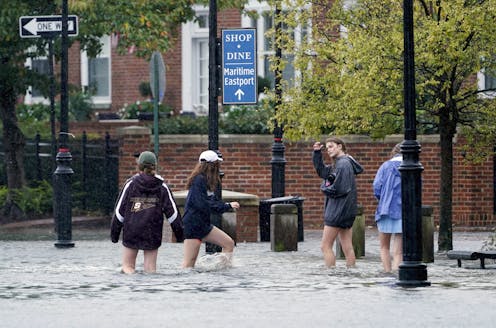
The U.S. East Coast has been hit with hurricanelike flooding[1] in recent weeks, with South Carolina and Georgia getting the latest round. High tides are part of the problem, but there’s another risk that has been slowly creeping up: sea level rise.
Since 1880, average global sea levels have risen by more than[2] 8 inches (23 centimeters), and the rate has been accelerating[3] with climate change.
Depending on how well countries reduce their greenhouse gas emissions in the coming years, scientists estimate that global sea levels could rise[4] by an additional 2 feet by the end of this century. In some areas – including Charleston, South Carolina, where a storm and high tide on Nov. 5, 2021, sent water levels about 8 feet above normal[5] – sinking land[6] is making the impact even worse.
I’m a geoscientist who studies sea level rise[7] and the effects of climate change. Here’s a quick explanation of two main ways climate change is affecting oceans levels and their threat to the world’s coasts.
Ocean thermal expansion
Climate change, fueled by fossil fuel use and other human activities, is causing average global surface temperatures to rise. This is leading the ocean to absorb more heat than it did before the industrial era began. That, in turn, is causing ocean thermal expansion.
Thermal expansion simply means that as the ocean heats up, sea water molecules move slightly farther apart. The farther apart the molecules are, the more space they take up.
That expansion leads to the ocean rising higher onto land.
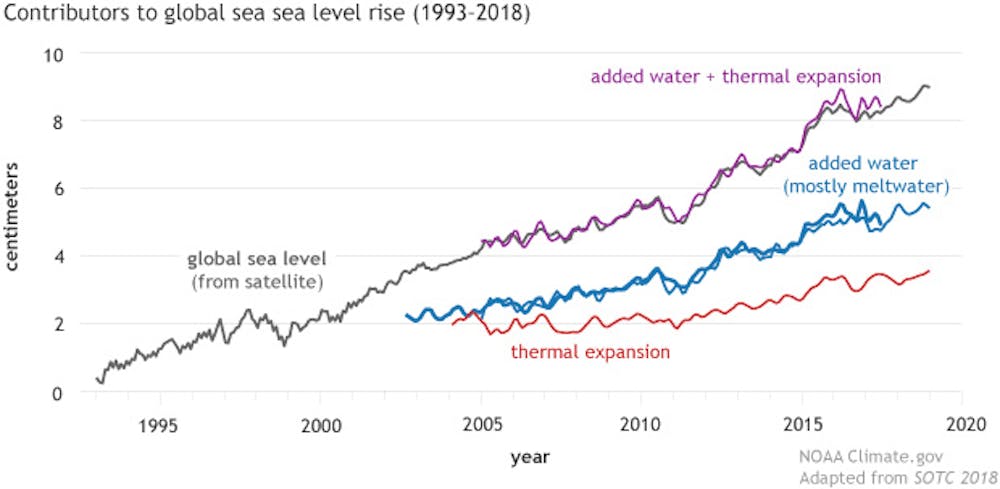
During the past several decades, about 40%[9] of global sea level rise was due to the effect of thermal expansion. The ocean, which covers just over two-thirds of the Earth’s surface, has been absorbing and storing more than 90%[10] of the excess heat added to the climate system due to greenhouse gas emissions.
Melting land ice
The other major factor in rising sea levels is that the increase in average global temperatures is melting land ice – glaciers and polar ice sheets – at a faster rate than natural systems can replace it.
When land ice melts, that meltwater eventually flows into the ocean, adding new quantities of water to the ocean and increasing the total ocean mass.
During the past several decades, about 50% of global sea level rise[11] was induced by land ice melt.
Currently, the polar ice sheets in Greenland and Antarctica hold enough frozen waters that if they melted completely, it would raise the global sea level by up to 200 feet, or 60-70 meters[12] – about the height of the Statue of Liberty.
Climate change is melting sea ice as well. However, because this ice already floats at the ocean’s surface and displaces a certain amount of liquid water below, this melting does not contribute to sea level rise.
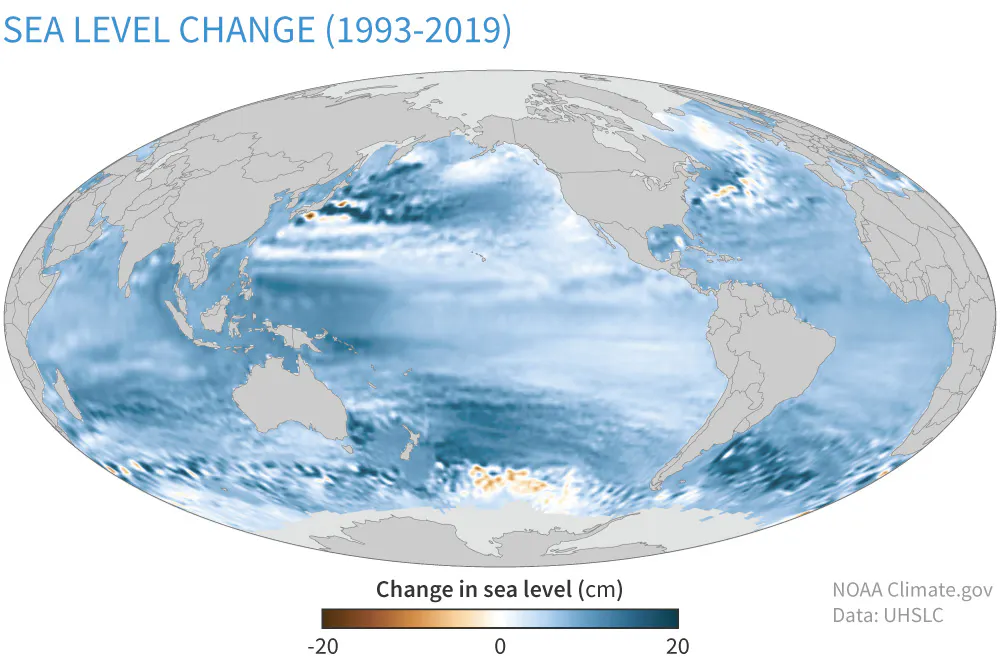 How average sea level rose from 1993 to 2018 across the world ocean. The rise was 6-8 inches (15-20 centimeters) in some basins.
NOAA[13]
How average sea level rose from 1993 to 2018 across the world ocean. The rise was 6-8 inches (15-20 centimeters) in some basins.
NOAA[13]
While the surface height of the ocean[14] is rising globally, the impact is not the same for every coastal region on Earth. The rate of rise can be several times faster in some places than others. This difference is caused by an area’s unique local conditions – such as shifts in ocean circulation and the uplift or subsidence of the land.
The risks will keep rising long after emissions stabilize
Nearly 4 in 10 U.S. residents live near a coastline, and millions of people are already dealing with coastal flooding[15] during hurricanes and high tides that can damage homes, buildings and other coastal infrastructure and ecosystems. The Chesapeake Bay area was hit with flooding during high tides in late October, and Miami now deals with high-tide flooding[16] several times a year.
Worldwide, researchers have estimated that sea level rise this century could cause trillions of dollars in damage[17]. In some low-lying island nations, including the Maldives in the Indian Ocean and Kiribati in the Pacific Ocean, rising seas are already forcing citizens to make stark choices about building costly ocean protections that will only last so long or plan to abandon their islands.
Officials from countries worldwide are meeting at the U.N. climate conference in Glasgow with a goal of agreeing to reduce global greenhouse gas emissions enough to keep global temperatures from rising too high.
Even when emissions come down, sea level will keep rising for centuries because the massive ice sheets in Greenland and Antarctica will continue to melt and take a very long time to reach a new equilibrium. The latest report from the Intergovernmental Panel on Climate Change shows[19] the excess heat already in the climate system has locked in the current rates of thermal expansion and land ice melt for at least the next few decades.
References
- ^ hurricanelike flooding (www.cnn.com)
- ^ have risen by more than (www.globalchange.gov)
- ^ rate has been accelerating (climate.nasa.gov)
- ^ global sea levels could rise (theconversation.com)
- ^ 8 feet above normal (twitter.com)
- ^ sinking land (www.scseagrant.org)
- ^ geoscientist who studies sea level rise (scholar.google.com)
- ^ NOAA Climate.gov (www.climate.gov)
- ^ about 40% (www.climate.gov)
- ^ more than 90% (www.climate.gov)
- ^ 50% of global sea level rise (www.climate.gov)
- ^ 200 feet, or 60-70 meters (nsidc.org)
- ^ NOAA (www.climate.gov)
- ^ surface height of the ocean (ipcc.ch)
- ^ coastal flooding (oceanservice.noaa.gov)
- ^ Miami now deals with high-tide flooding (theconversation.com)
- ^ trillions of dollars in damage (www.nature.com)
- ^ Jonas Gratzer/Getty Images (www.gettyimages.com)
- ^ The latest report from the Intergovernmental Panel on Climate Change shows (theconversation.com)