Women's academic careers are in a 'holding pattern' while men enjoy a 'tailwind'
- Written by: Fleur Sharafizad, Lecturer in Management, Edith Cowan University

Female academics continue to be underrepresented[1] in senior academic positions in Australia[2] and internationally[3]. Most research has focused on the low number of women professors at universities. But the largest drop-off[4] in the number of female academics is between two mid-level positions: lecturer and senior lecturer.
We set out to find why this occurs, using a new method[5] to explore the career journeys of male and female academics. We found they continue to experience different careers: men commonly described a clear run at their career goals, while many women found themselves in a holding pattern as a result of having to juggle other responsibilities.
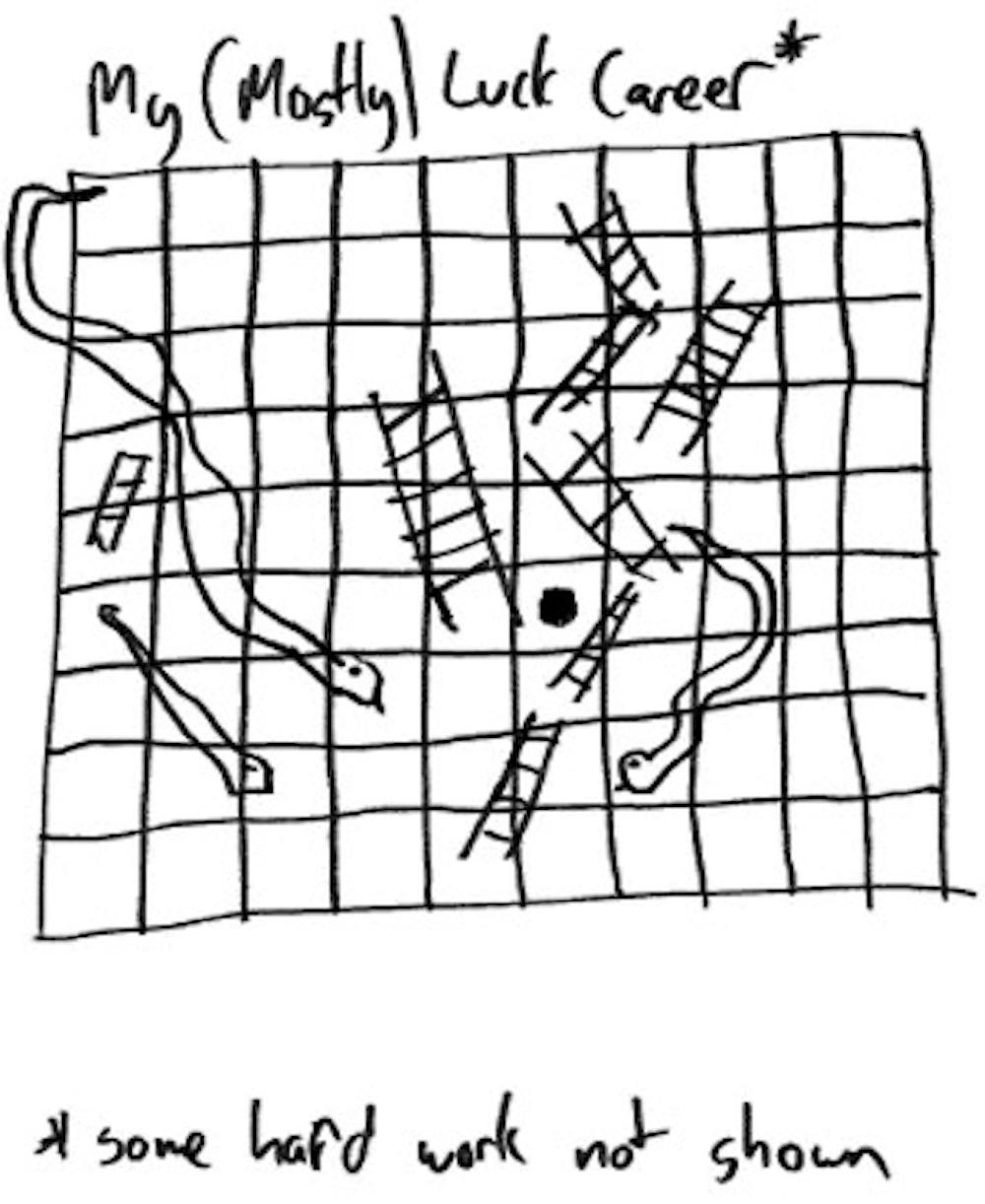
Another male academic wrote “tailwinds” on his drawing as shown below.
Juggling competing responsibilities
Female academics were much more likely to include their families in their career drawings, highlighting the interrelatedness of work and family. Those with children were all primary carers. Their academic work had one set of requirements, their family another and both required their attention, often at the same time.
This situation resulted in a constant struggle and negotiation, as the drawing below shows.
 Danielle DWR: Up the Hill.
Author provided
Danielle DWR: Up the Hill.
Author provided
Connectedness was also clear in the drawing below created by another female academic.
To maintain a level of balance – “to keep my head above water” as one put it – most female academics chose not to progress their careers. They could not see themselves successfully managing their domestic tasks in a senior lecturer role. One female lecturer said:
“Half the time I feel like I am sinking, so for now I am happy just to keep doing the best I can in my job and then retire at the age of 65.”
Seven of the eight female lecturers reported putting their career aspirations on hold.
Read more: Forget the ideal worker myth. Unis need to become more inclusive for all women (men will benefit too)[15]
Doing the ‘academic housework’
Another reason for the holding pattern was female academics undertaking more service activities. Coined “academic housework[16]”, these activities are associated with caring and include assisting students, administration of teaching, or organising professional academic activities. Generally, these activities are not considered for career progression[17].
This situation was confirmed by a member of the executive leadership team who said some women:
[…] have literally taken on a lot of things that you can tell no one else wants to do – academic housework.
Similarly, a female academic reported male colleagues are:
[…] focusing on the things that matter for promotion, not on the things that matter for the team.
Lacking support from colleagues
Some junior female academics did not support ambitious senior female colleagues. They referred to them as “alpha women”, “men dressed in women’s clothing” or “women acting like men”. This situation was confirmed by senior female academics who reported backlash from other women for being ambitious. One said:
“I am ambitious and if this was a man sitting here there would be a different connotation of ‘Wow, you’ve done well!’, but for a woman it is like, ‘Well, how are your children? And your family and everything else?’ So, there is an issue.”
Another female academic reported “thinking like a man” had helped her have a very successful career. She reported that this requires not thinking about family, putting yourself first and “being selfish”.
Fear of backlash may stop some women, however, from pursuing career progression.
Read more: Time to gender parity has blown out to 135 years. Here's what women can do to close the gap[18]
What can universities do?
Despite their career aspirations, organisational and personal reasons resulted in women not pursuing promotion to senior lecturer and beyond. Our study identified a clear holding pattern among female lecturers that inhibited their progression to the next level.
While male academics reported focused career trajectories, women reported difficulty managing many work and life responsibilities in pursuing their careers.
Universities can help female lecturers break the holding pattern cycle and assist their career progression. They can start by developing guidance in better negotiating academic housework and service tasks and by changing the narrative and culture around career ambition for women at universities. This will be a win-win for female academics and universities.
References
- ^ underrepresented (journals.sagepub.com)
- ^ Australia (www.dese.gov.au)
- ^ internationally (doi.org)
- ^ largest drop-off (www.dese.gov.au)
- ^ new method (doi.org)
- ^ Chart: The Conversation. Data: Department of Education, Skills and Employment Higher Education Staff Data 2020 (www.dese.gov.au)
- ^ CC BY (creativecommons.org)
- ^ No change at the top for university leaders as men outnumber women 3 to 1 (theconversation.com)
- ^ Our research (doi.org)
- ^ at home looking after children (www.science.org)
- ^ fewer submissions from female academics (www.insidehighered.com)
- ^ How COVID is widening the academic gender divide (theconversation.com)
- ^ Draw, Write, Reflect (doi.org)
- ^ not all knowledge can be expressed in words (journals.sagepub.com)
- ^ Forget the ideal worker myth. Unis need to become more inclusive for all women (men will benefit too) (theconversation.com)
- ^ academic housework (doi.org)
- ^ not considered for career progression (doi.org)
- ^ Time to gender parity has blown out to 135 years. Here's what women can do to close the gap (theconversation.com)