
It's time to talk about gay reparations and how they can rectify past persecutions of LGBTQ people
- Written by: Paula Gerber, Professor of Human Rights Law, Monash University
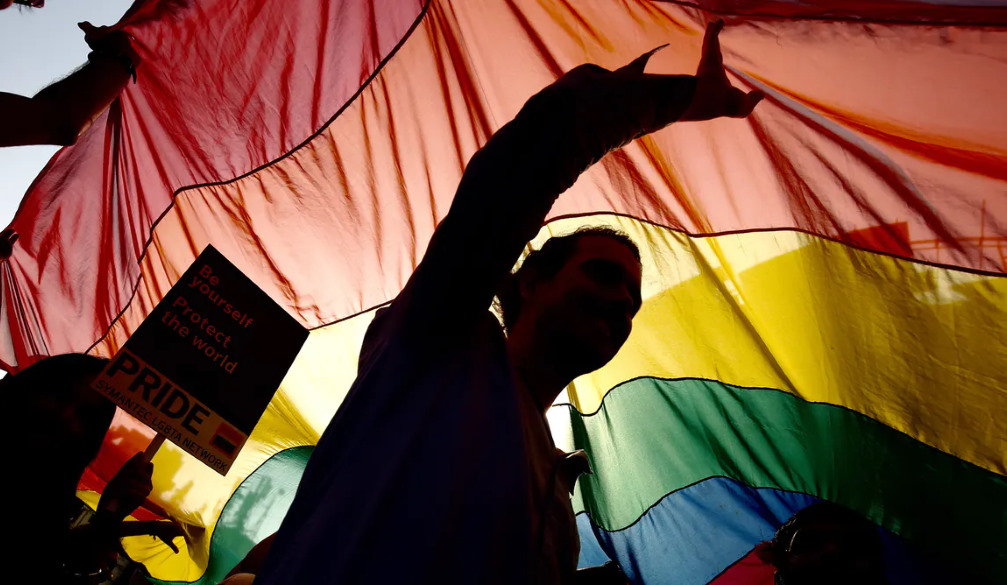
The word “reparations” comes from the Latin verb reparāre, meaning “to repair.” However, nowadays, many people equate reparations with the payment of compensation or damages.
We need to understand and embrace the true meaning of the word and start to have genuine conversations about reparations for LGBTQ people — a group that has endured a long and painful history of persecution around the globe.
A brief history of gay persecution
Perhaps the most high-profile persecutions of gays were those perpetrated by the Nazis during the second world war. Thousands of gay men were sent to concentration camps where they were forced to wear a pink triangle[1] and ultimately killed.
But the history of gay persecution predates the Holocaust, and has continued after the Nazi regime ended.
From the 12th century, gays in Christian Europe were castrated, decapitated, drowned in swamps and burned at the stake[2]. And in modern times, the state-sanctioned killing[3] of LGBTQ people continues in many countries, including Iran[4] and Saudi Arabia[5].
Read more: Most countries score an F on our LGBT human rights report card[6]
There are still 71 countries[7] that criminalise consensual gay sex — half of which are Commonwealth nations — but thankfully this number is going down.
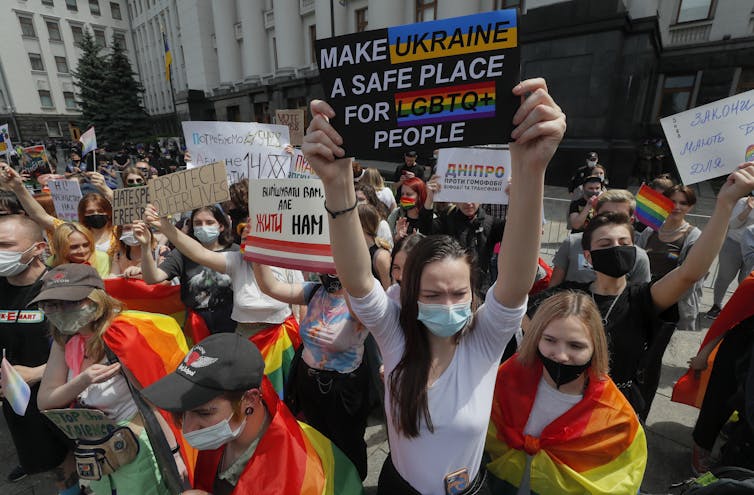 A rally in Ukraine last weekend to demand a stop to violence against LGBTQ activists, feminists, and others deemed a threat to so-called ‘traditional values’. Sergey Dolzhenko/EPA
What are gay reparations?
There are numerous forms[8] that gay reparations can take. They often entail a formal government apology to the LGBTQ community for past wrongs and a promise to do better in the future.
They can also include memorialising the victims of state-sponsored repression of gays, as Germany did in 2008 when it unveiled a memorial to gay victims of the Holocaust[9].
Gay reparations often include pardons[10] to those convicted of the “crime” of being gay.
In 2017, for instance, the UK issued posthumous pardons to thousands[11] of gay and bisexual men convicted of “gross indecency” in the past, including Alan Turing[12], the mathematician who famously broke the Germans’ Enigma codes during the second world war. He committed suicide two years after he was convicted for “acts of gross indecency”, based on his relationship with Arnold Murray, and underwent chemical castration[13].
Occasionally, gay reparations can involve financial compensation for wages or pensions lost due to time spent in prison or a mental institution because of a homosexual offense. Such compensation[14] has been available in Spain since 2009 and in Germany since 2016.
Read more: Calls for a posthumous pardon ... but who was Alan Turing?[15]
What are the arguments against gay reparations?
There is strong resistance to the idea of gay reparations in some countries, especially the United States.
Some of the opposition is rooted in run-of-the-mill homophobia. Statistics show a rise in hate crimes against LGBTQ people in recent years in many countries, including the UK[16] and Germany[17]. Homophobic hate speech by politicians is on the rise[18] in many places, and in Poland, nearly 100 localities have declared themselves “anti-LGBTQ” zones[19].
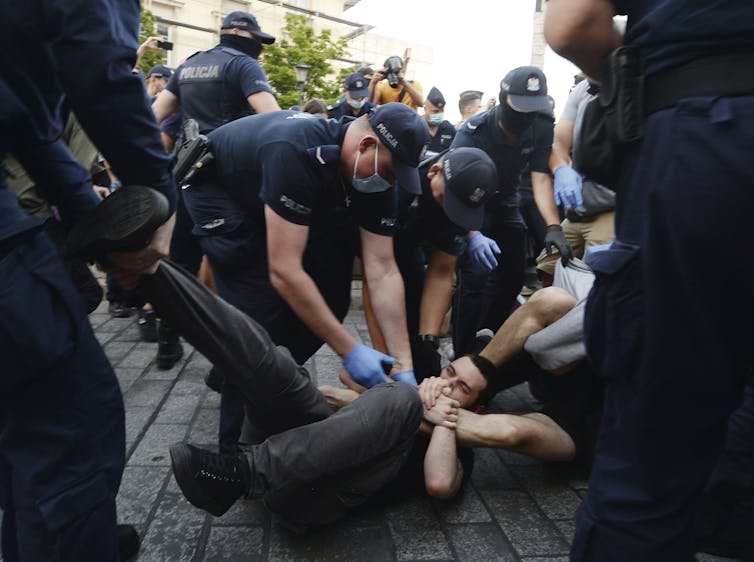 Police scuffle with LGBTQ protesters at a rally against the arrest of an LGBTQ activist in Poland last year. Czarek Sokolowski/AP
But the arguments against gay reparations are more nuanced. Omar G Encarnacion[20], a US scholar who wrote the new book The Case for Gay Reparations, identified five arguments used by opponents against gay reparations:
-
it is wrong to apply today’s values to the historic persecution of gays because the discrimination perpetrated against gays in the past was generally legal at the time
-
this is no more than an exercise in virtue signaling (the conspicuous expression of moral righteousness), with the risk of becoming a slippery slope that could open the floodgates to reparations for just about anyone who has faced hardship or discrimination in life
-
gay reparations are divisive and take identity politics and “victimhood” to a new level
-
gay reparations lack justification because, unlike the case of racial discrimination, there is little evidence of intergenerational damage linked to anti-gay discrimination
-
they are redundant because of the economic success of the gay community.
Encarnacion systematically refutes each of these arguments, noting that critics of gay reparations are misinformed about the purpose of acknowledging and repairing the wrongs perpetrated against LGBTQ people.
Their arguments rely on stereotypes and flawed comparisons between gays and other groups that have been persecuted (especially African Americans), and generally show a lack empathy for the gay community.
What reparations can look like in practice
There is a clear trend[21] towards countries decriminalising homosexuality with Bhutan, Angola, Gabon, Botswana, Mozambique, the Seychelles and Trinidad and Tobago all abolishing these laws in recent years.
While these reforms are welcomed, they are merely the start of the journey towards equality for LGBTQ people — not the end. It is time all countries acknowledge and offer reparations for the mistakes of homophobic laws that have targeted gays and destroyed millions of lives.
Read more: New research documents the severity of LGBTQA+ conversion practices — and why faith matters in recovery[22]
Australia provides a useful model. In 2016, Victorian Premier Daniel Andrews, in a world first, apologised for the homophobic laws of the past in his state. In a moving speech[23] he said,
There was a time in our history when we turned thousands of ordinary young men into criminals. And it was profoundly and unimaginably wrong. […] This parliament and this government are to be formally held to account for designing a culture of darkness and shame. […] We are so sorry. Humbly, deeply, sorry.
This apology came after laws were enacted in the state of Victoria expunging convictions[24] for homosexual conduct. And it has been followed by other landmark actions, including the enactment of laws banning “conversion therapy”[25] and the construction of the first Pride Centre[26] in Australia to support the LGBTQ community.
Reparations like this must be the ultimate goal. As the writer and philosopher Michael Bassey Johnson once observed:
Sometimes, the mistake is not the problem; the lack of remorse is the real mistake.
References
- ^ pink triangle (theconversation.com)
- ^ burned at the stake (www.the-low-countries.com)
- ^ state-sanctioned killing (cpjp.org.au)
- ^ Iran (www.amnesty.org)
- ^ Saudi Arabia (www.out.com)
- ^ Most countries score an F on our LGBT human rights report card (theconversation.com)
- ^ 71 countries (antigaylaws.org)
- ^ numerous forms (foreignpolicy.com)
- ^ memorial to gay victims of the Holocaust (www.reuters.com)
- ^ pardons (www.bbc.com)
- ^ pardons to thousands (www.theguardian.com)
- ^ Alan Turing (theconversation.com)
- ^ chemical castration (www.bbc.com)
- ^ compensation (foreignpolicy.com)
- ^ Calls for a posthumous pardon ... but who was Alan Turing? (theconversation.com)
- ^ the UK (www.bbc.com)
- ^ Germany (www.reuters.com)
- ^ on the rise (www.rferl.org)
- ^ “anti-LGBTQ” zones (www.bbc.com)
- ^ Omar G Encarnacion (global.oup.com)
- ^ trend (www.bbc.com)
- ^ New research documents the severity of LGBTQA+ conversion practices — and why faith matters in recovery (theconversation.com)
- ^ speech (www.premier.vic.gov.au)
- ^ expunging convictions (theconversation.com)
- ^ banning “conversion therapy” (www.sbs.com.au)
- ^ construction of the first Pride Centre (www.vic.gov.au)