HOPE Foundation and Taiwan’s Top Lung Cancer Experts Call for Seamless Integration of Early Screening, Precision Diagnostics, and Early Treatment
TAIPEI, TAIWAN - Media OutReach Newswire - 16 August 2025 - Lung cancer continues to be the leading cause of cancer-related deaths worldwide. Yet, progress is within reach. In Taiwan, thanks to the National Lung Cancer Early Detection Program, the proportion of early-stage lung cancer cases continues to rise.
Against this backdrop, HOPE Foundation for Cancer Care, one of the largest cancer-focused patient advocacy groups in Taiwan, recently hosted a press conference titled "Healthy Taiwan, Leading the World – Ushering in a New Era of Early Screening and treatment of Lung Cancer". The event brought together distinguished government officials, ten leading medical authorities in lung cancer, and renowned lung cancer experts from major medical centers nationwide to chart the next phase of early lung cancer prevention and control policies. United in their commitment, participants advocated for the seamless integration of early screening, precision diagnostics, and early treatment in lung cancer care, strengthening efforts to promote early detection and intervention. Ultimately, aiming to support Taiwan in achieving its ambitious goal of reducing cancer mortality rates by one-third by 2030, setting a new international benchmark in cancer control.

Taiwan's proactive approach to lung cancer prevention is recognized globally for its vision and effectiveness. In July 2022, the government launched the Lung Cancer Early Detection Program, offering biannual low-dose CT (LDCT) screenings for high-risk groups, including those with a family history of lung cancer and heavy smokers. This pioneering initiative has positioned Taiwan as an international role model in lung cancer prevention. Over the past three years, more than 210,000 screenings have led to the identification of 2,506 lung cancer cases—over 80% of which were diagnosed at an early stage, with late-stage diagnoses dropping sevenfold. Previously, late-stage diagnosis was the norm, but Taiwan's proactive policies have transformed the landscape, reversing the trend and ensuring that most initial lung cancer cases are now detected early.
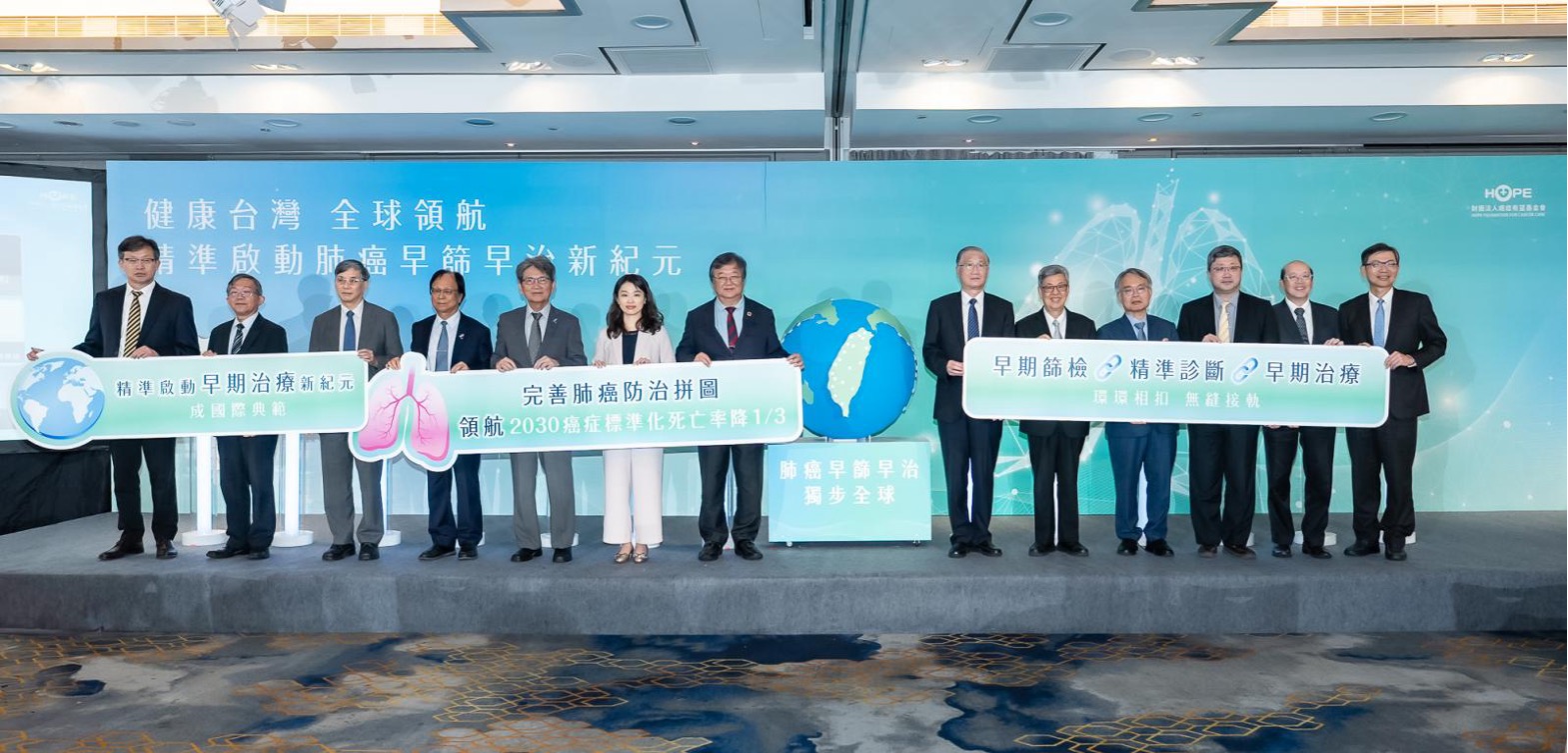
During his recent visit to Taiwan, Dr. Cary Adams, CEO of the Union for International Cancer Control (UICC), commended Taiwan's National Cancer Control Program, its comprehensive cancer registry, and robust National Health Insurance (NHI) system for establishing an exemplary cancer care network. He encouraged Taiwan to further improve early lung cancer screening rates and timely access to treatment, reinforcing its status as a global public health leader. At the conference, Minister of Health and Welfare Dr. Chiu Tai-Yuan pledged ongoing cross-ministerial collaboration and policy innovation to improve early lung cancer detection and treatment. Legislator Wang Cheng-Hsu also reaffirmed his commitment to early detection and intervention, advocating for increased resources and improved legislation to ensure early-stage lung cancer patients receive comprehensive care.
Leading medical experts further emphasized Taiwan's advancements. Dr. Yang, Pan-Chyr, Academician of Academia Sinica, highlighted how the LDCT screening program has driven a shift toward earlier-stage diagnosis, with research indicating it could reduce lung cancer mortality by 53%. Dr. Chen Chien-Jen, Academician of Academia Sinica emphasized that the next key challenge is ensuring early-stage patients benefit from precision diagnostics and early treatment. Dr. Yang Cheng-Ta, President of the Taiwan Lung Cancer Society, added that emerging AI technology is now capable of analyzing LDCT images to predict an individual's six-year cancer risk, which will improve identification of high-risk groups and support early intervention. Dr. Yang Chih-Hsin, President of Taiwan Association for the Study of Lung Cancer, urged early-stage patients to undergo genetic testing promptly, enabling medical teams to tailor optimal treatment plans, including surgery, targeted therapy, or immunotherapy as adjuvant treatments.
HOPE called for NHI resources to shift toward early lung cancer diagnosis and treatment, highlighting the importance of genetic testing and adjuvant therapy for high-risk early-stage patients to reduce relapse and mortality. Clinical evidence shows that adjuvant targeted therapy after surgery for stage IB–IIIA lung cancer with EGFR mutations can reduce five-year mortality by 10%, which is vital for improving outcomes and easing the burden on the healthcare system. Dr. Chen Jin-Shing, Head of Thoracic Surgery Division at National Taiwan University Hospital, advocated for priority reimbursement of adjuvant targeted therapy for patients with stage IB-IIIA lung cancer, while Dr. Chen Chih-Yi, Board Member of HOPE emphasized the importance of improving access to early genetic testing and treatment. Dr. Huang, Ming-Shyan, President of the Taiwan Clinical Oncology Society, pointed out that early-stage lung cancer treatment in Taiwan is not yet fully aligned with international guidelines, and urged that expanded screening must be matched with optimized NHI resource allocation and improved treatment access.
Other leading voices reinforced the need for comprehensive care. Dr. Wang Chin-Chou, Board Member of Taiwan Society of Pulmonary and Critical Care Medicine, stressed that while surgery is the primary treatment for early-stage lung cancer, it must be accompanied by proactive adjuvant therapy strategies and long-term follow-up. Dr. Chang Wen-Cheng, CEO of Taiwan Cancer Foundation emphasized that the integration of screening, diagnosis, and treatment is crucial to truly realize early detection and treatment, as well as maximizing the value of screening program. Dr. Chen Jen-Shi, President of Taiwan Oncology Society, recommended that in addition to current NHI and Cancer Drug Fund financing, the government should promote diverse payment mechanisms—such as co-payment models or commercial insurance to supplement the NHI system—to further improve access to early lung cancer treatment.
Uniting multiple lung cancer treatment experts from medical centers across Taiwan, a concerted effort to usher in a new era of early lung cancer screening and treatment. (Listed by institution from North to South)
· Dr. Chen Yu-Min, Director of General Chest Medicine Department, Taipei Veterans General Hospital
· Dr. Lee Kang-Yun, Attending Physician, Division of Pulmonary Medicine, Shuang Ho Hospital
· Dr. Huang Chun-Yao, Attending Physician, Division of Chest Medicine, Taipei Tzu Chi Hospital
· Dr. Tsai Chen-Liang, Director of Pulmonary and Critical Care Medicine Division, Tri-Service General Hospital
· Dr. Yeh Yu-Wen, Physician, Division of Thoracic Medicine, Shin Kong Wu Ho-Su Memorial Hospital
· Dr. Chang Sheng-Yu, Attending Physician and Leader of the Lung Cancer Team, Far Eastern Memorial Hospital
· Dr. Yang Tsung-Ying, Director of General Chest Medicine Department, Taichung Veterans General Hospital
· Dr. Hsia Te-Chun, Deputy Director, Department of Internal Medicine, China Medical University Hospital
· Dr. Lin Chien-Chung, Attending Physician, Division of Chest Medicine, National Cheng Kung University Hospital
Hashtag: #HOPEFoundation
The issuer is solely responsible for the content of this announcement.