SEAMEO STEM-ED and Partners Highlight Two-Year SEA-TEP Program Success, Advancing STEM Teacher Education with Chevron’s Support
BANGKOK, THAILAND - Media OutReach Newswire - 14 August 2025 - The two-year Southeast Asian Teacher Education Programme (SEA-TEP), led by SEAMEO STEM-ED (The Southeast Asian Ministers of Education Organization Regional Centre for STEM Education) and regional partners, through the Chevron-funded education initiative marked a significant milestone in develop scalable model for STEM teacher education reform across Southeast Asia.
The programme's achievements were presented during the Thailand International Conference on Education Research (ThaiCER) 2025: The Education for the Future during 7th-9th August 2025, in Bangkok, Thailand, underscoring a pivotal step forward in strengthen the capacity of STEM education for both pre-service and in-service programmes, regional collaboration, and innovative instructional practices to prepare educators to meet the demand of 21st-century classrooms and international assessment benchmark.
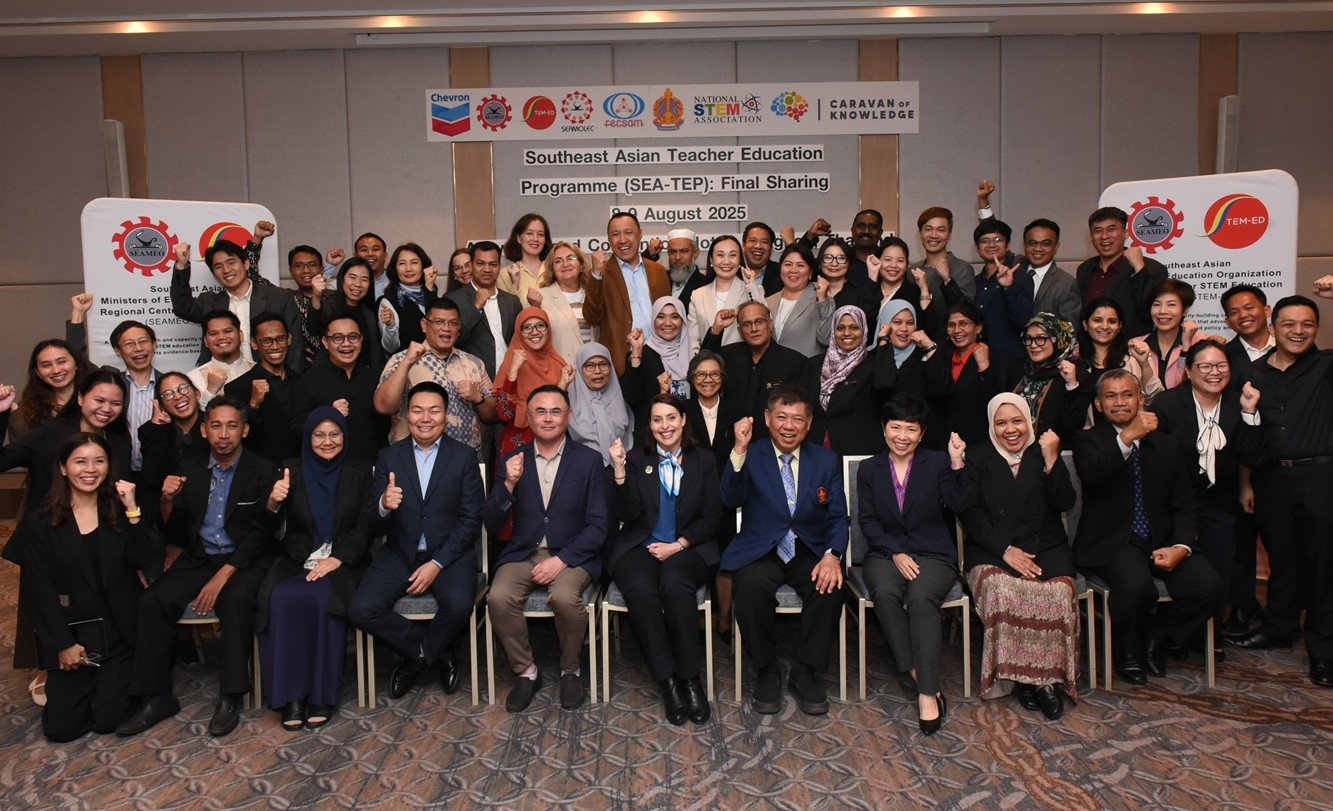
Across Southeast Asia, education systems continue to face critical challenges in teacher preparation including limited access to high-quality pre-service training, insufficient integration of interdisciplinary integration, and a lack of effective, instructional resources. Addressing these systemic gaps creates an important opportunity to enhance high-quality STEM education across the region to meet the demands of rapidly changing world. In response to these challenges, the Southeast Asian Teacher Education Programme (SEA-TEP) was launched in March 2023 with implementation in Kazakhstan, Thailand, Cambodia, Indonesia and Malaysia. SEAMEO-STEM-ED works in partnership with SEAMEO SEAMOLEC, SEAMEO RECSAM, the National STEM Association Malaysia, Caravan of Knowledge, and Cambodia's Ministry of Education and leading regional teacher education institutions to collaboratively deliver a model for transformative teacher development through across diverse education systems.
The SEA-TEP interventions introduce innovative instructional practices for pre-service and in-service teachers, ensuring the development of phenomenon-based STEM lessons that incorporate effective strategies and digital tools. These practices are closely aligned with the OECD's PISA 2025 Science Framework.
SEA-TEP adopts instructional materials grounded in the United States' Next Generation Science Standards (NGSS) while also responding to local classroom contexts—highlighting the importance of contextualizing STEM learning units. Participants learn to design lesson plans using the Claim–Evidence–Reasoning (CER) framework and modelling techniques. These approaches help students move beyond rote memorization, fostering evidence-based reasoning and critical thinking through curriculum innovation that reflects the competencies assessed by PISA.
Dr. Kessara Amornvuthivorn, SEAMEO STEM-ED's Programme Director said, "The SEA-TEP model provides a structured approach to strengthening teacher education through collaboration across national and regional networks. By building the capacity of education leaders, SEA-TEP offers a scalable model for advancing STEM instruction. SEAMEO STEM-ED has partnered with implementation teams in five countries to enhance STEM teaching practices through the adoption of high-quality learning materials. The program has delivered professional development to more than 120 educators from 24 universities and teacher development institutes. Faculty members from these institutions have cascaded the training to over 1,500 pre-service and in-service teachers across 214 schools. By empowering both educators and institutions, SEA-TEP is contributing to the improvement of STEM teaching standards across participating countries and offering a promising model for regional collaboration in teacher education and development."
Zamira Kanapyanova, General Manager, Corporate Affairs, Eurasia Pacific, Chevron added, "At Chevron, we believe that empowering educators with the right tools and resources is important for nurturing the next generation of innovators, engineers, and problem-solvers. Through strategic regional programs like SEA-TEP, we aim to strengthen the foundation of STEM learning and help build a more resilient and competitive workforce for the future."
The implementation of SEA-TEP across Southeast Asia has resulted in measurable improvements in student learning outcomes. Participating teachers reported that the SEA-TEP strategies helped students connect abstract scientific concepts with real-world applications. Notably, teachers observed clearer, evidence-based reasoning in student work, especially when using CER tools in environmental investigations. Prior to SEA-TEP's adoption, many students struggled to apply scientific principles to everyday contexts. Post-implementation, however, classroom experiences revealed marked growth: students now demonstrate the ability to design experiments, interpret data, and make informed decisions based on diverse evidence sources. A significant improvement was also observed in students' ability to make well-founded claims supported by concrete evidence and scientific reasoning.
These insights from teacher feedback highlight how SEA-TEP not only aligns with global education goals but also empowers educators to cultivate inquiry-based learning environments—ensuring students are equipped with the critical thinking skills needed to navigate global challenges.
First Vice-Minister of Education, Maira Meldebekova of the Republic of Kazakhstan said "SEA-TEP program is an example of fruitful international cooperation and large-scale changes in education. Such initiatives make it possible to test new formats of work with teachers, adapt and scale best practices at the national level. Teacher training modules that incorporated best practices from participating countries contributed to developing STEM approaches among teachers in Kazakhstan and transformation of STEM education.
Ministry of Education of the Republic of Kazakhstan would like to extend our sincere gratitude to our strategic partners for their contribution to development of practical and cross-functional approaches to education".
The success of SEA-TEP lays a strong foundation for advancing policy integration in STEM teacher education across Southeast Asia and Kazakhstan. To ensure long-term impact, early engagement with decision-makers is key. In Kazakhstan, Policy recommendations emerging from the programme include revising national educational standards to promote interdisciplinary learning at the secondary level and establishing government-endorsed registries of certified STEM trainers. In response to a ministerial decree promoting innovation infrastructure within teacher training institutions, Ualikhanov University and Caravan of Knowledge are establishing a STEAM Competence Center to deliver high-quality professional development focused on STEM innovations. Furthermore, fostering regional professional learning communities (PLCs) is critical to ensure targeted teaching support and instructional leadership. These policy directions highlight how SEA-TEP model can serve as a strategic enabler for systemic STEM teacher education reform throughout Southeast Asia and Kazakhstan.
Following the regional sharing and reflection session, SEA-TEP's final stage now focuses on consolidating key research insights, capturing best practices, and informing long-term strategies for sustainability and policy adoption. The success of SEA-TEP continues to serve as a path for advancing high-quality STEM teacher education across Southeast Asia and beyond.
Hashtag: #SEAMEOSTEMED #STEM #TEACHER #EDUCATION #SEATEP #CHEVRON
The issuer is solely responsible for the content of this announcement.