


Small Chinese city reaps global success with sunflowers
HOHHOT, CHINA - Media OutReach Newswire - 6 February 2025 - At 57, Wang Fei is hailed as the "King of Sunflower Seeds" in his hometown of Bayannur, in northern China.
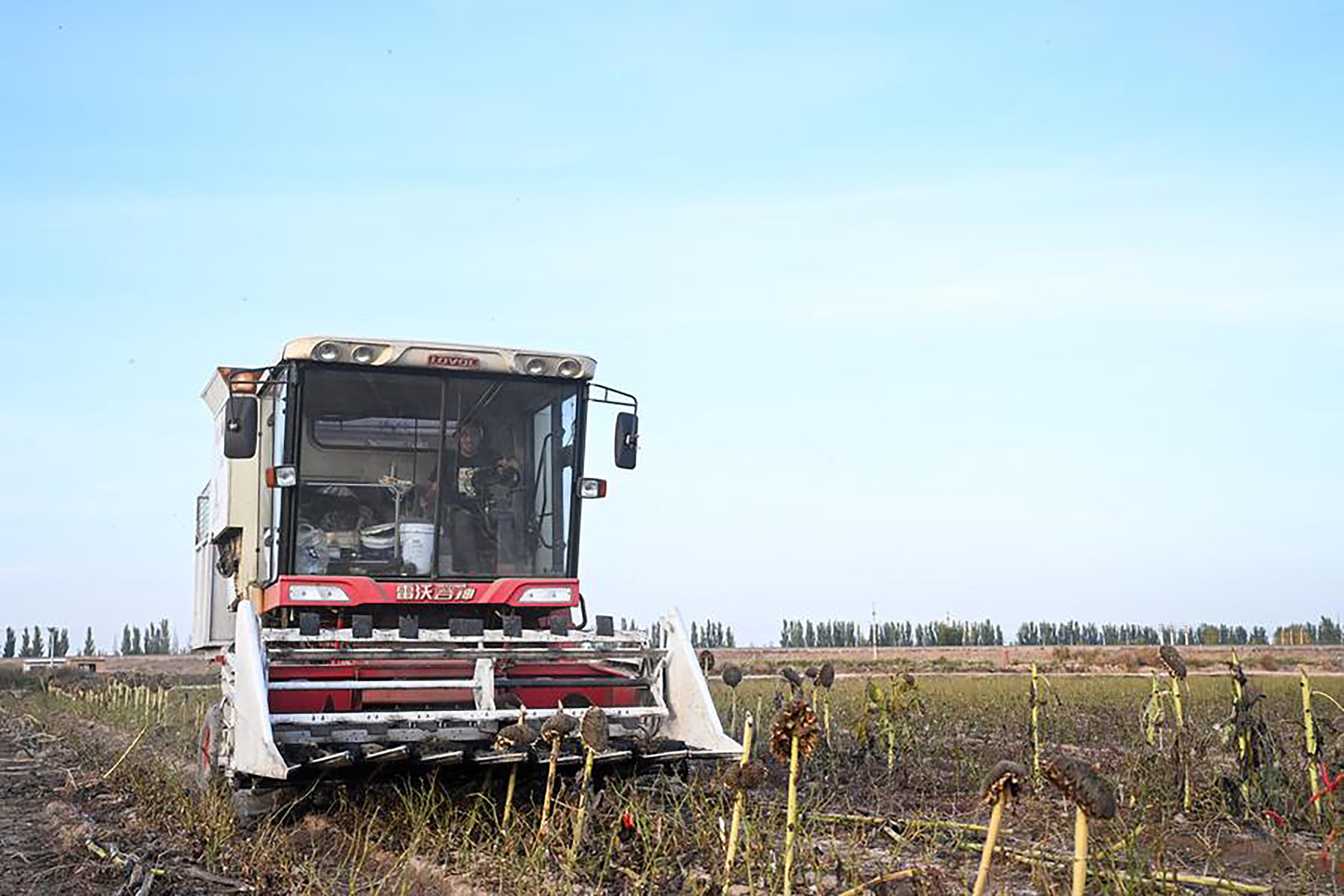
A farmer drives a harvester to harvest sunflower seeds in a field in Linhe District of Bayannur, north China's Inner Mongolia Autonomous Region
The title reflects not only his passion for the crunchy snack but also his remarkable achievement in transforming locally grown sunflower kernels into a global commodity, with markets spanning the Republic of Korea, Egypt and Germany.
If you enjoy eating sunflower seeds, there's a good chance they originated from the saline-alkali fields of Bayannur - China's largest base for edible sunflower production. In 2024 alone, the region produced more than 940,000 tonnes of sunflowers, with exports spanning over 40 countries and regions.
Wang is one of the local farmers who have leveraged the booming sunflower industry to become a successful entrepreneur.
BOOMING INDUSTRY, CHALLENGING LAND
Located in the Inner Mongolia Autonomous Region, Bayannur was once burdened by nearly 4.8 million mu (320,000 hectares) of saline-alkali land, where traditional crops like wheat and corn struggled to grow.
The introduction of sunflowers in the 1970s marked a turning point for the city with a permanent population of 1.5 million.
With its distinct seasons, abundant sunshine, vast plains and ample water resources, Bayannur offered an environment strikingly similar to the sunflower's native habitat in North America, making it an ideal setting for this resilient crop, according to Zhang Ruhong, vice mayor of Bayannur.
In the 1980s, Wang began cultivating sunflowers on his family's saline-alkali land. "They are resistant to salt and alkali, drought-tolerant and easy to grow," he said.
By 2024, Bayannur had expanded its sunflower planting area to 4.4 million mu, nearly half of the country's total. The city's sunflower industry has flourished into a comprehensive value chain, encompassing seed sales, cultivation, processing, exports, e-commerce logistics and even tourism.
Sunflowers are the world's fourth-largest oilseed crop, following soybeans, rapeseed and peanuts, said Zhang Haiyang, an oilseed industry expert.
He noted that sunflowers have gained prominence as a key specialty oilseed crop in China, particularly in northern regions, thanks to their high nutritional and aesthetic value.
The sunflower seed market was valued at 32.3 billion U.S. dollars in 2023 and is projected to grow at a compound annual growth rate of around 9.4 percent between 2024 and 2032, according to Global Market Insights, a market research and management consulting firm.
To take Bayannur's sunflower industry to new heights, local agricultural scientists have successfully introduced high-quality seed varieties, including SH361 and SH363, as well as a resistant strain specially designed to combat broomrape, a parasitic plant that has long plagued sunflower production globally.
TINY SEEDS, BIG JOURNEY
In the run-up to the Spring Festival, the factories of Bayannur buzzed with activity as machines roared and workers hustled to sort sunflower seeds for export.
"We were extremely busy before the holiday, as we wanted to complete and ship all orders abroad," said Zhao Lei, general manager of Bayannur Rong Da Co., Ltd. "Our sunflower seeds have seen strong overseas demand last year, with exports reaching 35,000 tonnes."
Across China, many regions have cultivated industries tailored to their unique local conditions. For instance, oranges from Ganzhou in Jiangxi Province and strawberries from Dandong in Liaoning Province have become key drivers of social and economic development.
Bayannur has also leveraged its local strengths, establishing 120 leading sunflower processing enterprises to seize market opportunities.
Wang Fei, who began trading sunflower seeds domestically in 1987, ventured into the international market in 2012. Last year, his company, Mintai Agricultural Trading Co., Ltd., recorded operating revenues exceeding 700 million yuan (about 97.63 million U.S. dollars), with exports making up the bulk.
"In China, people love eating sunflower seeds during festivals. Foreigners share this habit as well. Holidays like Christmas mark our peak export seasons," Wang said, adding that the holiday economy strongly stimulates consumption.
Bayannur's sunflower seeds and kernel products now reach over 40 countries and regions in the Middle East, Southeast Asia and Europe, generating an annual export value of 4.2 billion yuan -- 64 percent of the city's total agricultural exports.
These achievements are underpinned by strong policy support. Over the past two years, Bayannur has implemented innovative strategies to promote exports, such as fostering leading companies to establish overseas warehouses, advancing cross-border e-commerce, and streamlining customs clearance processes.
Challenges like rising shipping costs, exacerbated by the Red Sea crisis, have also driven adaptability. Last year, Wang began shifting some shipments from sea to land transport, exporting sunflower seeds to Europe via China-Europe freight trains, significantly reducing costs.
"My goal this year is to expand my sunflower seed exports into the Spanish market," he said with a smile.
Hashtag: #Bayannur
The issuer is solely responsible for the content of this announcement.










