The George Christensen formula — how do maverick MPs succeed in Australian politics?
- Written by: Paul Williams, Senior Lecturer, School of Humanities, Griffith University
Nationals MP George Christensen recently copped condemnation[1] from federal parliament for spreading misinformation about COVID-19.
The member for the central Queensland seat of Dawson falsely claimed masks and lockdowns were ineffective against the spread of COVID, demanding governments “open society back up” to “restore our freedoms [and] end this madness”. In a rare move, both Labor and the government backed the motion against him.
The comments were outrageous, but not surprising. Christensen, who has been in parliament since 2010, has a long history[2] of courting controversy, including comments on Muslim immigrants and global warming.
Why do people listen to him? Where does his power base come from?
Democratically elected, so…
Understanding why Christensen can make such statements — and why the news media report them — is simple: as a democratically elected MP, he is entitled to air even the most egregious views under parliamentary privilege.
Of course, the parliament is equally entitled to condemn him. And the more novel his views, and the more conflict they produce, the more likely they are to be reported.
What is more difficult to explain, however, is how and why maverick politicians succeed in a liberal democracy like Australia, where the confines of political discourse have traditionally been quite narrow.
Unlike many European polities, Australian politics have never really entertained hard socialism on the left or ultra-conservatism on the right, at least until the rise of Pauline Hanson’s One Nation in the late 1990s.
The maverick tradition in Australia
Yet mavericks have existed since the earliest days of Australian politics.
Before the evolution of the modern party system 130 years ago, rogues were common in legislatures free from party constraints. Today, given the major parties’ discipline over their MPs — most of whom boast frontbench ambitions — and an aggressive Fourth Estate, political mavericks are much rarer.
Read more: Twenty years on, One Nation is still chaotic, controversial and influential[3]
And those who fail to toe the party line are often forced out. Pauline Hanson, Bob Katter, Clive Palmer, Fraser Anning (Queensland appears to be a natural home to mavericks) are just a few examples of those who left established parties to lead their own, self-titled brigades.
Other mavericks include Graeme Campbell (Western Australia), Jacqui Lambie (Tasmania) and Fred Nile, Mark Latham and Craig Kelly (NSW).
While overwhelmingly from conservative ranks, mavericks have come from the centre, such as South Australia’s Nick Xenophon. They have also come from the hard left, in the case of Queensland’s Fred Paterson, Australia’s only Communist Party MP, elected to a central Queensland seat in the 1940s.
What is it about Queensland?
But what is it about Queensland regional voters and their predilection for mavericks?
The answer lies in understanding Queensland’s unique political culture – steeped in a populism that vilifies “elites” and “outsiders”. This itself built upon five pillars:
- a reverence for strong, opinionated leaders
- a demand for regional services across Australia’s most decentralised mainland state
- a demand for local infrastructure
- a preference for political pragmatism (“common sense” solutions to complex problems)
- a Queensland chauvinism that encourages locals to feel superior to other Australians.
In a decentralised state overwhelmingly dependent on primary industries, where regional voters[4] boast significantly higher rates of Christian identity and lower rates of higher education and multiculturalism, it’s perhaps unsurprising regional Queensland has long been shaped by frontier politics.
And any regional MP hoping to maintain electoral support must pander at least to some of these elements.
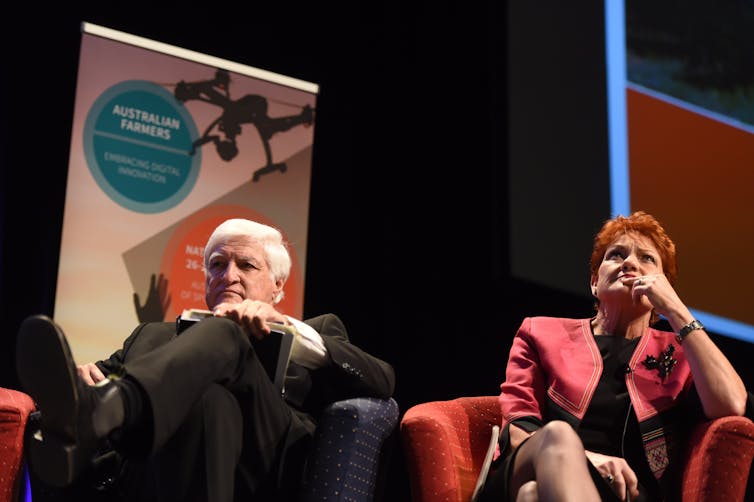 Bob Katter and Pauline Hanson are two more examples of ‘maverick’ MPs who hail from Queensland.
Lukas Coch/AAP
Bob Katter and Pauline Hanson are two more examples of ‘maverick’ MPs who hail from Queensland.
Lukas Coch/AAP
Christensen, for example, has previously called for a ban on the burqa and Muslim immigration from “radicalised” countries. In 2016, he floated the return of the death penalty. In 2014, the MP labelled environmentalists “terrorists” and, in a statement he later regretted[5], described the “Safe Schools” program as paedophile “grooming”.
Yet Christensen also supported a banking royal commission when his Coalition colleagues would not. And while his pandemic libertarianism – rooted in Donald Trump’s Republicanism – is a new development on the Australian hard right, it’s hardly surprising it finds a ready audience among regional Queenslanders, already suspicious of capital city power.
Christensen’s success
The formula appears to work. The seat of Dawson, based on sugar farming districts surrounding Mackay, has been in Country/ National/Liberal-National party hands for all but 12 of its 72-year history. But over the past decade, Christensen has turned a thin after-preference margin of 2.4% into a safe 14.6% buffer.
However, the Christensen style has come at a cost. In sating the appetite of local voters, the MP has inevitably angered metropolitan colleagues and, therefore, blocked any chance of promotion.
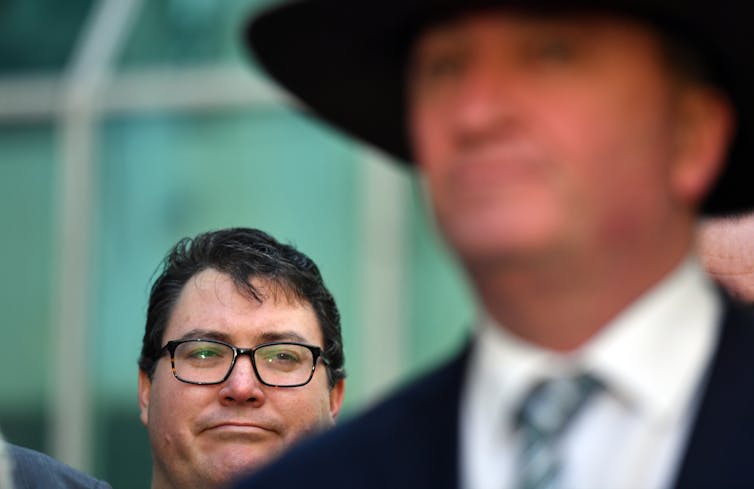 Nationals leader Barnaby Joyce (pictured in 2016) argues it is better not to provoke Christensen.
Mick Tsikas/AAP
Nationals leader Barnaby Joyce (pictured in 2016) argues it is better not to provoke Christensen.
Mick Tsikas/AAP
Interestingly, returned Nationals’ leader Barnaby Joyce, himself something of a maverick, refuses to rebuke his MP — Joyce insists it’s worse than useless to “prod the [Christensen] bear”. Given the Morrison government’s razor-thin majority, an unwanted by election could plunge the Coalition into crisis.
In April, Christensen stunned observers when he announced his retirement[6] at the next federal election. On Sunday, Whitsunday Regional Council Mayor Andrew Willcox was preselected[7] as the Liberal National Party’s candidate for Dawson. Coal miner Shane Hamilton[8] will contest the election for Labor.
Christensen’s successor won’t have to mirror him to hold the seat, but engaging in at least some of his populist behaviour will go far in building support over the longer term.
In choosing the timing of his own departure from a safe seat at age just 43, it seems Christensen remains a maverick to the very end.
Read more: Right out there: how the pandemic has given rise to extreme views and fractured conservative politics[9]
References
- ^ copped condemnation (www.abc.net.au)
- ^ long history (www.sbs.com.au)
- ^ Twenty years on, One Nation is still chaotic, controversial and influential (theconversation.com)
- ^ regional voters (onlinelibrary.wiley.com)
- ^ later regretted (www.sbs.com.au)
- ^ announced his retirement (www.abc.net.au)
- ^ preselected (www.abc.net.au)
- ^ Shane Hamilton (7news.com.au)
- ^ Right out there: how the pandemic has given rise to extreme views and fractured conservative politics (theconversation.com)