We need the arts to live, but artists need to earn a living
- Written by: Mark Harvey, Senior Lecturer in Creative Arts, University of Auckland
It seems unlikely the arts will be a priority in the government’s May 20 budget. With housing affordability, climate change and child poverty all urgent issues, arts funding might not be seen as equally important.
I argue it is — for two main reasons: it makes economic sense, and it is also essential to our health and well-being in myriad ways. The two are, of course, interrelated.
Despite the wider arts sector accounting for up to 7% of the total workforce, it receives a disproportionately small proportion of overall government spending.
Last year, arts, culture and heritage were given just 0.33% of the total 2020 Budget and COVID-19 Recovery[1] package (NZ$374 million out of $112.1 billion). This was an increase on previous years, but still miniscule compared with other sectors.
And yet the performing arts alone contributed $2.3 billion[2] to the economy in 2018. According to the Ministry for Culture and Heritage, the sector “matched or outpaced other sectors of the economy in terms of income, employment and value added”.
Furthermore, New Zealanders participate in cultural activities at least as much[3] as in sports and other recreations. For Māori, arts and culture overshadow sports and other leisure activities.
The myth of suffering for your art
Still, the arts struggle to secure continued long-term funding. For example, a scheme such as the Pathway to Arts and Culture[4], removed in 2011 by the National-led government, has not been reintroduced. But this could secure a liveable income for many working in the creative arts.
According to a 2019 survey[5] by Creative New Zealand, the average annual income of freelance creative artists was just $15,000. Without greater support and investment, artists will continue to be some of the country’s lowest earners.
Read more: If New Zealand can radically reform its health system, why not do the same for welfare?[6]
Some people will be unsympathetic. There are persistent myths about the creative arts – that it is not “real work” and that artists must “suffer for their art” – that contribute to negative perceptions of the sector.
But these notions are just that – myths. There is no evidence creativity requires practitioners to suffer, that it is part and parcel of being creative. We know the arts can improve mental health[7], but working in poverty as an artist can do quite the opposite[8].
Understanding the place of art in society
In my role as a parent, educator and arts practitioner, however, I often hear those myths expressed — that those working in the sector are not contributing to society in any meaningful or useful way, that they should “get a real job”.
These views are reinforced in many ways. The creative arts are not compulsory at all secondary schools, and anecdotal evidence suggests guidance counsellors often steer students away from careers in the arts.
All this suggests overly narrow definitions are at work. I define the creative arts as including any discipline – from writing to fine arts to film and television production – that exists in community, educational and professional contexts.
Read more: Has the government rescued the arts in this budget? There are some winners but not much has changed[9]
If our appetites for Netflix[10] and Spotify[11] are anything to go by, we turn to the creative arts every day. They are a fundamental part of our lives, identities and ways of seeing the world.
We could learn from Te Ao Māori (the Māori world) where everything is interconnected and the creative arts are integral, not just “cultural relief” to ease our daily toils as workers or part of a temporary COVID recovery package.
In Te Ao Māori the arts help communicate who we are, our spirituality, our well-being and our whakapapa. They are an essential part of our tikanga that we use to navigate existing together as whanau, communities, iwi and hapū.
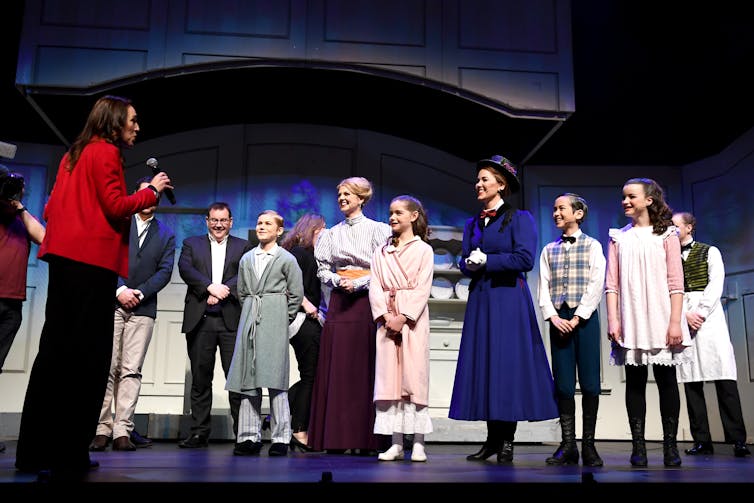 The arts are integral: Prime Minister and Associate Arts Minister Jacinda Ardern meets the cast of Mary Poppins in Auckland during the 2020 election campaign. GettyImages
We need the arts more than ever
It’s not that the government doesn’t acknowledge the role of the arts in the nation’s health and well-being. Prime Minister and Associate Minister for Arts Jacinda Ardern has spoken and written[12] publicly about this on several occasions.
The government has also used temporary support packages to help arts organisations and professionals through the pandemic. However, there have been no significant long-term funding increases for arts practitioners, nor for arts education, and most COVID grants are limited to building commercial capacity.
What to do? The government needs to consult with practitioners, researchers and experts across all genres of arts practice to determine how and where to invest for the best returns, and how to build a sustainable life as an artist.
Read more: Artists' welfare: why it's time to act[13]
For too long arts practitioners have been told what they need by central and local government and arts managers, or asked repeatedly to prove the value of what they do. As my colleague Molly Mullen has argued[14]:
What is needed in Aotearoa is not another blunt impact assessment tool, but an informed, critical conversation about what resources, support, tools and knowledge are needed.
With current existential crises such as COVID-19, climate change, growing inequality, housing security and populist politics, we need the creative arts more than ever to make sense of the world and how to live in it.
Now is the time for our government to show the value it places on that vital function.
References
- ^ 2020 Budget and COVID-19 Recovery (www.treasury.govt.nz)
- ^ contributed $2.3 billion (mch.govt.nz)
- ^ at least as much (www.stats.govt.nz)
- ^ Pathway to Arts and Culture (www.beehive.govt.nz)
- ^ 2019 survey (www.creativenz.govt.nz)
- ^ If New Zealand can radically reform its health system, why not do the same for welfare? (theconversation.com)
- ^ improve mental health (www.mentalhealth.org.uk)
- ^ the opposite (www.independent.co.uk)
- ^ Has the government rescued the arts in this budget? There are some winners but not much has changed (theconversation.com)
- ^ Netflix (thinktv.co.nz)
- ^ Spotify (www.statista.com)
- ^ written (www.nzherald.co.nz)
- ^ Artists' welfare: why it's time to act (theconversation.com)
- ^ argued (artsaccess.org.nz)