
Remembering Andrew Peacock, a Liberal leader of intelligence, wit and charm
- Written by: Ian Hancock, School visitor, Australian National University
Andrew Sharp Peacock, for so long “the coming man” of Australian politics, has died in the United States aged 82.
Born in 1939, he was educated at Scotch College, Melbourne, acquired a law degree at the University of Melbourne, where he also met his first wife, Susan Rossiter, the daughter of Victorian Liberal politician Sir John Rossiter.
By the age of 26 he had been president of the Victorian Young Liberals and became president of the Victorian Division of the Liberal Party at a time when Victoria was the Liberals’ “jewel in the crown”.
Liberal warhorses, of whom Senator Magnus Cormack[1] was one, saw Peacock as the future of the Liberal Party. Peacock also gained an impeccable contact with the past when, in 1966, he succeeded Sir Robert Menzies[2] in the seat of Kooyong.
He immediately attracted attention when he arrived in Canberra, where in the Liberal Party Room he experienced the resentment of the envious and of the by-passed.
There was a minor setback when John Gorton in 1968 brought another Victorian, Phillip Lynch[3], into the ministry, overlooking Peacock who believed Gorton had promised him a promotion. Perhaps surprisingly, 35 years later Peacock was still expressing hurt at being overlooked.
In the parliamentary party, he joined the so-called Mushroom Club[4] with other good friends like Jim Killen, Tom Hughes and Don Chipp, all of whom were expected to advance, and did so.
Gorton promoted Peacock after almost losing the supposedly the unlosable election of 1969[5]. As minister for the army, Peacock found it difficult working under Defence Minister Malcolm Fraser, and would again feel a lasting pain when “Bill” McMahon, with Fraser’s help, displaced Gorton in March 1971[6].
Peacock survived a McMahon cull of Gorton supporters, performed well as minister for external territories, and stayed on the front bench after Gough Whitlam won the 1972 election.
The “coming man” appeared closer to arrival when Fraser appointed Peacock foreign minister in 1975, a move that benefited Fraser by keeping a potential challenger out of the country.
Read more: Vale Bob Hawke, a giant of Australian political and industrial history[7]
The job meant Peacock could do what he always did so well: meeting and greeting the high-ranking and influential from around the world. His natural charm, good looks and genuine goodwill, combined with a sympathy for people and an understanding of different countries’ situations, enabled him to work with and alongside Asians and Africans, Europeans, Americans and Pacific Islanders.
Cormack wanted his “pupil” to challenge Fraser for the leadership. Peacock flopped badly when, having previously moved to the seemingly unsuitable portfolio of industrial relations, he did try for the leadership in 1982.
At least he was well placed to succeed Fraser after the Coalition lost the 1983 election to Bob Hawke’s Labor Party. Peacock proceeded to lose two of his own – in 1984 and 1990 – while doing better than expected in adverse circumstances in opposing Hawke.
Critically, however, Peacock exposed a weakness that offset the advantages of intelligence, charm, and apparent self-possession. Beyond proclaiming the shibboleths, it was never clear just what he believed in and what he stood for.
During Peacock’s supposed rivalry with Howard – beneath the surface it was really one between their supporters – one senior moderate Liberal explained his own dilemma:
do I vote for Howard, whose views I dislike, or for Peacock, whose views remain a mystery?
A former federal president from the 1980s once described Peacock as a man who would denounce you in a “vile” manner and then walk through a door, see you, smile broadly and greet you warmly.
After losing in 1990, Peacock drifted towards the exit door of politics and looked more at ease as the Howard-appointed Ambassador to the United States. At the end of his tenure in 2000 he took various positions in business in America and Australia.
So, why did the “coming man” never arrive at the Lodge? Commentators usually scoffed at Peacock’s own explanation that he was never sure he really wanted the top job.
Yet, looking at how he went about his early career in the Liberal Party, where he was striving to advance himself and was not in a mood to accept setbacks, he was not the same man who reached for the party leadership three times in the 1980s.
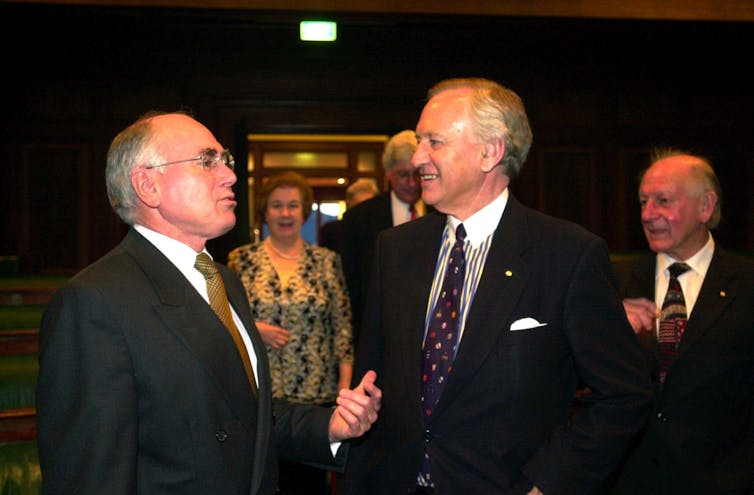 Peacock with John Howard in 2000.
AAP/Alan Porritt
Peacock with John Howard in 2000.
AAP/Alan Porritt
Unlike Peacock, Fraser and Howard went for the leadership with agendas. They stood, most of the time, for identifiable and consistent positions and they were there for the long haul.
Peacock was probably at his best when he left that world behind him.
He married happily the third time, and through Penne Percy Korth gravitated to a world occupied by the more moderate Republicans. He also had a close relationship with his three daughters.
Beyond appearances, Peacock had the endearing quality of generating a natural warmth, charm and wit.
References
- ^ Senator Magnus Cormack (biography.senate.gov.au)
- ^ he succeeded Sir Robert Menzies (www.theage.com.au)
- ^ Phillip Lynch (adb.anu.edu.au)
- ^ Mushroom Club (www.moadoph.gov.au)
- ^ election of 1969 (en.wikipedia.org)
- ^ displaced Gorton in March 1971 (www.naa.gov.au)
- ^ Vale Bob Hawke, a giant of Australian political and industrial history (theconversation.com)