Christine Holgate gets her own bully pulpit – and uses it to effect
- Written by: Michelle Grattan, Professorial Fellow, University of Canberra
Queensland Nationals Senator Matt Canavan, juggling a couple of committee engagements, hadn’t planned to attend Tuesday’s hearing at which former Australia Post CEO Christine Holgate appeared.
But party elder Ron Boswell was insistent, telling Canavan he must be there, in the room, fighting for Australia Post’s small business licensees.
Boswell, himself a former senator, retains one of the best political “noses” in the business. He’d spoken to Canavan soon after the Holgate affair blew up last October, warning the issue was trouble and needed to be fixed.
Canavan was initially sceptical, thinking people would react against the Cartier watches she’d given four executives as a reward for a deal with banks to shore up Post’s licensee network.
But he’s come round to Boswell’s thinking.
The government has been somewhat dismissive of the campaign the licensees have waged in support of Holgate.
But Canavan judges the many small post office businesses in regional areas could pack quite a punch in next year’s election campaign if they chose. And in these areas in Queensland the Nationals are competing with One Nation.
At Tuesday’s hearing, Canavan wasn’t backward. It was he who put to Post’s chairman Lucio Di Bartolomeo the pointed question: “Given that, as you say, Miss Holgate has a lot of support amongst your employees and important clients and suppliers, and given that Miss Holgate this morning has called for your resignation, would it not be better for Australia Post if you were to leave now, as well?” It was a reasonable proposition, but the chairman said he wasn’t going anywhere.
What has been notable, as Holgate lashed out at Prime Minister Scott Morrison for “bullying” her with his parliamentary tirade and Di Bartolomeo for not backing her, is the breadth of her constituency of support. It includes business figures and respected financial journalists, as well as the licensees.
Read more: View from The Hill: Christine Holgate presents a compelling story of Morrison's bullying[1]
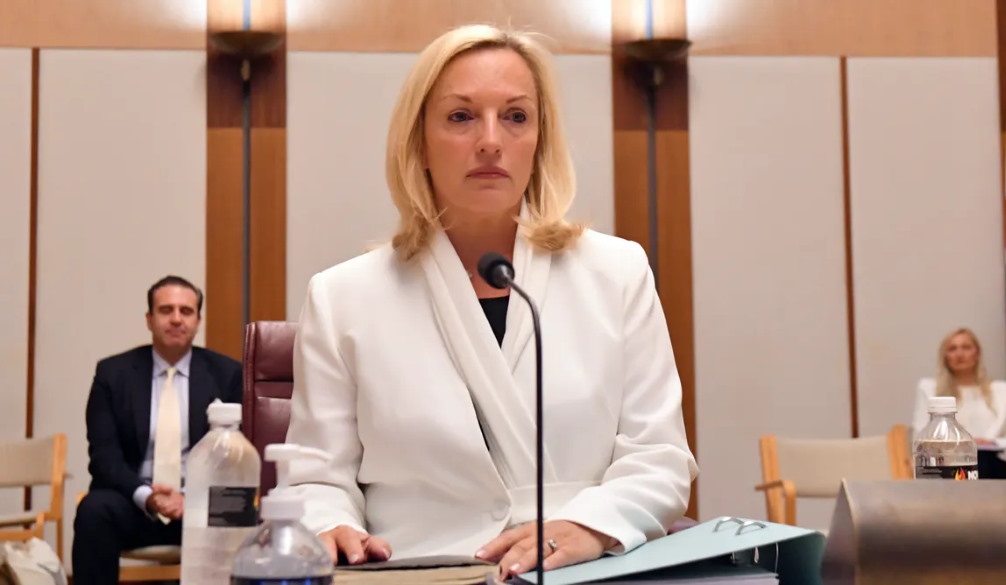
With her claim gender was a factor in how she was treated, and the suffragette-white attire, she has now astutely tapped into the new women’s movement that’s arisen off the back of the Brittany Higgins issue. In doing this, she’s hit Morrison where he’s particularly vulnerable.
Politically, her advocates stretch from Greens Senator Sarah Hanson-Young to One Nation’s Pauline Hanson, who was the moving force behind the Senate inquiry.
The bedfellows might be somewhat uncomfortable with each other, but it’s a big bed.
The week left Morrison and the government on the ropes over Holgate’s treatment. References to “luxury watches” have lost much of their shock value.
The government can only hope the issue will simply fade with time, as issues do. Except that those small business operators mightn’t forget.
There’s an interesting contrast in how Morrison is currently dealing with Higgins, who alleges she was raped by a colleague in a minister’s office, and with Holgate.
The PM has reaffirmed he plans to meet Higgins. She’s indicated she’s not keen on re-entering Parliament House, so he’s willing to arrange another venue. He says he’s looking forward to hearing what she has to say.
Holgate, who wants an apology from Morrison, this week asked him to call her.
But he rejected that as unnecessary. Outstanding issues are between her and the Post board, he said. That may be true. By the same token, not to make the gesture is discourteous, at the least.
Remember, this was an executive who performed extremely well at Australia Post and who came out of the inquiry into the watches affair with only minor points against her.
Neither Morrison nor the two Australia Post shareholder ministers (Communications Minister Paul Fletcher and then Finance Minister Mathias Cormann) spoke directly to Holgate on October 22, the day Morrison excoriated her in Parliament.
Again, they would say that was a matter for the chairman, and again, they would be technically right. But given the stakes, wouldn’t one have thought Fletcher, in particular, might have sought to make direct contact?
Holgate’s appearance at the Senate inquiry not only gave a detailed insight into the behind-the-scenes events of that October day, but also revealed some of the arguments that had been going on about the future of Australia Post.
She produced part of a review by consultants BCG the government had commissioned, that canvassed cost-cutting measures and the possible sale of Post’s parcel section. She and the management team had pushed back against cutting services and jobs, and opposed divestiture.
So before the watches affair, the government was already – to a greater or lesser extent – irritated by the forceful head of this government business enterprise that some Liberals would like to see part or even fully privatised.
As speculation grew after her evidence about the BCG report, Fletcher on Wednesday said the government had no plans to sell off the parcels service – which performed strongly over the pandemic.
Anyway, probably any attempt to do so would run into vigorous resistance from the Nationals.
Read more: Politics with Michelle Grattan: Matt Canavan on Holgate, Di Bartolomeo, and John Andersen[2]
The government hasn’t released the BCG report. Obviously it canvasses important issues about the business and should be in the public domain.
But who is surprised? It is of a piece with this government’s penchant for secrecy, if it can get away with it (not that it’s alone among governments here).
It even tried to hold back the report into Holgate and the watches, until public pressure made that untenable.
Further afield, among the advantages, from the government’s point of view, of the national cabinet is that much more can be kept “in confidence” than in the old Council of Australian Governments days.
Crossbench senator Rex Patrick has a “test case” in the Administrative Appeals Tribunal for the release of minutes from the national cabinet, which has been crucial in the pandemic decision-making process. Patrick says he “wants to expose the government’s secrecy overreach and to open the document vault for others to look in and see”.
Morrison this week talked about how Australia Post must be accountable. But his government likes to minimise the extent of its own accountability, especially when awkward issues surface.
It is worth remembering that if we didn’t have Senate inquiries like the Holgate one we would get even less information.
Read more: If bullying can happen to Christine Holgate at the highest level, then what happens to other women at work?[3]
Question time, at least in the House of Representatives, has become almost useless as a means of holding the government to account. There is a report imminent from a House committee about how to improve it, but you’d have to be an optimist to see a prospect of qualitative change.
But the Senate committee on COVID, the inquiry into the Holgate affair, and regular estimates hearings on a range of issues, have forced some transparency and accountability.
References
- ^ View from The Hill: Christine Holgate presents a compelling story of Morrison's bullying (theconversation.com)
- ^ Politics with Michelle Grattan: Matt Canavan on Holgate, Di Bartolomeo, and John Andersen (theconversation.com)
- ^ If bullying can happen to Christine Holgate at the highest level, then what happens to other women at work? (theconversation.com)