



Recruiting more Chinese-Australians into public service
- Written by: Yun Jiang, Managing Editor, Australian National University
A powerful and assertive China poses significant policy challenges for Australia. Many of our most pressing policy issues have crucially important China angles, from freedom of speech on university campuses to scientific research collaboration and supply chain management.
Yet, there is a dire lack of policy expertise on China in the public service and few signs this is improving.
The Australian Public Service (APS) has long recognised the importance of Asia expertise generally. However, an independent review[1] in 2019 noted that while Asia proficiency was a core focus of the 2012 Asian Century White Paper[2],
coordinated and sustained action to deepen Asia-relevant capabilities was not taken then, and it remains a skills gap across the public service.
For example, Asian language skills remain poor in Australia, and the number of people fluent in Mandarin is dismally low, especially among Australians without a Chinese background.
One estimate has put the number of fluent Mandarin speakers of non-Chinese background at just 130[3] across the entire country. And with a decreasing number[4] of year 12 students without Chinese background studying Mandarin, the prospects of this situation improving are low.
Read more: Australia has too few home-grown experts on the Chinese Communist Party. That's a problem[5]
Too few Chinese-Australians in the public service
Recruiting, retaining and promoting more Chinese-Australians with China capability should be of the utmost importance for the public service.
Yet, Australians of Chinese heritage are significantly under-represented in the public service, at just 2.6% of the total workforce based on the latest available internal figures.
This is despite Mandarin and Cantonese being two of the most common foreign languages spoken at home in Australia at 2.5% and 1.2% of the total population, respectively, according to the last census[6].
Read more: Why the Australia-China relationship is unravelling faster than we could have imagined[7]
This is not simply a problem of workplace composition lagging demographic changes. The numbers of new Chinese-Australians being recruited into the public service are also significantly lower than they should be.
This demographic group has an enormous amount to contribute to Australia’s China literacy and policy-making capabilities. Yet, in the public service, Chinese-Australians are more likely to be found in accounting and IT roles, rather than policy-making roles.
The under-representation problem is especially acute in senior management, with only two Chinese-Australian “first assistant secretaries” out of a total of 577 across the entire Australian Public Service. This is just 0.3% of people in this key senior executive role.
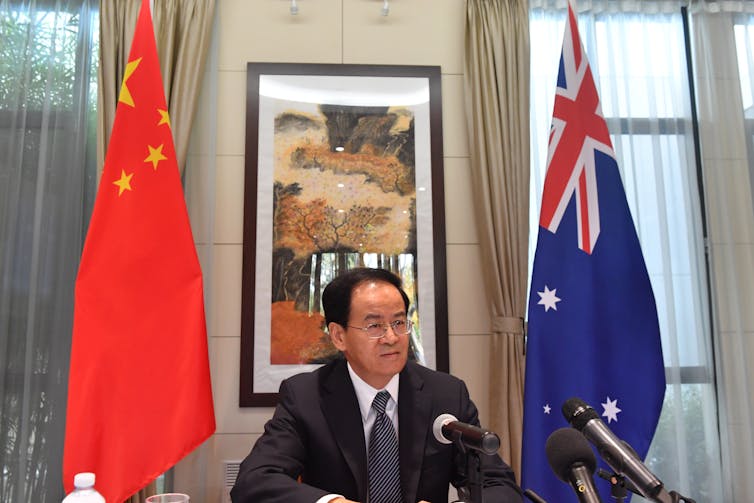 With high tensions between Australia and China, we need more China specialists in positions of authority in the public service. Mick Tsikas/AAP
Why this is happening
In a report published[8] today for the Lowy Institute, I have identified some of the major causes of under-representation of Chinese-Australians in the public service. Workplace culture, management systems and recruitment processes are among the principal challenges holding back this important source of talent.
When Chinese-Australians with deep knowledge of China are recruited to the public service, management preconceptions may hinder their placement in China-related roles. There is a tendency to perceive their ethnic and cultural background as an impediment or “conflict of interest” to work on issues related to China, even after they have successfully completed the exhaustive security clearance process.
The result is that government departments may spend substantial resources training public servants to speak a Chinese language and improve their expertise on Chinese society and culture, while those with existing Chinese language skills, knowledge and experience are side-lined.
Another pervasive problem in some bureaucratic systems is that staff are constrained by their formal role definition or official rank in how they can contribute their knowledge and expertise.
The Australian Public Service recruitment and promotion systems also tend to value “generic” public policy skills rather than “specialised” knowledge, such as country or regional expertise. This further contributes to a mismatch of skills and expertise with roles and positions.
What can be done to fix the situation
While the public service has taken steps towards addressing diversity and inclusion issues (and there has been notable work done by some government agencies), there is a sense some of these efforts are merely superficial.
Agencies may hold feel-good Harmony Day[9] morning teas, while ignoring systemic workplace culture issues. Other initiatives are treated as “extra-curricular”, to be done outside working hours rather than as a core component of an employee’s work.
To fix the situation, the Australian Public Service needs to target culturally and linguistically diverse communities for recruitment, as well as support their retention and promotion. This is similar to what it is currently doing to progress women through the ranks.
Read more: Australia has a great chance to engage in trade diplomacy with China, and it must take it[10]
The public service should also collect and publish better data on the representation of different culturally and linguistically diverse groups. However, the public service is doing the reverse: it removed ethnic diversity questions from last year’s APS employee census[11].
The irony is that despite the urgent demand within the Australian Public Service for Chinese language and cultural skills, the existing skills of many public servants are being overlooked or not used at all.
Australia has a large, diverse and growing population of Chinese-Australians, but the APS is failing to take advantage of this. And those who are in the service are often undervalued or underutilised.
A better harnessing of the skills and knowledge of this community would have substantial benefits for Australian policy-making in one of its most important bilateral relationships.
References
- ^ independent review (pmc.gov.au)
- ^ 2012 Asian Century White Paper (theconversation.com)
- ^ at just 130 (www.abc.net.au)
- ^ decreasing number (www.australiachinarelations.org)
- ^ Australia has too few home-grown experts on the Chinese Communist Party. That's a problem (theconversation.com)
- ^ last census (www.abs.gov.au)
- ^ Why the Australia-China relationship is unravelling faster than we could have imagined (theconversation.com)
- ^ report published (www.lowyinstitute.org)
- ^ Harmony Day (www.harmony.gov.au)
- ^ Australia has a great chance to engage in trade diplomacy with China, and it must take it (theconversation.com)
- ^ APS employee census (www.canberratimes.com.au)










