Australia's inflation rate now starts with a 4, allowing the RBA to hold fire on rates
- Written by: Isaac Gross, Lecturer in Economics, Monash University
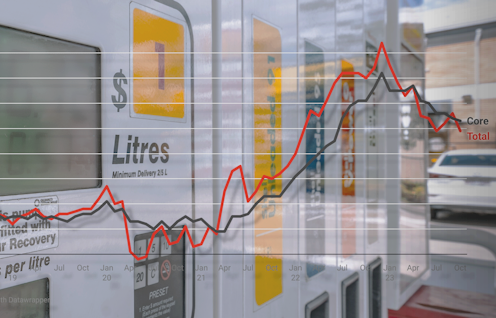
Australia’s inflation rate has dived from 5.6% to 4.9%[1] in October, pushing it below 5% for the first time in 20 months.
The Australian Bureau of Statistics figures relate to the newer monthly measure of annual inflation, rather than the traditional quarterly measure, which came in at 5.4%[2] in the September quarter, down from 6% in the June quarter.
Pushing down the annual inflation rate was a fall in average prices in October.
In October average prices fell 0.3%, driven down by a 2.9% fall in the price of petrol, a 7% fall in the price of price of holiday travel and accommodation, and a 2.5% fall in the price of household gas.
Read more: Why further RBA rate hikes are less likely now than even 1 week ago[3]
Even the average cost of rent fell 0.4% in the month, driven down by an increase in Commonwealth Rent Assistance.
The bureau says without the increase in rent assistance, measured rents would have climbed 0.7% making annual growth 8.6% instead of 7.6%.
The easing of inflation wasn’t limited to just a few sectors. So-called core inflation, which excludes volatile items like fruit, fuel and holiday travel, also experienced a decline, falling from 5.5% to 5.1%.
It means the RBA can relax just a bit
Economists who had anticipated a higher rate are now reconsidering their expectations for next week’s Reserve Bank board meeting, believing a further increase in interest rates at that meeting is now much less likely.
However, it is important not to get carried away with one month’s news.
We have previously seen inflation dip in a single month only to bounce back later.
Still, it is welcome news in the lead-up to the festive season.
It comes on top of news of very soft retail sales in October, up just 1.2%[4] over a year in which we now know prices grew 4.9% and the population grow by about 2.4%, implying a fall in purchases per person of around 6%
Falling inflation in the US is about to help
While a lot of the fall in Australian inflation in October was due to lower oil prices, a lot from here on will be driven by a much higher Australian dollar, which climbed from 63.4 US cents to 66.5 US cents throughout November – an increase approaching 5%.
The higher dollar means that even if the price of oil and other overseas prices don’t fall further in November, they should fall further in Australian dollars.
The Australian dollar has climbed because the US dollar has fallen amid expectations that no further US interest rate hikes will be needed in the light of much lower inflation throughout the Western world.
Having said that, inflation in the cost of Australian services, from haircuts to dentistry[5], continues to concern Reserve Bank Governor Michele Bullock.
We will know more when the Australian Bureau of Statistics releases the major quarterly inflation report at the end of January ahead of the first Reserve Bank board meeting for the year on Monday and Tuesday February 5 and 6.
The Reserve Bank’s goal of bringing inflation back to its target band of 2-3% by late 2025[6] remains challenging, especially with ongoing price pressures in the labor-intensive services sector.
Still, if Australia can mimic the success of the US and other Western countries in continuing to bring inflation down, interest rates should peak soon, and perhaps even fall sometime in 2024.
References
Authors: Isaac Gross, Lecturer in Economics, Monash University