
The sometimes celebrated, sometimes controversial Michael Leunig
- Written by: Richard Scully, Professor in Modern History, University of New England

Michael Leunig – who died in the early hours of Thursday December 19, surrounded by[1] “his children, loved ones, and sunflowers” – was the closest thing Australian cartooning had to a prophet. By turns over his long career, he was a poet, a prophet and a provocateur.
The challenge comes in attempting to understand Leunig’s significance: for Australian cartooning; for readers of The Age and other papers past; and for the nation’s idea of itself.
On this day, do you remember the gently philosophical Leunig, or the savagely satirical one? Do you remember a cartoon that you thought absolutely nailed the problems of the world, or one you thought was terribly wrong-headed?
Leunig’s greatness lay in how intensely he made his audiences think and feel.
There is no one straightforward story to tell here. With six decades of cartooning at least weekly in newspapers and 25 book-length collections of his work, how could there be?
The light and the dark
One thread is an abiding fondness for the whimsical Leunig. Mr Curly and Vasco Pyjama live on in the imaginations of so many readers.
Particularly in the 1980s and 90s, Leunig’s work seemed to hold up a moral and ethical mirror up to Australian society – sometimes gently, but not without controversy, such as his 1995 “Thoughts of a baby lying in a childcare centre[2]”.

Another thread is the dark satirist.
In the 1960s and 70s, he broke onto the scene as a wild man in Oz and the Nation Review who deplored Vietnam and only escaped the draft owing to deafness in one ear.
Then he apparently mellowed to become the guru of the Age, still with a capacity to launch the occasional satirical thunderbolt. Decidedly countercultural, together with Patrick Cook and Peter Nicholson, Leunig brought what historian Tony Moore has called “existential and non-materialist themes to the Australian black-and-white tradition”.
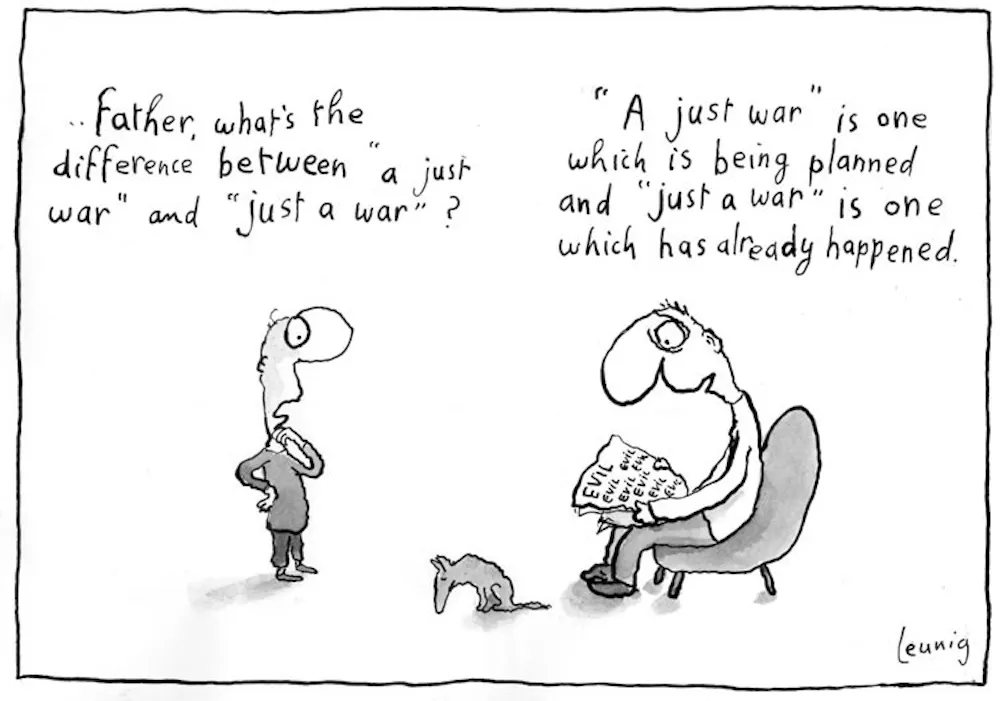 Just War. Image courtesy of Michael Leunig, CC BY-NC-ND[5][6]
By 1999, he was declared[7] a “national living treasure” by the National Trust, and was being lauded by universities for his unique contributions to the national culture.
But to tell the story of Leunig’s significance from the mid 90s on is to go beyond the dreamer and the duck. In later decades you could see a clear distinction between some cartoons that continued to console in a bewildering world, and others that sparked controversy.
Politics and controversy
Leunig saw 9/11 and the ensuing “War on Terror” as the great turning point in his career[8]. He fearlessly returned to the themes of the Vietnam years, only to receive caution, rebuke and rejection from editors and readers.
He stopped drawing Mr Curly and Vasco Pyjama. The world was no longer safe for the likes of them.
Then there was a cartoon refused by the Age in 2002, deemed by editor Michael Gawenda to be inappropriate: in the first frame, a Jew is confronted by the gates of the death camp: “Work Brings Freedom [Arbeit Macht Frei]”; in the second frame an Israeli viewing a similar slogan “War Brings Peace”.
Rejected, it was never meant to see the light of day, but ABC’s Media Watch and Crikey[9] outed it because of the constraint its spiking represented to fair media comment on the Middle East.
That the cartoon was later entered, without Leunig’s knowledge, in the infamous Iranian “Holocaust Cartoon” competition of 2006[10], has only added to its infamy and presaged the internet’s era of the uncontrollable circulation of images.
A decade later, from 2012[11], he reworked Martin Niemöller’s poetic statement of guilt over the Holocaust. The result was outrage, but also acute division within the Australian Jewish community.
 First They Came. Image courtesy of Michael Leunig, CC BY-NC-ND[12][13]
Dvir Abramovich (chairperson of the Anti-Defamation Commission) made a distinction[14] between something challenging, and something racist, believing it was the latter.
Harold Zwier (of the Australian Jewish Democratic Society) welcomed the chance[15] for his community to think critically about Israel’s policies in Gaza and the West Bank.
From 2019 – a mother, distracted, looking at her phone rather than her baby[16]. Cries of “misogyny”, including from Leunig’s very talented cartoonist sister, Mary[17].
 Mummy was Busy. Image courtesy of Michael Leunig, CC BY-NC-ND[18][19]
Then from 2021 – a COVID-19 vaccination needle atop an armoured tank, rolling towards a helpless citizen[20].
Leunig’s enforced retirement (it is still debated whether he walked or was pushed) was long and drawn-out. He filed his last cartoon for the Age this August[21]. By then, he had alienated more than a few of his colleagues in the press and the cartooning profession.
Support of the downtrodden
Do we speak ill of the dead? We hope not. Instead, we hope we are paying respect to a great and often angry artist who wanted always to challenge the consumer society with its dark cultural and geopolitical secrets.
Leunig’s response[22] was a single line of argument: he was “Just a cartoonist with a moral duty to speak”.
You don’t have to agree with every provocation, but his purpose is always to take up the cause of the weak, and deploy all the weaponry at his disposal to support the downtrodden in their fight.
“The role of the cartoonist is not to be balanced”, said Leunig, but rather to “give balance”.
 Motoring News. Image courtesy of Michael Leunig, CC BY-NC-ND[23][24]
For Leunig, the weak were the Palestinian civilians, the babies of the post-iPhone generation, and those forced to be vaccinated by a powerful state; just as they were the Vietnamese civilians, the children forced to serve their rulers through state-sanctioned violence, the citizens whose democracy was undercut by stooges of the establishment.
That deserves to be his legacy, regardless of whether you agree or not about his stance.
The coming year will give a great many people pause to reflect on the life and work of Leunig. Indeed, he has provided us with a monthly schedule for doing just that: Leunig may be gone, but 2025 is already provided for, via his last calendar[25].
References
- ^ surrounded by (www.theguardian.com)
- ^ Thoughts of a baby lying in a childcare centre (www.facebook.com)
- ^ Image courtesy of Michael Leunig (www.leunig.com.au)
- ^ CC BY-NC-ND (creativecommons.org)
- ^ Image courtesy of Michael Leunig (www.leunig.com.au)
- ^ CC BY-NC-ND (creativecommons.org)
- ^ declared (www.leunig.com.au)
- ^ great turning point in his career (www.leunig.com.au)
- ^ Crikey (www.crikey.com.au)
- ^ competition of 2006 (www.smh.com.au)
- ^ from 2012 (ajds.org.au)
- ^ Image courtesy of Michael Leunig (www.leunig.com.au)
- ^ CC BY-NC-ND (creativecommons.org)
- ^ distinction (www.australianjewishnews.com)
- ^ welcomed the chance (ajds.org.au)
- ^ rather than her baby (www.abc.net.au)
- ^ cartoonist sister, Mary (www.abc.net.au)
- ^ Image courtesy of Michael Leunig (www.leunig.com.au)
- ^ CC BY-NC-ND (creativecommons.org)
- ^ a helpless citizen (www.instagram.com)
- ^ this August (www.theage.com.au)
- ^ Leunig’s response (web.archive.org)
- ^ Image courtesy of Michael Leunig (www.leunig.com.au)
- ^ CC BY-NC-ND (creativecommons.org)
- ^ via his last calendar (thestore.com.au)