


Uni students have had to be vaccinated against other diseases — COVID-19 is no different
- Written by: Paul Harpur, Associate Professor, TC Beirne School of Law, the University of Queensland; International Distinguished Fellow, the Burton Blatt Institute, Syracuse University., The University of Queensland
Should universities require students to be fully vaccinated against COVID-19 before attending campus once vaccines are readily available in Australia?
Professor Iain Martin, vice-chancellor of Deakin University and former dean of the Faculty of Medical and Health Sciences at the University of Auckland, says yes[1].
Campus life is filled with potential super-spreader events. Students attend lectures, seminars, social events and industry functions.
Read more: 'Campus covid' was as inevitable as freshers' flu – here's how universities can look after their students[2]
Student immunisation and screening[3] requirements existed for certain courses before the pandemic. COVID-19 vaccinations are now required[4] for students in certain circumstances. They include those who enter premises that have government-driven mandatory vaccination requirements[5], such as restricted vulnerable facilities. Examples include hospitals, residential aged care, disability accommodation services and correctional centres.
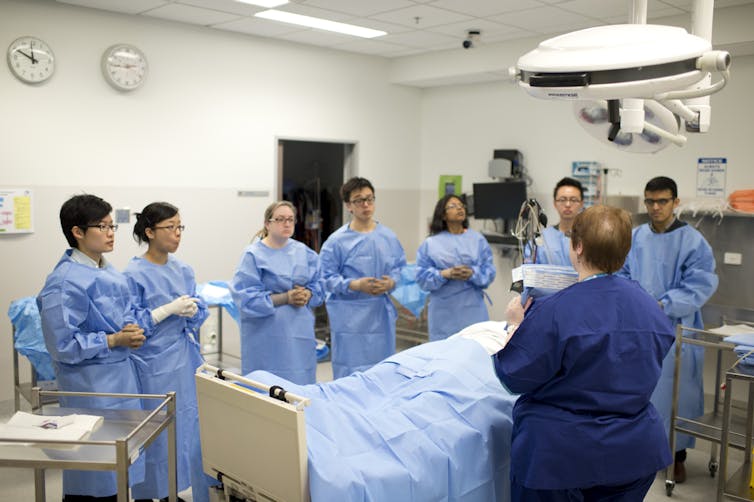 Vaccinations are already mandatory for students in certain settings.
Monash University/Flickr, CC BY-NC[6][7]
Vaccinations are already mandatory for students in certain settings.
Monash University/Flickr, CC BY-NC[6][7]
Until now, Australian universities have not sought to mandate COVID-19 vaccinations for all students. However, Martin says[8]:
“I am unequivocally of the view that we have a duty to be vaccinated unless there is an overwhelming health reason why an individual cannot take any of the available vaccines.”
In response, National Union of Students president Zoe Ranganathan accepted the importance of vaccinations, but called for a less “punitive[9]” approach.
In Canada, some have suggested[10] mandatory vaccinations should apply only to students on campus. Those who refuse to get vaccinated “should be offered online alternatives”.
Read more: Mandatory COVID-19 vaccines on university campuses: An obvious solution or a problem?[11]
Universities have a duty of care
Universities also need to consider their duty to staff. There are work health and safety[12] implications of permitting unvaccinated students to potentially bring COVID-19 to campus.
Vaccination “significantly reduces the risk of getting COVID-19 from all known variants[13]”. Thus, it will reduce the risk of COVID-19 spreading on campus.
Because of their age, most university students have been less vulnerable to COVID-19. However, new variants of the virus are increasing the risk[14] to people of all ages.
And not every university student has robust health. Staff and students can have disabilities or medical conditions[15] that make them unable to be vaccinated or especially vulnerable[16] if they catch the virus.
Universities should take steps to ensure vulnerable members of their community are not exposed to COVID-19 on campus. Mandatory vaccination is one way to ensure this.
Read more: No big packed lectures allowed if we're to safely bring uni students back to campus[17]
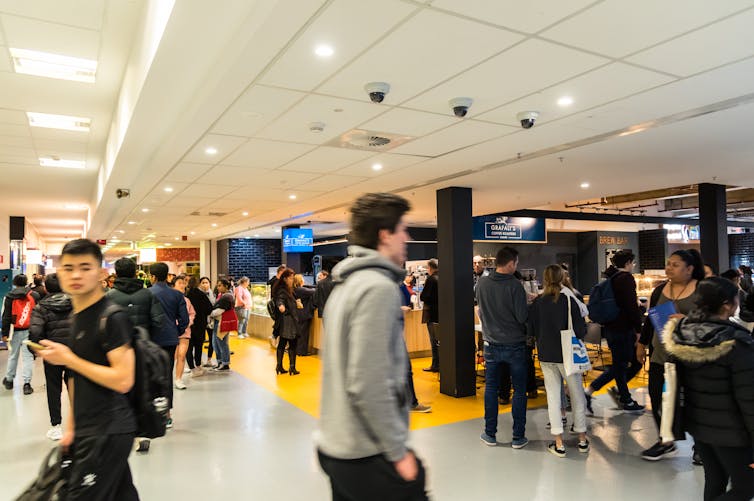 Student life on campus is full of potential super-spreader events.
Shutterstock[18]
Student life on campus is full of potential super-spreader events.
Shutterstock[18]
University leadership must balance public health and opinion, along with the risk of permitting potentially unsafe students onto campus. It appears an overwhelming number of Australians support mandatory vaccines. Researchers at the universities of Sydney and Western Australia found three-quarters[19] of Australians would support a mandatory COVID-19 vaccination policy for travel, study and work.
Another consideration for universities is international students, whose fees subsidise affordable public education and research and innovation. Prior to COVID-19, 32%[20] of university students in Australia were full-fee-paying international students. International students also bring in billions to the Australian economy.
Read more: As hopes of international students' return fade, closed borders could cost $20bn a year in 2022 – half the sector's value[21]
Whereas Australia has until now been largely free from COVID-19, many countries across Asia, Europe, Latin America and North America have been hit hard by the pandemic. If Australia is to open up to students from these countries, mandatory vaccinations will make Australia a safer destination and more attractive for a customer base who have lived through a nightmare.
A recent IDP Connect survey[22] found an overwhelming majority of international students were already vaccinated or willing to be vaccinated to return to campuses.
Thus, both the economic and public health grounds for mandatory vaccination of students on campus are compelling.
Read more: Australia's international education market share is shrinking fast. Recovery depends on unis offering students a better deal[23]
Campuses overseas are making it mandatory
While the mandatory vaccination debate is new in Australian universities, it has attracted more attention overseas.
In Canada some universities, including Ottawa[24] and Toronto[25], are mandating vaccinations. Others, such as the University of Calgary, are being criticised[26] for not mandating vaccinations for students before they attend class.
Over 730[27] colleges in the United States have made vaccination mandatory. These universities include Columbia[28], Harvard[29], Princeton[30], Stanford[31], UCLA[32], and Yale[33].
Read more: Campus outbreaks of COVID-19 were almost guaranteed[34]
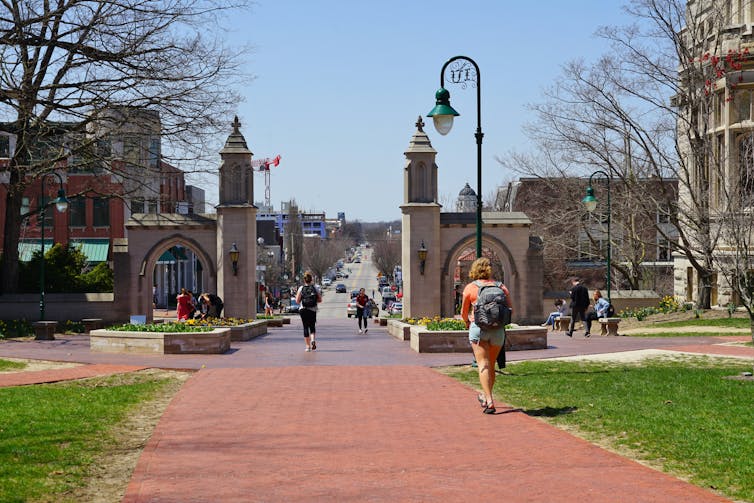 The US Supreme Court has upheld Indiana University’s mandatory vaccination policy.
Shutterstock[35]
The US Supreme Court has upheld Indiana University’s mandatory vaccination policy.
Shutterstock[35]
The US mandates have led to unsuccessful legal challenges. Students challenged Indiana University’s mandatory vaccination policy, claiming it interfered with their due process rights to bodily integrity. In August 2021, US Supreme Court Justice Amy Coney Barrett rejected the students’ request[36] for emergency relief.
The US Court of Appeals for the Seventh Circuit had unanimously declined to issue an injunction while the students’ appeal moved forward to the Supreme Court. The appeals court noted[37]:
“Each university may decide what is necessary to keep other students safe in a congregate setting […] Health exams and vaccinations against other diseases (measles, mumps, rubella, diphtheria, tetanus, pertussis, varicella, meningitis, influenza and more) are common requirements of higher education. Vaccination protects not only the vaccinated persons but also those who come in contact with them, and at a university close contact is inevitable.”
The authors would like to recognise the support of Georgia Atcheson.
References
- ^ says yes (www.theage.com.au)
- ^ 'Campus covid' was as inevitable as freshers' flu – here's how universities can look after their students (theconversation.com)
- ^ immunisation and screening (www.health.qld.gov.au)
- ^ required (about.uq.edu.au)
- ^ government-driven mandatory vaccination requirements (www.attorneygeneral.gov.au)
- ^ Monash University/Flickr (www.flickr.com)
- ^ CC BY-NC (creativecommons.org)
- ^ says (www.theage.com.au)
- ^ punitive (www.theage.com.au)
- ^ suggested (theconversation.com)
- ^ Mandatory COVID-19 vaccines on university campuses: An obvious solution or a problem? (theconversation.com)
- ^ work health and safety (www.safeworkaustralia.gov.au)
- ^ significantly reduces the risk of getting COVID-19 from all known variants (jcsmr.anu.edu.au)
- ^ increasing the risk (www.yalemedicine.org)
- ^ medical conditions (www.health.gov.au)
- ^ especially vulnerable (theconversation.com)
- ^ No big packed lectures allowed if we're to safely bring uni students back to campus (theconversation.com)
- ^ Shutterstock (www.shutterstock.com)
- ^ three-quarters (www.sydney.edu.au)
- ^ 32% (theconversation.com)
- ^ As hopes of international students' return fade, closed borders could cost $20bn a year in 2022 – half the sector's value (theconversation.com)
- ^ IDP Connect survey (resources.idp-connect.com)
- ^ Australia's international education market share is shrinking fast. Recovery depends on unis offering students a better deal (theconversation.com)
- ^ Ottawa (www.cbc.ca)
- ^ Toronto (www.utoronto.ca)
- ^ criticised (www.cbc.ca)
- ^ 730 (www.chronicle.com)
- ^ Columbia (covid19.columbia.edu)
- ^ Harvard (www.thecrimson.com)
- ^ Princeton (covid.princeton.edu)
- ^ Stanford (www.stanforddaily.com)
- ^ UCLA (www.studenthealth.ucla.edu)
- ^ Yale (yalehealth.yale.edu)
- ^ Campus outbreaks of COVID-19 were almost guaranteed (theconversation.com)
- ^ Shutterstock (www.shutterstock.com)
- ^ rejected the students’ request (www.nytimes.com)
- ^ noted (www.nytimes.com)










