


Putin made Trump wait, then strung him along – it’s clear his war aims in Ukraine have not changed
- Written by: Jon Richardson, Visiting Fellow, Centre for European Studies, Australian National University
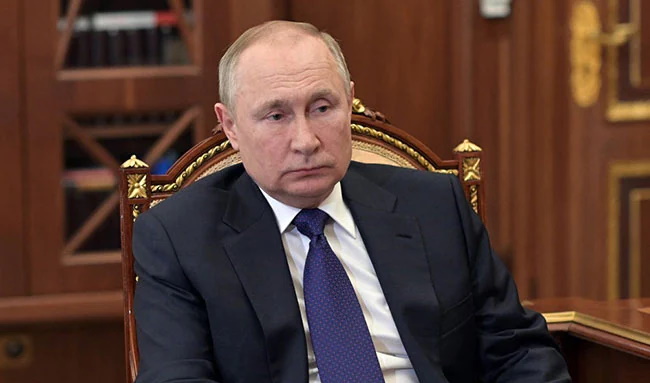
US President Donald Trump’s phone call with his Russian counterpart, Vladimir Putin, didn’t take a tangible step towards ending the hostilities in Ukraine, let alone finding an enduring peace. Rather, it provided further evidence of Putin’s ability to string along and outsmart Trump.
For starters, Putin sent a signal by making Trump wait[1] for more than an hour to talk. Putin was speaking at a televised conference with Russian businesspeople and even made a joke about the delay when told the time for his call was approaching.
This was clearly designed to show his alpha status, both to Trump and the Russian public. Steve Witkoff, Trump’s special envoy, was reportedly made to wait eight hours by Putin when he arrived in Moscow last week for talks.
And after Tuesday’s call, Putin only agreed[2] to pause attacks on Ukraine’s energy infrastructure for 30 days, rather than the total ceasefire proposed by Trump and agreed to by Ukrainian President Volodymyr Zelensky.
And even this agreement lacked clarity. The lengthy Kremlin statement[3] on the call said the pause would only apply to attacks on energy infrastructure, while the vaguer White House read-out said it included a much broader “energy and infrastructure” agreement. The Kremlin will doubtless stick to the narrow concept.
The Kremlin’s statement[4] also said Trump proposed this idea and Putin reacted positively. This seems implausible given that pausing attacks on energy infrastructure would be the least costly partial ceasefire for Russia to agree to.
It seems more likely this proposal came from Putin as a “compromise”, even though Trump was earlier threatening fire and brimstone if Russia did not agree to a proper ceasefire.
Russia will still be able to continue its ground offensive in Ukraine, where it has the upper hand thanks to Ukrainian manpower shortages (despite its own horrendous losses). It will also be able to maintain its bombardment of Ukrainian civilian targets that has already cost possibly as many as 100,000 civilian lives[5] and half a trillion US dollars[6] in mooted reconstruction costs.
Ukraine, meanwhile, has only rarely hit residential areas in Russia. However, it has achieved considerable success[7] with long-distance drone attacks on Russian oil refineries and energy infrastructure, threatening one of the main funding sources of Moscow’s war effort.
Putin’s war aims remain unchanged
The Kremlin’s read-out of the call also noted that various sticking points remain to achieve a full ceasefire in Ukraine.
These included[8] the Kyiv regime’s “inability to negotiate in good faith”, which has “repeatedly sabotaged and violated the agreements reached.” The Kremlin also accused Ukrainian militants of “barbaric terrorist crimes” in the Kursk region of Russia that Ukraine briefly occupied.
This is not new language, but shows breathtaking chutzpah. It’s Russia, in fact, that has broken several agreements[9] vowing to respect Ukraine’s borders, as well as numerous provisions of the Geneva Conventions on treatment of civilian populations[10] and prisoners of war. It has even violated the Genocide Convention[11] in the eyes of some scholars.
That a US president could let this kind of statement go unchallenged underscores the extent of the White House’s volte-face on Ukraine.
The Kremlin also asserted that a “key principle[12]” for further negotiations must be the cessation of foreign military aid and intelligence to Ukraine.
Given Trump has already frozen arms and intelligence support to Ukraine to make Zelensky more compliant, Putin no doubt thinks he might do so again. This, in turn, would strengthen Russia’s leverage in negotiations.
Trump has already given away huge bargaining chips that could have been used to pressure Russia towards a just and enduring outcome. These include:
- holding talks with Russia without Ukraine present
- ruling out security guarantees for Ukraine and NATO membership in the longer term, and
- foreshadowing that Ukraine should cede its sovereign territory in defiance of international law.
Putin may be content to string out the ceasefire talks as long as he can in the hopes Russian troops can consolidate their hold on Ukrainian territory and completely expel Ukrainian forces from the Kursk region inside Russia.
He shows no sign of resiling from his key aims since the beginning of the war – to reimpose Russian dominance over Ukraine and its foreign and domestic policies, and to retain the territories it has illegally annexed.
The fact Moscow has signed treaties[13] to formally incorporate and assimilate these Ukrainian regions fully into Russia – rather than merely occupying them – underlines how this has always been a war of imperial reconquest rather than a response to perceived military threat.
At the same time, if he can get much of what he wants, Putin may just be tempted to end the war to further a more business-as-usual relationship with the US. Trump has dangled various carrots to encourage Putin to do this, from renewed US investment in Russia[14] to easing sanctions[15] to ice hockey games[16].
Ukraine’s lines in the sand
Ukraine’s immediate reaction to the Trump-Putin call appears to be cautiously accepting of a limited ceasefire on energy infrastructure. This is no doubt to avoid incurring Trump’s wrath.
At the same time, Ukraine’s bottom line remains firm[17]:
- Ukraine’s territorial integrity and sovereignty are non-negotiable
- it must be able to choose its own foreign alliances and partnerships, and
- it must be able to defend itself, without limits on the size of its army or its weaponry.
The only way to square the circle would be to freeze the conflict at the current front lines in Ukraine and leave the status of the annexed Ukrainian regions to be resolved in future negotiations.
But even this would have little credibility unless Russia revoked its annexations and allowed international organisations and observers to enter the region to encourage a modicum of compliance with international law.
References
- ^ making Trump wait (www.newsweek.com)
- ^ agreed (apnews.com)
- ^ lengthy Kremlin statement (apnews.com)
- ^ Kremlin’s statement (kremlin.ru)
- ^ 100,000 civilian lives (theconversation.com)
- ^ half a trillion US dollars (ukraine.un.org)
- ^ achieved considerable success (www.atlanticcouncil.org)
- ^ included (www.newsweek.com)
- ^ broken several agreements (www.prospectmagazine.co.uk)
- ^ treatment of civilian populations (cepa.org)
- ^ Genocide Convention (newlinesinstitute.org)
- ^ key principle (www.theguardian.com)
- ^ signed treaties (www.theguardian.com)
- ^ renewed US investment in Russia (www.nytimes.com)
- ^ easing sanctions (www.reuters.com)
- ^ ice hockey games (apnews.com)
- ^ remains firm (kyivindependent.com)










