Cocaine is being contaminated with powerful opioids called nitazenes. Here’s why it’s a dangerous mix
- Written by: Nicole Lee, Adjunct Professor at the National Drug Research Institute (Melbourne based), Curtin University
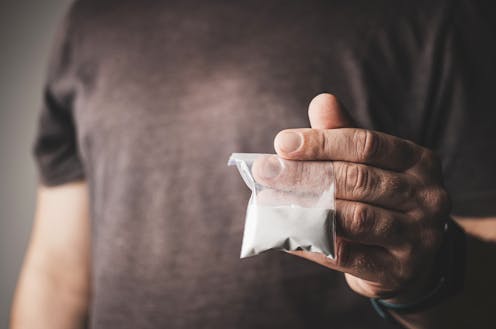
Earlier this month, drugs sold as cocaine in Melbourne[1] were found to be contaminated with a powerful group of opioids, known as nitazenes[2].
These new synthetic drugs were also the suspected cause of four people being hospitalised[3] in Sydney in May. And in April, nitazenes were found in drugs used by around 20 people[4] who overdosed in outer Sydney.
So what are nitazenes, why are they so dangerous, and how can we minimise the harms they cause?
What are nitazenes?
Nitazenes are a group of synthetic opioids[5]. This means they’re made in a lab (distinct from morphine or heroin which come from the opium poppy).
Nitazenes were developed in the 1950s[6] to expand options for pain management, but the research was abandoned because they were too dangerous. There’s no modern medical use for these drugs.
Other common opioids include heroin[7], morphine[8] and fentanyl[9], which are used for medical and non-medical purposes.
Nitazenes vary in potency and purity but can be ten times stronger[10] than fentanyl, and up to 500 times[11] more potent than heroin.
Some people use nitazenes intentionally seeking a stronger effect, but they’ve also been found in a range of common recreational drugs in Australia such as cocaine[12], MDMA (ecstasy)[13] and ketamine[14]. This means some people may take nitazenes without knowing it.
Because all these drugs are illegally manufactured[15], there’s no quality control, so people using them can’t be sure what they’re taking or how strong the drugs are.
Why are nitazenes so dangerous?
When someone takes nitazenes, there’s a very fine line[16] between intoxication and overdose. Because these drugs are so strong they can be especially dangerous for people who are not used to taking opioids.
They’re also very quick to act and can stay longer in the body than other opioids. If someone has taken too much heroin, it takes an hour or more[17] before they stop breathing, but nitazenes can take just a few minutes.
Opioids interfere with the part of the brain that controls breathing. Someone overdosing on opioids may have a strong pulse but their breathing[18] will be shallow or stop.
Taking nitazenes[19] in combination with another illicit drug can make them even more dangerous. There’s a risk of getting the unwanted effects from both drugs and if someone uses a stimulant like cocaine with an opioid, the stimulant can sometimes mask[20] the effect of the opioid, so they may not initially realise they are overdosing.
How big is this problem?
Places like the United States[22], the United Kingdom[23] and Ireland[24] have seen concerning increases in overdoses related to nitazenes in recent years, so experts in Australia[25] are worried we may follow suit.
And given nitazenes have been found in Australia in drugs sold as cocaine[26], MDMA[27] and ketamine[28], more people may be at risk of overdose.
Although only a relatively small proportion of the population use cocaine, use has increased significantly[29] in the past 20 years in Australia. In 2022–23, 4.5% of the population reported having used cocaine in the past 12 months, up from 1.3% in 2001.
MDMA use decreased during the COVID pandemic but there are signs it’s increasing again[30]. In 2023, 2.7% of the population reported using MDMA at least once in the previous year.
Ketamine has also increased in popularity[31] as a recreational drug. In 2022–23, 1.4% of the population reported having used ketamine in the past 12 months, up from 0.4% in 2016. Some 4.2% of Australians in their 20s reported ketamine use in 2022–23.
Most people who use these sorts of drugs do so only occasionally, but harms from nitazenes are a concern even for people who use these drugs just once.
Reducing the risk of harm
People using drugs such as cocaine, MDMA or ketamine can get them checked at a drug checking service[32]. However, drug checking services are currently only available in the Australian Capital Territory[33] and Queensland[34]. Victoria[35] is due to get a service by the end of this year.
Australians can also buy nitazene test strips[36], which can detect the presence of nitazenes in a drug sample. While cross-reactivity is often a problem for drug test strips, in recent testing, nitazene strips were found not to cross-react[37] to a panel of other common substances outside the nitazene class.
If you can’t get your drugs tested, make sure you buy from a known dealer, take just a small amount to start when you buy a new batch (we suggest one-quarter of your normal dose), and never use alone. If you’re with a group of friends, stagger use or make sure you are with someone who is not using, a bit like a designated driver.
If you regularly use these types of drugs you can keep naloxone[39] on hand. Naloxone reverses the effects of opioids by temporarily blocking the opioid receptors in the brain. It’s free at pharmacies in Australia to anyone who might experience or witness an opioid overdose.
If you or someone you know has trouble breathing or any unwanted symptoms after taking a drug, call triple zero immediately, even if you have administered naloxone.
Governments can do a few simple things to prevent the harms[40] we’ve seen in other countries from nitazenes. They could expand harm reduction services, such as drug checking and supervised injecting services, and ensure we have ample stocks of naloxone.
If you’re worried about your own or someone else’s drug use you can call the National Alcohol and other Drug Hotline on 1800 250 015.
References
- ^ Melbourne (www.health.vic.gov.au)
- ^ nitazenes (theconversation.com)
- ^ hospitalised (www.health.nsw.gov.au)
- ^ 20 people (www.health.nsw.gov.au)
- ^ opioids (adf.org.au)
- ^ developed in the 1950s (theconversation.com)
- ^ heroin (adf.org.au)
- ^ morphine (www.healthdirect.gov.au)
- ^ fentanyl (adf.org.au)
- ^ ten times stronger (doi.org)
- ^ up to 500 times (www.health.nsw.gov.au)
- ^ cocaine (www.health.vic.gov.au)
- ^ MDMA (ecstasy) (www.health.nsw.gov.au)
- ^ ketamine (www.health.vic.gov.au)
- ^ illegally manufactured (theconversation.com)
- ^ very fine line (www.cahma.org.au)
- ^ an hour or more (www.health.ny.gov)
- ^ breathing (www.betterhealth.vic.gov.au)
- ^ nitazenes (adf.org.au)
- ^ mask (www.training.fadaa.org)
- ^ Sebastian Ervi/Pexels (www.pexels.com)
- ^ United States (journals.lww.com)
- ^ United Kingdom (www.bmj.com)
- ^ Ireland (analyticalsciencejournals.onlinelibrary.wiley.com)
- ^ experts in Australia (www.abc.net.au)
- ^ cocaine (www.health.vic.gov.au)
- ^ MDMA (www.health.nsw.gov.au)
- ^ ketamine (www.health.vic.gov.au)
- ^ increased significantly (www.aihw.gov.au)
- ^ increasing again (aihw.gov.au)
- ^ increased in popularity (www.aihw.gov.au)
- ^ drug checking service (360edge.com.au)
- ^ Australian Capital Territory (directionshealth.com)
- ^ Queensland (www.quihn.org)
- ^ Victoria (theconversation.com)
- ^ nitazene test strips (www.drugpolicy.org.au)
- ^ not to cross-react (www.sciencedirect.com)
- ^ Fahroni/Shutterstock (www.shutterstock.com)
- ^ naloxone (adf.org.au)
- ^ prevent the harms (www.vaada.org.au)