Men may not be exaggerating
- Written by: Thea van de Mortel, Professor, Nursing, School of Nursing and Midwifery, Griffith University
What’s the difference?[1] is a new editorial product that explains the similarities and differences between commonly confused health and medical terms, and why they matter.
The term “man flu” takes a humorous poke[2] at men with minor respiratory infections, such as colds, who supposedly exaggerate their symptoms.
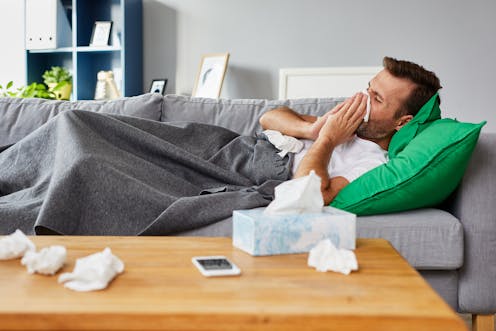
According to the stereotype, a man lies on the sofa with a box of tissues. Meanwhile his female partner, also with a snotty nose, carries on working from home, doing the chores and looking after him.
But is man flu real? Is there a valid biological reason behind men’s symptoms or are men just malingering? And how does man flu differ from flu?
What are the similarities?
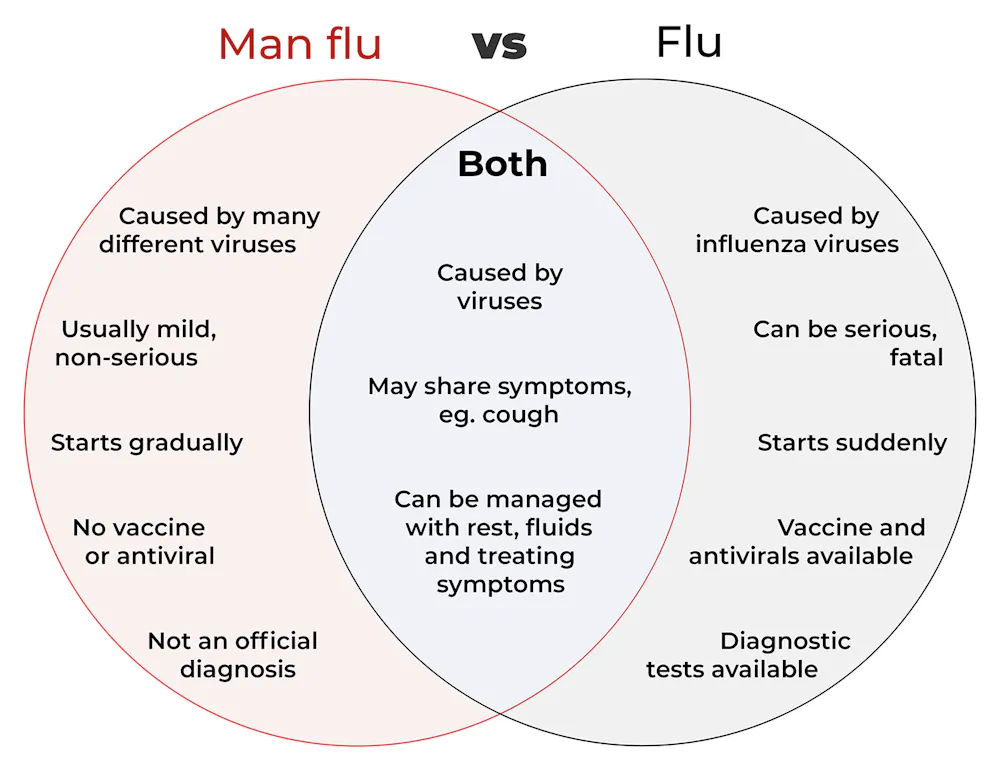
Man flu could refer to a number of respiratory infections – a cold, flu, even a mild case of COVID. So it’s difficult to compare man flu with flu.
But for simplicity, let’s say man flu is actually a cold. If that’s the case, man flu and flu have some similar features.
Both are caused by viruses (but different ones). Both are improved with rest, fluids, and if needed painkillers, throat lozenges or decongestants to manage symptoms[3].
Both can share[4] similar symptoms. Typically, more severe symptoms such as fever, body aches, violent shivering and headaches are more common in flu (but sometimes occur in colds). Meanwhile sore throats, runny noses, congestion and sneezing are more common in colds. A cough is common in both.
What are the differences?
Flu[5] is a more serious and sometimes fatal respiratory infection caused by the influenza virus. Colds are caused by various viruses such as rhinoviruses[6], adenoviruses[7], and common cold coronaviruses[8], and are rarely serious.Colds tend to start gradually[9] while flu tends to start abruptly.
Flu can be detected[10] with laboratory or at-home tests. Man flu is not an official diagnosis.
Severe flu symptoms may be prevented with a vaccine[11], while cold symptoms cannot.
Serious flu infections may also be prevented or treated[12] with antiviral drugs such as Tamiflu. There are no antivirals for colds.
 X chromosomes carry important immune function genes. Rost9/Shutterstock[19] Oestrogen (the female sex hormone) also seems to strengthen[20] the immune response, and as levels vary throughout the lifespan, so does the strength[21] of women’s immune systems. Men are certainly more likely to die from some infectious diseases, such as COVID[22]. But the picture is less clear with other infections such as the flu, where the incidence and mortality between men and women varies widely[23] between countries and particular flu subtypes and outbreaks. Infection rates and outcomes in men and women can also depend on the way a virus is transmitted[24], the person’s age, and social and behavioural factors. For instance, women seem to be more likely to practice protective behaviours[25] such as washing their hands, wearing masks or avoiding crowded indoor spaces. Women are also more likely[26] to seek medical care when ill. So men aren’t faking it? Some evidence suggests men are not over-reporting symptoms, and may take longer to clear an infection. So they may experience man flu more harshly than women with a cold. So cut the men in your life some slack. If they are sick, gender stereotyping is unhelpful, and may discourage men from seeking medical advice. References^ What’s the difference? (theconversation.com)^ humorous poke (www.oxfordlearnersdictionaries.com)^ manage symptoms (activities.nps.org.au)^ can share (www.cdc.gov)^ Flu (www.cdc.gov)^ rhinoviruses (www.ncbi.nlm.nih.gov)^ adenoviruses (www.cdc.gov)^ coronaviruses (journals.lww.com)^ start gradually (www.cdc.gov)^ detected (www.cdc.gov)^ a vaccine (www.cdc.gov)^ prevented or treated (www.health.nsw.gov.au)^ One study (www.sciencedirect.com)^ differences (www.nature.com)^ respond more effectively (www.nature.com)^ work more strongly (www.ncbi.nlm.nih.gov)^ stronger immune responses (www.nature.com)^ immune function genes (www.nature.com)^ Rost9/Shutterstock (www.shutterstock.com)^ strengthen (www.nature.com)^ the strength (www.science.org)^ COVID (www.aihw.gov.au)^ varies widely (iris.who.int)^ transmitted (www.frontiersin.org)^ practice protective behaviours (www.ncbi.nlm.nih.gov)^ more likely (bmcprimcare.biomedcentral.com)