Chinese electric vehicles are transforming Australia’s car market. Are we getting a good deal?
- Written by: Sanjoy Paul, Associate Professor, UTS Business School, University of Technology Sydney
China’s electric vehicle (EV) manufacturers are having a moment.
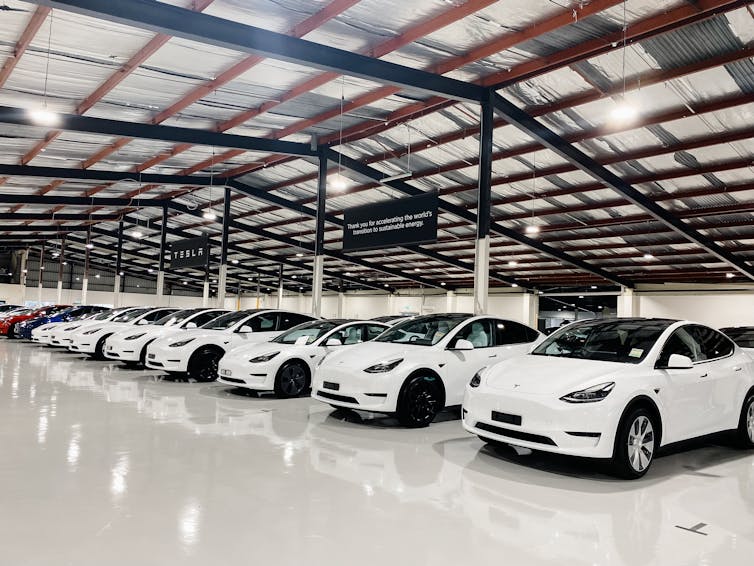
For a long time, the race to electrify motoring has been almost synonymous with American carmaker Tesla, a clear early leader.
But Chinese manufacturer BYD has been closing the gap, with some projections[1] indicating it could overtake Tesla on annual battery-only electric vehicle sales this year.
That has implications for Australia, which is becoming a strong market for green motoring.
Year-to-date, new battery-only EV sales in Australia are up 16.5%[2]. Hybrids and plug-in hybrids (vehicles that use a combination of a battery and conventional fuel) performed even more strongly over the same period, up 114.6%[3].
Among the more than 30 brands[4] currently marketing EVs in Australia, BYD’s options are proving popular. Back in January, the company’s monthly Australian sales beat Tesla’s[5] for the first time, with 1,310 cars compared to Tesla’s 1,107.
And it’s not the only major Chinese brand with a presence here, set to be joined[6] soon by a host of others including XPeng, Zeekr and Aion.
As new, more affordable EVs continue to flood Australia’s car market, will consumers here be the winners?
Read more: Electric vehicles will start to cut emissions and improve air quality in our cities – but only once they're common[7]
Electric is finally becoming affordable
EVs, and particularly Tesla’s offerings, have long had to struggle against perceptions of being overpriced[8].
One of the biggest appeals of Chinese EV brands is their perceived value for money. Many consumers who once felt locked out of the market are being enticed by new, more affordable offers.
BYD’s popular Atto 3 SUV, for example, starts at A$44,499, while Tesla’s basic version of the Model 3 costs $54,900 after discounts[9].
The increasing availability of Chinese brands is making the Australian market more competitive, forcing major brands to reduce prices. Tesla has already reduced prices three times since the start of April for its most popular version of the Model Y[11].
Free trade advantages are also boosting affordability here. Unlike the United States[12] and the European Union[13], Australia is not imposing new tariffs on Chinese-made EVs, as it doesn’t have a domestic car manufacturing industry to protect.
Too good to be true?
The coming wave of affordable EVs might seem like a win-win for Australian consumers. But as relatively new entrants, it will take time for these brands to establish reputations in Australia for quality, serviceability and value.
There are reasons for consumers to tread carefully.
In 2023, the Australian Strategic Policy Institute (ASPI) urged customers to be aware of the potential security risks[14] of buying a Chinese-made EV.
More generally, EVs rely on connection to the internet for a range of tasks, and collect swathes of personal data including locations, routes driven and calls made by drivers. ASPI warned that this personal privacy issue may become a national security risk if a person drives to a secure facility.
There are also supply chain concerns. About 80% of EVs sold in Australia, including Tesla models, are manufactured in China[16]. Any disruptions in China, whether natural or geopolitical, could impact car production and supply to the Australian and global markets.
And while a more affordable electric vehicle market is good news, concerns about price instability may also put off some customers.
Australian customers who purchased the Tesla Model Y in March before three subsequent rounds of price cuts have missed out on almost $10,000 in savings. Growing uncertainty about whether EV prices will drop further could put some people off, especially as more than ten new brands prepare to enter the Australian market[17].
EVs face broader challenges in Australia
Despite the growing number of brands and models on offer, there remain several hurdles for the full adoption of EVs in Australia.
The country continues to lack sufficient EV infrastructure like charging facilities, a problem only heightened by its vast distances. Despite an ongoing rollout[18], charging infrastructure remains sparse in Australia.
Recent research[19] found that more than $1.2 billion in investment would be required to establish 5,800 fast-charging sites across Australia by 2040.
Some individuals looking to install charging infrastructure at home are facing high costs and possible new problems getting insured[20] due to fire risks.
A 2022 survey[22] found that irrespective of brand and manufacturing location, Australian users have several broader concerns about EVs. Of these, safety concerns trumped both price and perceived benefits as an impact on intention to buy.
Australia is also suffering from a stubborn shortage of EV technicians. A recent survey across 2,000 advertised EV technician jobs found that only about 40%[23] were filled.
Despite these concerns, the growing uptake of electric and hybrid vehicles is likely to bring significant benefits to the Australian economy. It’s also an important step in achieving our net zero targets.
Government and industry should focus on speeding up adoption by mitigating these challenges sooner rather than later.
Read more: Petrol, pricing and parking: why so many outer suburban residents are opting for EVs[24]
References
- ^ projections (www.cnbc.com)
- ^ 16.5% (www.fcai.com.au)
- ^ 114.6% (www.carexpert.com.au)
- ^ 30 brands (electricvehiclecouncil.com.au)
- ^ beat Tesla’s (www.drive.com.au)
- ^ set to be joined (www.carsales.com.au)
- ^ Electric vehicles will start to cut emissions and improve air quality in our cities – but only once they're common (theconversation.com)
- ^ overpriced (www.abc.net.au)
- ^ after discounts (www.news.com.au)
- ^ ice_blue/Shutterstock (www.shutterstock.com)
- ^ Model Y (www.drive.com.au)
- ^ the United States (www.abc.net.au)
- ^ the European Union (www.reuters.com)
- ^ potential security risks (www.aspistrategist.org.au)
- ^ Adam Rhodes UK/Shutterstock (www.shutterstock.com)
- ^ manufactured in China (www.drive.com.au)
- ^ prepare to enter the Australian market (www.theguardian.com)
- ^ ongoing rollout (www.energymatters.com.au)
- ^ Recent research (www.sciencedirect.com)
- ^ high costs and possible new problems getting insured (www.afr.com)
- ^ mastersky/Shutterstock (www.shutterstock.com)
- ^ survey (www.sciencedirect.com)
- ^ only about 40% (www.abc.net.au)
- ^ Petrol, pricing and parking: why so many outer suburban residents are opting for EVs (theconversation.com)