Want to help our precious nocturnal bugs during Matariki’s longer nights? Turn the lights down low
- Written by: Janice Lord, Associate Professor in Botany, University of Otago
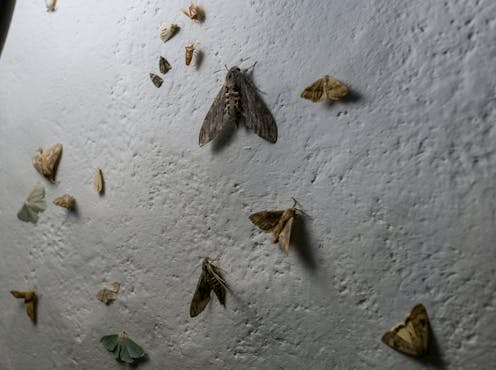
In a world increasingly affected by light pollution, we can take time during the shorter days and longer nights around Matariki to appreciate the superpowers of our nocturnal bugs.
As diurnal creatures, our world view is strongly biased towards a daytime perspective. We pay more attention to events happening during daylight, and sometimes overlook the fascinating world of nocturnal insects.
Human eyes are very poor at gathering enough light particles – photons – to see clearly at night. We need the light of a full moon to have much hope of navigating safely.
For millennia, then, we’ve used fire and more recently electricity to artificially light up the night. Nocturnal insects now deal with a very different nightscape than they did even a century ago.
It’s been estimated that 23% of the world’s land area is affected by light pollution. This is thought to be one of the factors contributing to insect decline worldwide.
Recent research suggests about a third of insects attracted to artificial lights will die by morning, often from exhaustion[1]. If those insects have been prevented from mating and laying eggs, there are huge implications for population survival, as well as for ecosystem functions such as pollination and biocontrol.
Nocturnal superpowers
Many bugs are more active at night, most likely to avoid daytime predators. Some can also make their own light. New Zealand glow worms, the larvae of fungus gnats, use bioluminescence to hunt[2].
Elsewhere in the world, some flying beetles are commonly known as fireflies due to the fiery crackles of light they produce to confuse and ward off predators[3].
Moonlight is roughly one million times less intense than sunlight. But nocturnal insects can navigate, see colour and detect movement with only the light from the stars and moon[4].
This superpower is due in part to their incredible compound eyes. These are made up of millions of tiny lenses that each capture the maximum amount of light from a small field of view, and focus it onto a bundle of photoreceptors.
The ability to make sense of very low light levels is also due to higher contrast sensitivity at the expense of detail. Moths in particular boast several adaptations that aid in navigating and perceiving[5] in low light.
Many New Zealand moths are nocturnal, and their eyes are largely specialised for motion detection, differentiating between intensities of light rather than distinct wavelengths.
Compared with day-flying butterflies, which can perceive more detail and differentiate wavelengths as colours, moths have evolved greater perception of contrast and large-scale changes in their visual environment. But this comes at the expense of spatial sensitivity[6].
LED lights and moths
Contrary to myth, nocturnal insects do not fly around artificial lights because they confuse them with the moon or stars. Recent research, filming moths with high-speed cameras, found they use moonlight and starlight to differentiate between “up” and “down” as they fly.
Their erratic flight around your outside light is actually due to them trying to orientate themselves[7] to a nonexistent horizon.
The colour of artificial lights can also affect how attractive they are to nocturnal insects. In recent years, Dunedin (like many cities around the world) has been replacing old high-pressure sodium bulbs in street lights with LEDs that use less energy and have lower maintenance costs.
But this hasn’t been so great for night-flying insects. Moths can detect light wavelengths as low as 300 nanometres (invisible to human eyes) and as high as 700nm (orange-red to humans). But many have a peak sensitivity at 400nm (human blue).
The old sodium bulbs produced a warm orange or golden glow. But the brighter LEDs commonly produce a cool white light at the blue end of the spectrum, right at peak sensitivity for many moths. Warmer LED lights (with a lower colour temperature) can be less attractive to flying insects, and also help reduce light pollution across the city.
Helping our night bugs
Closer to home, we can make a difference for our own backyard bugs (and other nocturnal and twilight fauna) by reducing light pollution[8].
Something as simple as closing curtains at night will discourage flying insects from crashing into windows – and getting inside!
Using motion-activated outside lights, rather than having them permanently on, can reduce the deaths toll in your local moth populations. And selecting warmer coloured light bulbs and fairy lights will make them less attractive to nocturnal insects.
Finally, turning off your lights and venturing outside will not only give your backyard bugs a break, but also help you appreciate the wonders of the night sky at Matariki.
References
- ^ often from exhaustion (www.sciencedirect.com)
- ^ bioluminescence to hunt (www.nzgeo.com)
- ^ confuse and ward off predators (news.ncsu.edu)
- ^ light from the stars and moon (royalsocietypublishing.org)
- ^ navigating and perceiving (www.linkedin.com)
- ^ expense of spatial sensitivity (www.cell.com)
- ^ trying to orientate themselves (www.scientificamerican.com)
- ^ reducing light pollution (darksky.org)