‘Sleep tourism’ promises the trip of your dreams. Beyond the hype plus 5 tips for a holiday at home
- Written by: Charlotte Gupta, Senior postdoctoral research fellow, Appleton Institute, HealthWise research group, CQUniversity Australia
Imagine arriving at your hotel after a long flight and being greeted by your own personal sleep butler. They present you with a pillow menu and invite you to a sleep meditation session later that day.
You unpack in a room kitted with an AI-powered smart bed, blackout shades, blue light-blocking glasses and weighted blankets.
Holidays are traditionally for activities or sightseeing – eating Parisian pastry under the Eiffel tower, ice skating at New York City’s Rockefeller Centre, lying by the pool in Bali or sipping limoncello in Sicily. But “sleep tourism[1]” offers vacations for the sole purpose of getting good sleep.
The emerging trend extends out of the global wellness tourism industry – reportedly worth more than US$800 billion globally[2] (A$1.2 trillion) and expected to boom[3].
Luxurious sleep retreats and sleep suites at hotels are popping up all over the world[4] for tourists to get some much-needed rest, relaxation and recovery. But do you really need to leave home for some shuteye?
Not getting enough
The rise of sleep tourism may be a sign of just how chronically sleep deprived we all are.
In Australia more than one-third of adults are not achieving the recommended 7–9 hours[5] of sleep per night, and the estimated cost of this inadequate sleep is A$45 billion[6] each year.
Inadequate sleep is linked to long-term health problems[7] including poor mental health, heart disease, metabolic disease and deaths from any cause.
Can a fancy hotel give you a better sleep?
Many of the sleep services available in the sleep tourism industry aim to optimise the bedroom for sleep. This is a core component of sleep hygiene[8] – a series of healthy sleep practices that facilitate good sleep including sleeping in a comfortable bedroom with a good mattress and pillow, sleeping in a quiet environment and relaxing before bed.
The more people follow sleep hygiene practices, the better their sleep quality and quantity[9].
When we are staying in a hotel we are also likely away from any stressors we encounter in everyday life (such as work pressure or caring responsibilities). And we’re away from potential nighttime disruptions to sleep we might experience at home (the construction work next door, restless pets, unsettled children). So regardless of the sleep features hotels offer, it is likely we will experience improved sleep when we are away.

What the science says about catching up on sleep
In the short-term, we can catch up on sleep[11]. This can happen, for example, after a short night of sleep when our brain accumulates “sleep pressure[12]”. This term describes how strong the biological drive for sleep is. More sleep pressure makes it easier to sleep the next night and to sleep for longer.
But while a longer sleep the next night can relieve the sleep pressure, it does not reverse the effects of the short sleep on our brain and body[13]. Every night’s sleep is important for our body to recover and for our brain to process the events of that day. Spending a holiday “catching up” on sleep could help you feel more rested, but it is not a substitute for prioritising regular healthy sleep at home.
All good things, including holidays, must come to an end. Unfortunately the perks of sleep tourism may end too.
Our bodies do not like variability in the time of day that we sleep. The most common example of this is called “social jet lag[14]”, where weekday sleep (getting up early to get to work or school) is vastly different to weekend sleep (late nights and sleep ins). This can result in a sleepy, grouchy start to the week on Monday. Sleep tourism may be similar, if you do not come back home with the intention to prioritise sleep.
So we should be mindful that as well as sleeping well on holiday, it is important to optimise conditions at home to get consistent, adequate sleep every night.
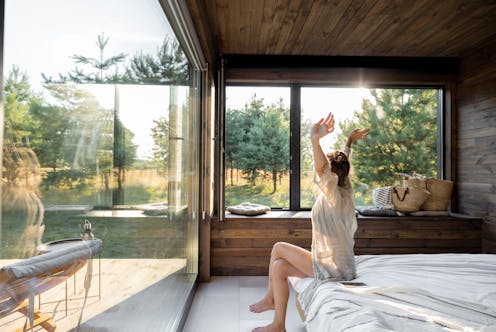
 Good sleep hygiene doesn’t require a passport.
Maridav/Shutterstock[15]
Good sleep hygiene doesn’t require a passport.
Maridav/Shutterstock[15]
5 tips for having a sleep holiday at home
An AI-powered mattress and a sleep butler at home might be the dream. But these features are not the only way we can optimise our sleep environment and give ourselves the best chance to get a good night’s sleep. Here are five ideas to start the night right:
1. avoid bright artificial light in the evening (such as bright overhead lights, phones, laptops)
2. make your bed as comfortable as possible with fresh pillows and a supportive mattress
3. use black-out window coverings and maintain a cool room temperature for the ideal sleeping environment
4. establish an evening wind-down routine, such as a warm shower and reading a book before bed or even a “sleepy girl mocktail[16]”
5. use consistency as the key to a good sleep routine. Aim for a similar bedtime and wake time – even on weekends.
References
- ^ sleep tourism (www.smh.com.au)
- ^ US$800 billion globally (www.forbes.com)
- ^ expected to boom (www.statista.com)
- ^ all over the world (www.countryandtownhouse.com)
- ^ 7–9 hours (www.sciencedirect.com)
- ^ A$45 billion (academic.oup.com)
- ^ long-term health problems (www.tandfonline.com)
- ^ sleep hygiene (www.ncbi.nlm.nih.gov)
- ^ sleep quality and quantity (www.tandfonline.com)
- ^ Makistock/Shutterstock (www.shutterstock.com)
- ^ we can catch up on sleep (theconversation.com)
- ^ sleep pressure (www.tandfonline.com)
- ^ effects of the short sleep on our brain and body (jcsm.aasm.org)
- ^ social jet lag (www.mdpi.com)
- ^ Maridav/Shutterstock (www.shutterstock.com)
- ^ sleepy girl mocktail (theconversation.com)