


ABC’s new series Ladies in Black gives us vintage fashions and feminist anthems
- Written by: Lisa French, Professor & Dean, School of Media and Communication, RMIT University
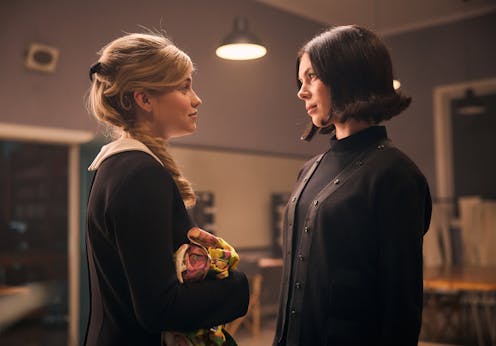
Ladies in Black, the new six-part ABC series, opens with Magda (Debi Mazar), the head of Goodes luxury department store’s “Model Gowns”.
As Magda is striding assuredly down the main street, we hear Peggy Lee’s famous 1962 anthem of feminist resilience: I’m A Woman[1].
Chic and modern, the epitome of the confident 1960s woman, she wears a hat from the vintage clothes collection of costume designer Marion Boyce. We are introduced to several other key characters, see a streetscape lined with classic cars. The scene of Sydney, 1961, is established.
Inspiration and adaptation
Taking its inspiration from the 1993 bestselling novel The Women in Black by Madeleine St. John, the series follows two earlier adaptations, firstly the 2015 theatrical musical Ladies in Black, which featured Tim Finn’s music, and then director Bruce Beresford’s successful 2018 feature film Ladies in Black.
Director Gracie Otto is quoted in press kit as offering the inspiration as Mad Men (2007–15) or The Marvellous Mrs. Maisel (2017–23), both of which are set in the same era as this series, and, like this one, tell stories about women who are seeking to achieve a place in the world on their own terms. One Australian production that comes to mind in a similar style is Miss Fischer Modern (2019).
However, it also belongs to a tradition – or perhaps it could almost be a genre – of shows set in department stores which have similar tropes: The Paradise (2012–13), set in 1875 and based on a novel about the founder of Paris’ Le Bon Marché; Mr Selfridge (2013–16), the recounting of the founding of Selfridge’s in London between 1908–28; and House of Promises (2022–23), set in a glamorous department store in 1920s Berlin.
The Cultural Context
Moving from the original book and various adaptations, all set in 1959, this television series is set two years later, suggesting that it is the next instalment.
The 1960s offers some key story elements: the postwar immigration boom[2] (reflected in the migrant characters and storylines); burgeoning arts and culture (picked up in references to “free love and French cinema” or “The Push[3]” — a left-wing libertarian group that existed in Sydney); and reference to the contraceptive pill, released in Australia in 1961[4].

None of these are offered in any detail, but they point to the context, as does the signalling of the sexism, classism and racism of the era from the first episode.
This show’s tribute towards the spirit of the swinging sixties includes several characters with sex on their minds.
Lisa (Clare Hughes), a naive first-year university student, gets into a bad situation that she won’t let streetwise Angela save her from.
Fay (Jessica De Gouw) and her husband Rudi (Thom Green) make out in a stylish Borgward Isabella car he bought to keep her entertained when their babies arrive – but she isn’t keen on having them yet and goes on the pill.
 Mrs Ambrose is the foil against all the other characters.
ABC
Mrs Ambrose is the foil against all the other characters.
ABC
In contrast, the terrifying Mrs Ambrose (Miranda Otto) is the foil against all the other characters. Recruited from Harrods to be the new head of Model Gowns, we know from the first moment when she moves a vase of flowers a few centimetres it is her way or the highway.
She epitomises colonialism, seeming to loath Australia and its messy local flowers, she sports a sense of English superiority, standing for the old world against modernity.
Finding its audience
People who love shopping are more likely to like this show than those who don’t.
Consumption and luxury department stores are, for those in the know, an experience that causes “feel good” dopamine release, sometimes referred to as retail therapy[5]. Whether one buys anything or not, it is a space where those who shop can imagine an alternative self. It has a lure, creates desire and admiration for something beautifully made, cut, or crafted, and importantly, connects to the individual.
 People who love shopping are more likely to like this show than those who don’t.
ABC
People who love shopping are more likely to like this show than those who don’t.
ABC
In the first episode, Angela (Azizi Donnelly) understands this as she delightedly touches the stock and thrilled, swings herself in a 360-degree circle on her first day on the “ladies’ cocktail” counter – clearly in heaven!
It is a big cast for a six-part series. This would imply the producers have more scenarios and are hoping it does well with viewers so they can make another.
The experience of the women is at the centre and female characters, whether friends or foes, get a lot of screen time and steal the show. The male characters are awful. They are inept, constantly let their wives, girlfriends and daughters down, and see everything from their own, male point of view.
A musical accompaniment to the future
The music is dominant throughout and working hard for the story. When Angela is getting ready for work in the second episode, the lyrics aren’t in English underpinning that she is a Lebanese girl from Redfern.
 Angela is a Lebanese girl from Redfern.
ABC
Angela is a Lebanese girl from Redfern.
ABC
Music connects well to the humour. Riffs of As Time Goes By (Dooley Wilson’s tune from Casablanca) provide musical link to lines such as Angela saying: “Of all the department stores in all the world, he had to walk into mine”. These references link characters and prepare the audience for trouble.
Whether you like Ladies in Black or not will depend on if you like shopping, fashion, stories with female leads about female friendship, clever music, and 60s costumes. If there is another series made, there are plenty of places for this story to go.
Ladies in Black is now screening on ABC TV and streaming on iView.
References
- ^ I’m A Woman (www.youtube.com)
- ^ postwar immigration boom (www.nma.gov.au)
- ^ The Push (en.wikipedia.org)
- ^ in 1961 (www.nma.gov.au)
- ^ retail therapy (health.clevelandclinic.org)










