Victoria is raising minimum rental standards – it’s good news for tenants and the environment
- Written by: Trivess Moore, Associate Professor, School of Property, Construction and Project Management, RMIT University
Following the lead of countries like New Zealand[1] and the United Kingdom[2], Australian states and territories[3] are moving slowly towards improving the basic quality and performance of rental housing.
Victoria is leading the way in Australia. The state government this week proposed new minimum requirements[4] for rental properties and rooming or boarding houses. These changes would be phased in from October 2025.
The new standards will greatly improve the quality and comfort of rental housing. They will also make it cheaper to live in.
It’s the most far-reaching response by any Australian government to the huge and well-documented problems of affordability[5] and poor conditions[6] in our rental housing.
Why are better standards needed?
About a third of Australian households[7] live in rental housing. They include many of our most disadvantaged and vulnerable households[8].
The sector also has some of our poorest-quality housing[9]. Many rental properties are energy-inefficient and poorly maintained.
The proposed standards are likely to help households by:
reducing energy bills to help manage the cost of living
improving health and wellbeing by providing more stable and comfortable temperatures in the home and reducing damp and mould
reducing environmental impacts by cutting energy use and moving away from gas appliances.
This government intervention is a step in the right direction. Market-based approaches to improving the quality and performance of private rental properties are failing to deliver[10].
State and local governments have increased financial support[11] for retrofitting housing to improve its performance. However, research has found uptake[12] by landlords[13] has been limited.
Minimum standards have been successfully introduced overseas[14]. In the UK, for example, landlords must ensure their properties achieve at least a level E energy performance certificate[15] (A is best). The aim is to lift the bottom of the market to a new minimum standard over time.
What is being proposed?
This table shows the key changes proposed in Victoria.

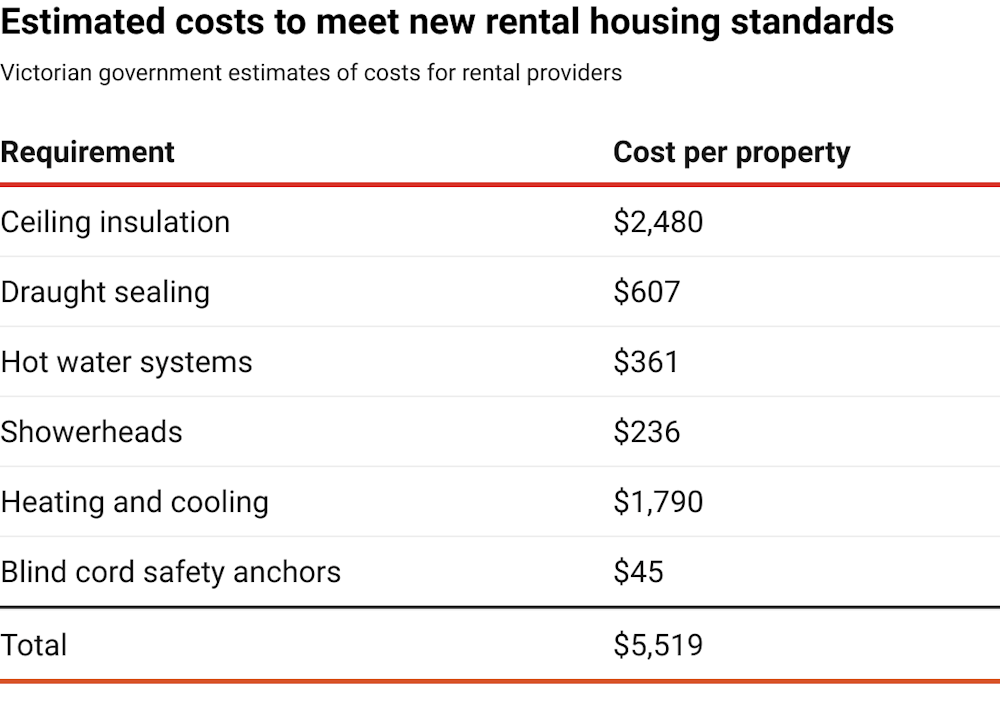 Table: The Conversation. Source: Victorian government, CC BY[20][21]
Wait, weren’t minimum standards already in place?
Victoria introduced minimum standards[22] for rental properties in 2021. These include:
a fixed heater (not portable) in good working order in the main living area
a stovetop in good working order with two or more burners
inside rooms, corridors and hallways have access to light to make the areas functional
all rooms free from mould and damp caused by or related to the building structure
windows in rooms likely to be used as bedrooms or living areas fitted with curtains or blinds that can be closed, block light and provide privacy.
The aim of the proposed new changes is not just to deliver basic rental housing, but housing that is safe, comfortable and energy-efficient.
What challenges will these changes bring?
Potential challenges include:
many landlords are already financially stretched and may pass on improvement costs to tenants or exit the market, but research[23] indicates the likely impact of these responses is low
changes will supercharge the retrofit industry, so strict governance will be needed to avoid issues with “cowboy” operators, as happened with schemes such as the Home Insulation Program[24] – the so-called “pink batts” scheme
labour shortages[25] across the construction industry mean more workers will have to be found to deliver these upgrades
we don’t yet know what the processes will be for checking compliance and providing recourse if upgrades fall short of requirements
tenants may hesitate to assert their rights because affordable rental housing is so hard to find[26]
safeguards will be needed to protect tenants from rent increases
there is a risk of gentrification if landlords decide to comprehensively retrofit and renovate homes.
Finally, even though this is an important milestone, more needs to be done. For example, having only one heater in the living room means tenants will need to use portable electric heaters in bedrooms or run the risk of mould developing. Similarly, having only one air conditioner in the living room means people will suffer during hot summer nights unless they sleep in that room.
Renters in the rest of Australia[27] are missing out on these important protections. Progress is urgently needed across the country if we, as a nation, are going to ensure renters have equal access to safe, cost-efficient, resilient and low-emission homes.
References^ New Zealand (www.tenancy.govt.nz)^ United Kingdom (www.gov.uk)^ states and territories (www.rentcover.com.au)^ new minimum requirements (engage.vic.gov.au)^ affordability (theconversation.com)^ poor conditions (theconversation.com)^ third of Australian households (www.abs.gov.au)^ disadvantaged and vulnerable households (www.tandfonline.com)^ poorest-quality housing (www.ahuri.edu.au)^ failing to deliver (theconversation.com)^ financial support (doi.org)^ uptake (www.tandfonline.com)^ landlords (www.sciencedirect.com)^ introduced overseas (www.tandfonline.com)^ level E energy performance certificate (www.gov.uk)^ Table: The Conversation. Source: Victorian government (engage.vic.gov.au)^ CC BY (creativecommons.org)^ A$5,519 per property (engage.vic.gov.au)^ Victorian Energy Upgrade (www.energy.vic.gov.au)^ Table: The Conversation. Source: Victorian government (engage.vic.gov.au)^ CC BY (creativecommons.org)^ minimum standards (tenantsvic.org.au)^ research (www.ahuri.edu.au)^ Home Insulation Program (www.anao.gov.au)^ labour shortages (www.abc.net.au)^ hard to find (www.anglicare.asn.au)^ rest of Australia (www.rentcover.com.au)
Table: The Conversation. Source: Victorian government, CC BY[20][21]
Wait, weren’t minimum standards already in place?
Victoria introduced minimum standards[22] for rental properties in 2021. These include:
a fixed heater (not portable) in good working order in the main living area
a stovetop in good working order with two or more burners
inside rooms, corridors and hallways have access to light to make the areas functional
all rooms free from mould and damp caused by or related to the building structure
windows in rooms likely to be used as bedrooms or living areas fitted with curtains or blinds that can be closed, block light and provide privacy.
The aim of the proposed new changes is not just to deliver basic rental housing, but housing that is safe, comfortable and energy-efficient.
What challenges will these changes bring?
Potential challenges include:
many landlords are already financially stretched and may pass on improvement costs to tenants or exit the market, but research[23] indicates the likely impact of these responses is low
changes will supercharge the retrofit industry, so strict governance will be needed to avoid issues with “cowboy” operators, as happened with schemes such as the Home Insulation Program[24] – the so-called “pink batts” scheme
labour shortages[25] across the construction industry mean more workers will have to be found to deliver these upgrades
we don’t yet know what the processes will be for checking compliance and providing recourse if upgrades fall short of requirements
tenants may hesitate to assert their rights because affordable rental housing is so hard to find[26]
safeguards will be needed to protect tenants from rent increases
there is a risk of gentrification if landlords decide to comprehensively retrofit and renovate homes.
Finally, even though this is an important milestone, more needs to be done. For example, having only one heater in the living room means tenants will need to use portable electric heaters in bedrooms or run the risk of mould developing. Similarly, having only one air conditioner in the living room means people will suffer during hot summer nights unless they sleep in that room.
Renters in the rest of Australia[27] are missing out on these important protections. Progress is urgently needed across the country if we, as a nation, are going to ensure renters have equal access to safe, cost-efficient, resilient and low-emission homes.
References^ New Zealand (www.tenancy.govt.nz)^ United Kingdom (www.gov.uk)^ states and territories (www.rentcover.com.au)^ new minimum requirements (engage.vic.gov.au)^ affordability (theconversation.com)^ poor conditions (theconversation.com)^ third of Australian households (www.abs.gov.au)^ disadvantaged and vulnerable households (www.tandfonline.com)^ poorest-quality housing (www.ahuri.edu.au)^ failing to deliver (theconversation.com)^ financial support (doi.org)^ uptake (www.tandfonline.com)^ landlords (www.sciencedirect.com)^ introduced overseas (www.tandfonline.com)^ level E energy performance certificate (www.gov.uk)^ Table: The Conversation. Source: Victorian government (engage.vic.gov.au)^ CC BY (creativecommons.org)^ A$5,519 per property (engage.vic.gov.au)^ Victorian Energy Upgrade (www.energy.vic.gov.au)^ Table: The Conversation. Source: Victorian government (engage.vic.gov.au)^ CC BY (creativecommons.org)^ minimum standards (tenantsvic.org.au)^ research (www.ahuri.edu.au)^ Home Insulation Program (www.anao.gov.au)^ labour shortages (www.abc.net.au)^ hard to find (www.anglicare.asn.au)^ rest of Australia (www.rentcover.com.au)