how the people of Tiaro rallied behind an iconic species
- Written by: Mariana Campbell, Research Lecturer, Conservation, Charles Darwin University
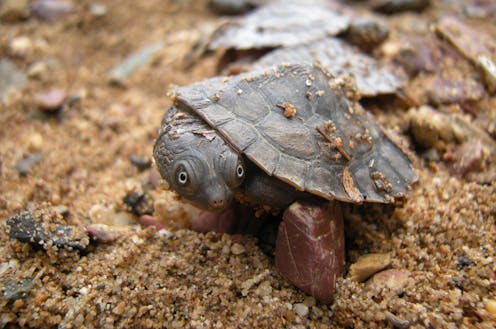
Australian freshwater turtles are facing an alarming trend. Almost half of these species are listed as vulnerable, endangered or critically endangered[1].
The Mary River turtle (Elusor macrurus) is one of Australia’s largest freshwater turtles, weighing up to 8kg. You might know it as the bum-breathing punk turtle[2] – it can stay underwater for days, extracting oxygen through its cloaca, and algae growing on its head can look like a mohawk. It’s also one of the most threatened[3]. This species is found only in the Mary River in south-east Queensland, which empties into the sea near K'Gari/Fraser Island.
Despite its highly restricted range, many Australians would have seen this turtle. In the 1960s and ’70s, thousands of turtle eggs were harvested from the banks of the Mary River and hatched in captivity. The hatchlings were sold as “penny turtles[4]” throughout the country.
Back then, no one knew these turtles belonged to a unique species restricted to a single river. Neither did anyone know that their sale – often as Christmas gifts due to their hatching time – was pushing the species towards extinction.
Intense egg harvesting, habitat changes and introduced predators such as foxes have drastically reduced the Mary River turtle population. Breeding female numbers fell 95%[5] between 1970 and 2000. Even more worrisome is that the population consists mainly of older adults. That’s often a warning sign of a species’ imminent extinction.
However, it is not all doom and gloom for the Mary River turtle. In 2001, the people of the Tiaro district bordering the river launched a conservation program[6]. A recent review[7] of this community-led program found things seem to be turning around for this iconic species.
A community-driven rescue
Tiaro is a small town with about 800 residents. Some of the most productive Mary River turtle nesting areas are close to the town. This inspired the Tiaro & District Landcare Group[8] to take action.
Their work was mainly focused on protecting turtle nests. Tiaro is surrounded by farms, mainly for cattle. The group erected fences to stop cattle trampling the nests, placed covers over nests to shield them from predators and recorded nesting activities.
These efforts have resulted in thousands of young Mary River turtles entering the river every year.

Enlisting the help of experts
The community soon realised they needed scientific help to develop an effective management plan. They hit upon an inventive fundraiser, selling homemade chocolate turtles, to support research.
The money provided scholarships for several higher-degree research students. It also paid for research equipment.
And the support went beyond money. The people of Tiaro provided accommodation, transport, local knowledge, land access and enthusiasm.
To date, the joint efforts of the community and scientists have resulted in 16 peer-reviewed scientific articles and six higher-degree research theses. We now know much more[9] about the turtles’ ecological requirements, population status and threats.
The published works have featured heavily in development, environmental management and natural resource planning throughout the catchment. As federal environment minister, Peter Garrett even cited[10] information from this research program when he vetoed controversial state government plans[11] for the Traveston Crossing Dam in 2009.
This long-term research effort has raised the profile of the turtle and the community that supports its preservation. A bronze turtle statue now stands proudly in the middle of Tiaro.
The statue is testament to the community’s dedication and the turtle’s local significance. It’s both a symbol of successful conservation and a tourist attraction.
Our turtles still need protection
The Mary River turtle remains threatened, as do other Australian turtle species[12]. A scientific assessment panel has recommended[13] upgrading the species to critically endangered under the Environment Protection and Biodiversity Conservation Act 1999.
This is due to the knowledge gained through the community-led research program rather than an increased extinction risk.
We argue that the outlook for the Mary River turtle is brighter now than when it was first listed as endangered 22 years ago. This is because the research program has enabled national priorities to be set accurately. As a result, local water resource planning and strategic development throughout the catchment properly take the turtle’s ecology into account.
By playing to each other’s strengths, community members and scientists have given the Mary River turtle a much better outlook.
The Mary River turtle is unique in its appearance and evolutionary history. It stands out as the sole species in its genus, having diverged from all other living species about 50 million years ago[14]. To put this into perspective, humans separated from our closest relatives, the chimpanzees and bonobos, less than 10 million years ago.
The species is listed at number 30 on the EDGE of Existence program, a global conservation initiative focusing on evolutionarily distinct threatened species[15].
Australia’s freshwater turtles play a vital role in maintaining freshwater ecosystems. They are also culturally important for First Nations people.
The advent of similar community-researcher conservation projects, such as 1 Million Turtles[16] and Turtles Forever[17], suggests the future is looking brighter for Australia’s freshwater turtles.
This story is part of Good Green News, a new series on community efforts to restore nature. Read other articles in the series here[18].
References
- ^ vulnerable, endangered or critically endangered (www.environment.gov.au)
- ^ bum-breathing punk turtle (phys.org)
- ^ most threatened (www.environment.gov.au)
- ^ penny turtles (australian.museum)
- ^ fell 95% (www.environment.gov.au)
- ^ conservation program (www.tiarolandcare.org.au)
- ^ recent review (onlinelibrary.wiley.com)
- ^ Tiaro & District Landcare Group (www.tiarolandcare.org.au)
- ^ know much more (doi.org)
- ^ even cited (www.environment.gov.au)
- ^ controversial state government plans (www.abc.net.au)
- ^ other Australian turtle species (www.publish.csiro.au)
- ^ has recommended (www.dcceew.gov.au)
- ^ 50 million years ago (doi.org)
- ^ evolutionarily distinct threatened species (www.zsl.org)
- ^ 1 Million Turtles (1millionturtles.com)
- ^ Turtles Forever (facebook.com)
- ^ here (theconversation.com)