midlife health is about more than a waist measurement. Here’s why
- Written by: Rob Newton, Professor of Exercise Medicine, Edith Cowan University
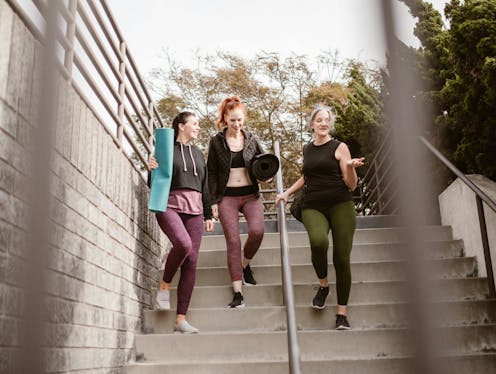
You’re not in your 20s or 30s anymore and you know regular health checks are important. So you go to your GP. During the appointment they measure your waist. They might also check your weight. Looking concerned, they recommend some lifestyle changes.
GPs and health professionals commonly measure waist circumference[1] as a vital sign for health. This is a better indicator than body mass index (BMI) of the amount of intra-abdominal fat. This is the really risky fat around and within the organs that can drive heart disease and metabolic disorders such as type 2 diabetes.
Men are at greatly increased risk of health issues if their waist circumference is greater than 102 centimetres[2]. Women are considered to be at greater risk with a waist circumference of 88 centimetres or more[3]. More than two-thirds of Australian adults[4] have waist measurements that put them at an increased risk of disease. An even better indicator is waist circumference divided by height or waist-to-height ratio[5].
But we know people (especially women) have a propensity to gain weight around their middle during midlife[6], which can be very hard to control. Are they doomed to ill health? It turns out that, although such measurements are important, they are not the whole story when it comes to your risk of disease and death.
Read more: The body mass index can't tell us if we're healthy. Here's what we should use instead[7]
How much is too much?
Having a waist circumference to height ratio larger than 0.5 is associated with greater risk of chronic disease as well as premature death and this applies in adults of any age. A healthy waist-to-height ratio is between 0.4 to 0.49. A ratio of 0.6 or more places a person at the highest risk of disease[8].
Some experts recommend waist circumference be routinely measured in patients during health appointments[9]. This can kick off a discussion about their risk of chronic diseases and how they might address this.
Excessive body fat and the associated health problems manifest more strongly during midlife. A range of social, personal and physiological factors come together to make it more difficult to control waist circumference as we age. Metabolism tends to slow down mainly due to decreasing muscle mass because people do less vigorous physical activity, in particular resistance exercise[10].
For women, hormone levels begin changing in mid-life and this also stimulates increased fat levels particularly around the abdomen[11]. At the same time, this life phase (often involving job responsibilities, parenting and caring for ageing parents) is when elevated stress can lead to increased cortisol which causes fat gain in the abdominal region[12].
Midlife can also bring poorer sleep patterns. These contribute to fat gain with disruption to the hormones that control appetite[13].
Finally, your family history and genetics can make you predisposed to gaining more abdominal fat[14].
Why the waist?
This intra-abdominal or visceral fat is much more metabolically active (it has a greater impact on body organs and systems) than the fat under the skin (subcutaneous fat).
Visceral fat surrounds and infiltrates major organs such as the liver, pancreas and intestines, releasing a variety of chemicals (hormones, inflammatory signals, and fatty acids). These affect inflammation, lipid metabolism, cholesterol levels and insulin resistance, contributing to the development of chronic illnesses[15].
The issue is particularly evident during menopause[17]. In addition to the direct effects of hormone changes, declining levels of oestrogen change brain function, mood and motivation[18]. These psychological alterations can result in reduced physical activity and increased eating – often of comfort foods high in sugar and fat.
But these outcomes are not inevitable. Diet, exercise and managing mental health can limit visceral fat gains in mid-life. And importantly, the waist circumference (and ratio to height) is just one measure of human health. There are so many other aspects of body composition, exercise and diet. These can have much larger influence on a person’s health.
Read more: Is menopause making me put on weight? No, but it's complicated[19]
Muscle matters
The quantity and quality of skeletal muscle (attached to bones to produce movement) a person has makes a big difference[20] to their heart, lung, metabolic, immune, neurological and mental health as well as their physical function.
On current evidence, it is equally or more important for health and longevity to have[21] higher muscle mass and better cardiorespiratory (aerobic) fitness than waist circumference within the healthy range.
So, if a person does have an excessive waist circumference, but they are also sedentary and have less muscle mass and aerobic fitness, then the recommendation would be to focus on an appropriate exercise program. The fitness deficits should be addressed as priority rather than worry about fat loss.
Conversely, a person with low visceral fat levels is not necessarily fit and healthy and may have quite poor aerobic fitness, muscle mass, and strength. The research evidence[22] is that these vital signs of health – how strong a person is, the quality of their diet and how well their heart, circulation and lungs are working – are more predictive of risk of disease and death than how thin or fat a person is.
For example, a 2017 Dutch study[23] followed overweight and obese people for 15 years and found people who were very physically active had no increased heart disease risk than “normal weight” participants.
Read more: Climb the stairs, lug the shopping, chase the kids. Incidental vigorous activity linked to lower cancer risks[24]
Getting moving is important advice
Physical activity has many benefits. Exercise can counter a lot of the negative behavioural and physiological changes that are occurring during midlife including for people going through menopause.
And regular exercise reduces the tendency to use food and drink to help manage what can be a quite difficult time in life[25].
Measuring your waist circumference and monitoring your weight remains important. If the measures exceed the values listed above, then it is certainly a good idea to make some changes. Exercise is effective for fat loss and in particular decreasing visceral fat[26] with greater effectiveness when combined with dietary restriction of energy intake[27]. Importantly, any fat loss program – whether through drugs, diet or surgery – is also a muscle loss program unless resistance exercise is part of the program. Talking about your overall health with a doctor is a great place to start.
Accredited exercise physiologists[28] and accredited practising dietitians[29] are the most appropriate allied health professionals to assess your physical structure, fitness and diet and work with you to get a plan in place to improve your health, fitness and reduce your current and future health risks.
References
- ^ measure waist circumference (theconversation.com)
- ^ greater than 102 centimetres (www.bmj.com)
- ^ 88 centimetres or more (www.bmj.com)
- ^ two-thirds of Australian adults (www.abs.gov.au)
- ^ waist-to-height ratio (www.baker.edu.au)
- ^ gain weight around their middle during midlife (www.ajog.org)
- ^ The body mass index can't tell us if we're healthy. Here's what we should use instead (theconversation.com)
- ^ places a person at the highest risk of disease (www.baker.edu.au)
- ^ waist circumference be routinely measured in patients during health appointments (www.nature.com)
- ^ less vigorous physical activity, in particular resistance exercise (onlinelibrary.wiley.com)
- ^ stimulates increased fat levels particularly around the abdomen (www.tandfonline.com)
- ^ increased cortisol which causes fat gain in the abdominal region (journals.lww.com)
- ^ disruption to the hormones that control appetite (journals.plos.org)
- ^ make you predisposed to gaining more abdominal fat (journals.plos.org)
- ^ contributing to the development of chronic illnesses (academic.oup.com)
- ^ Shutterstock/Zamrznuti tonovi (www.shutterstock.com)
- ^ during menopause (www.ajog.org)
- ^ declining levels of oestrogen change brain function, mood and motivation (www.sciencedirect.com)
- ^ Is menopause making me put on weight? No, but it's complicated (theconversation.com)
- ^ big difference (www.nature.com)
- ^ have (www.bmj.com)
- ^ The research evidence (bjsm.bmj.com)
- ^ 2017 Dutch study (www.ncbi.nlm.nih.gov)
- ^ Climb the stairs, lug the shopping, chase the kids. Incidental vigorous activity linked to lower cancer risks (theconversation.com)
- ^ quite difficult time in life (journals.lww.com)
- ^ decreasing visceral fat (bjsm.bmj.com)
- ^ combined with dietary restriction of energy intake (bmcwomenshealth.biomedcentral.com)
- ^ Accredited exercise physiologists (www.essa.org.au)
- ^ accredited practising dietitians (member.dietitiansaustralia.org.au)